
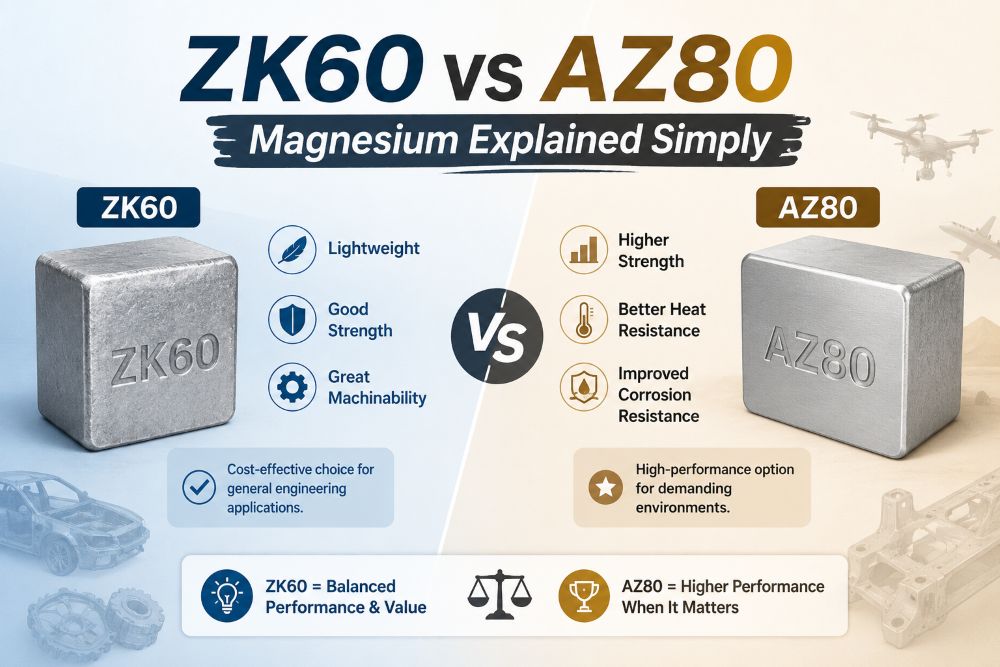
Choosing between ZK60 and AZ80 magnesium is not just a material name decision. Both alloys belong to the high-strength magnesium family, and both can support lightweight engineering. But they are not used in exactly the same way.
ZK60 is often considered when strength-to-weight performance, structural confidence, and demanding wrought applications are important. AZ80 is often selected when buyers need a strong magnesium alloy with practical forging, extrusion, and machining value. The right choice depends on the part, the process, and the level of performance expected from the final application.
For companies comparing magnesium alloy options, Miji Magnesium helps buyers evaluate alloy grade, product form, machining route, and application fit before material decisions become production problems.
Key Takeaways
- ZK60 and AZ80 are both high-strength magnesium alloys, but they serve different engineering priorities.
- ZK60 is often preferred when strength-to-weight performance and structural confidence are key goals.
- AZ80 is often selected when a strong wrought magnesium alloy with practical processing behavior is needed.
- The best alloy depends on whether the part will be forged, extruded, machined, or used in a structural application.
- Supplier capability matters because magnesium alloy performance depends on material quality, processing route, and application support.
1. What Are ZK60 and AZ80 Magnesium Alloys?
ZK60 and AZ80 are both wrought magnesium alloys. That means they are commonly used in product forms such as bar, plate, extrusion, and forging stock rather than only as cast parts. They are chosen when a buyer needs more than basic lightweight material.
These alloys are often used in applications where reduced weight must be balanced with strength, machining, forming, or production reliability.
| Alloy | Basic Identity | Main Engineering Purpose |
|---|---|---|
| ZK60 Magnesium | Magnesium-zinc-zirconium alloy | High-strength lightweight performance for demanding wrought applications. |
| AZ80 Magnesium | Magnesium-aluminum-zinc alloy | Strong wrought magnesium option with practical forging and machining value. |
Tip: Do not choose ZK60 or AZ80 only by alloy name. Start with the part function, then match the alloy to the manufacturing route and performance target.
2. Key Terms Buyers Should Understand
When comparing ZK60 vs AZ80 magnesium, buyers often see technical terms that sound similar but affect real production decisions. Understanding these terms helps prevent wrong material selection.
| Term | Simple Explanation | Why It Matters |
|---|---|---|
| Strength-to-Weight Ratio | The balance between material strength and low weight. | Important for aerospace, transportation, and lightweight structural parts. |
| Wrought Magnesium | Magnesium processed by rolling, extrusion, forging, or similar methods. | Often used where controlled mechanical behavior is important. |
| Forging Stock | Material prepared for forging into stronger shaped components. | Important when the final part needs structural confidence. |
| Extrusion | A process that forms magnesium into profiles or long shapes. | Useful for lightweight frames, bars, profiles, and engineered structures. |
| Machinability | How well the material performs during cutting, milling, or turning. | Affects production efficiency, part quality, and machining confidence. |
3. ZK60 Magnesium: Where It Creates Value
ZK60 is often chosen when the project needs stronger lightweight performance. It is not usually selected for ordinary applications where basic magnesium is enough. It becomes more relevant when the part has real mechanical responsibility.
3.1 High-Strength Lightweight Structures
ZK60 can be attractive when engineers need a magnesium alloy that contributes to structural performance while keeping weight low. It is often considered when a part must support load, movement, or repeated service conditions.
3.2 Forged and Extruded Components
ZK60 is often discussed for forged and extruded magnesium parts. These applications require more than material availability. They require strong processing control and a supplier who understands how the alloy behaves in production.
3.3 Aerospace and Precision Engineering
ZK60 can be a strong candidate for aerospace-related components, precision machined parts, and performance-focused industrial applications. In these projects, buyers usually care about consistency, confidence, and long-term material behavior.
3.4 When ZK60 May Not Be Necessary
ZK60 is not always the best choice. If the application does not need its performance advantages, a more practical alloy may make more sense. The goal is not to choose the strongest-sounding material. The goal is to choose the alloy that fits the job.
4. AZ80 Magnesium: Where It Works Best
AZ80 remains an important magnesium alloy because it offers a practical balance of strength, processing behavior, and industrial usability. It is often selected when buyers need a strong wrought magnesium material without overcomplicating the production route.
4.1 Forged Magnesium Parts
AZ80 is commonly used in forged magnesium applications. It can support parts that need strength, shape, and manufacturing practicality at the same time.
4.2 Industrial Structural Components
AZ80 is suitable for selected structural and mechanical parts where high-strength magnesium is needed, but the project also values stable production and practical material handling.
4.3 Machined Magnesium Parts
AZ80 can be used in machining applications when material quality and stock form are suitable. Like ZK60, its machining success depends heavily on the supplied material condition and consistency.
4.4 When AZ80 May Be Limited
AZ80 may not be the first choice when the project needs the strongest possible lightweight structural performance. In those cases, ZK60 may deserve closer review.
5. ZK60 vs AZ80 Magnesium Comparison Table
The table below gives a simple engineering comparison. It does not replace project-specific evaluation, but it helps buyers understand where each alloy usually fits.
| Engineering Factor | ZK60 Magnesium | AZ80 Magnesium | Selection Guide |
|---|---|---|---|
| Performance Focus | More performance-oriented for demanding lightweight parts. | Strong and practical for many wrought magnesium applications. | Choose ZK60 when performance comes first. |
| Strength-to-Weight Value | Strong fit where structural confidence is important. | Good fit where strength and manufacturability must balance. | Choose based on how critical the part is. |
| Forging Use | Useful for demanding forged components. | Commonly selected for forged magnesium parts. | Review part shape and final service conditions. |
| Extrusion Use | Good candidate for high-performance extruded parts. | Useful where strong extrusion behavior and practical production matter. | Match alloy to profile geometry and application load. |
| Machining | Can support precision machined applications with controlled stock quality. | Can support machined parts with practical material planning. | Stock quality and supplier consistency matter for both. |
| Best-Fit Application | Aerospace-related, high-performance, and demanding structural parts. | Forged, machined, and industrial lightweight components. | Choose by application priority, not by alloy name alone. |
Note: ZK60 and AZ80 are both useful alloys. The better option depends on the part function, process route, and supplier capability.
6. How to Choose Between ZK60 and AZ80
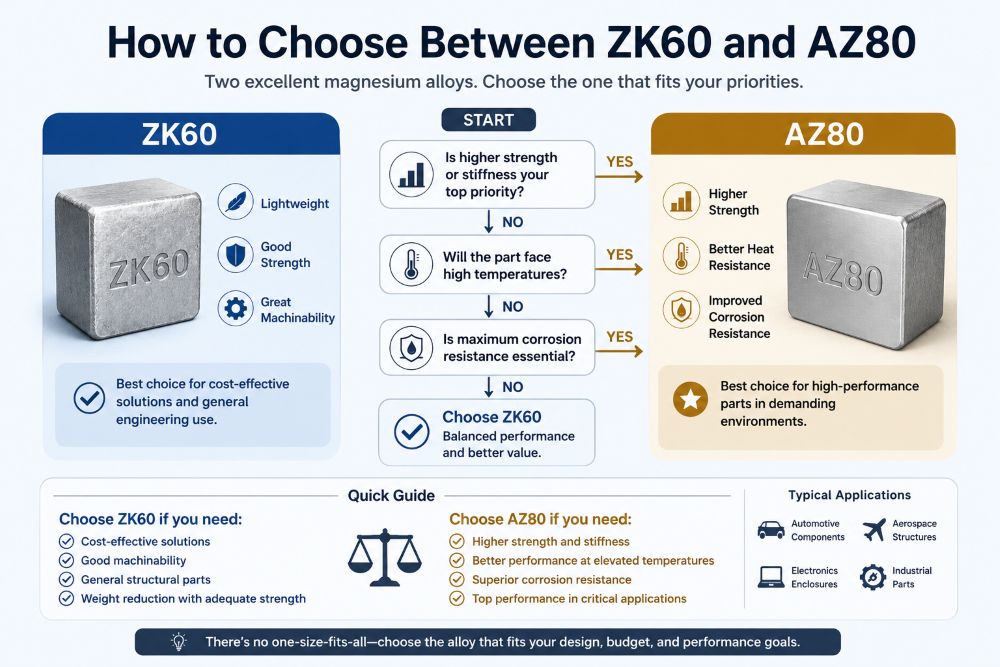
A good alloy decision follows the application. Buyers should not start with a material list and then force the part to match it. They should start with the part’s job.
6.1 Step 1: Define the Part Function
Ask whether the part is structural, moving, machined, forged, extruded, or used in a lightweight assembly. A high-risk structural part may justify ZK60. A strong industrial component may be better suited to AZ80.
6.2 Step 2: Identify the Manufacturing Route
The same alloy can behave differently depending on whether it is forged, extruded, or machined. Before selecting ZK60 or AZ80, confirm the production route.
6.3 Step 3: Decide How Much Performance Is Needed
If the application needs higher strength-to-weight confidence, ZK60 may be more attractive. If the project needs strong performance with practical manufacturability, AZ80 may be the better fit.
6.4 Step 4: Review Material Form
Buyers should confirm whether they need plate, bar, rod, extrusion, billet, or forging stock. The right alloy in the wrong form can still create production problems.
6.5 Step 5: Confirm Supplier Support
A capable magnesium alloy supplier should help clarify whether ZK60 or AZ80 is better for the application instead of only quoting a material name.
7. Quick Selection Checklist
Use this checklist before choosing between ZK60 and AZ80 magnesium.
- Confirm whether the part is structural or mainly functional.
- Check whether the part will be forged, extruded, or machined.
- Decide whether maximum strength-to-weight value is required.
- Review whether production stability is more important than peak performance.
- Confirm the required material form, such as plate, bar, extrusion, or forging stock.
- Ask whether the supplier can support repeat orders and technical discussion.
- Do not treat ZK60 and AZ80 as direct substitutes without application review.
8. Common Mistakes When Comparing ZK60 and AZ80
Many sourcing issues happen because buyers compare alloy names too quickly. These are the mistakes to avoid.
| Mistake | Why It Creates Risk | Better Approach |
|---|---|---|
| Treating ZK60 and AZ80 as interchangeable | The alloys serve different performance and process priorities. | Match each alloy to the part function. |
| Choosing only by availability | Fast supply of the wrong alloy can create downstream problems. | Confirm application fit before ordering. |
| Ignoring manufacturing route | Forging, extrusion, and machining need different material planning. | Select alloy and stock form together. |
| Underestimating supplier knowledge | A weak supplier can make even a good alloy decision harder to execute. | Work with a supplier who understands magnesium applications. |
| Selecting alloy too late | The design may already be locked into assumptions that limit performance. | Discuss alloy choice during early design and sourcing planning. |
9. Why Supplier Capability Matters
Magnesium alloy performance is not only about chemistry. It is also about material form, processing quality, communication, and application support.
At Miji Magnesium, customers often compare magnesium alloys as part of a complete production route. That may include plate, bar, extrusion, billet, forging stock, or machined magnesium solutions.
A capable magnesium supplier should help buyers evaluate:
- Whether ZK60 or AZ80 fits the application better.
- Which product form supports the manufacturing route.
- Whether the part should be forged, extruded, or machined.
- How material consistency affects repeat production.
- Whether custom dimensions or specific stock forms are needed.
- What sourcing risks should be discussed before ordering.
This support matters because the right alloy can still underperform if it is supplied in the wrong form or selected without enough application review.
10. Final Insight: Choose the Alloy That Helps the Part Succeed
ZK60 and AZ80 are both valuable magnesium alloys. Neither one is automatically better for every project.
ZK60 is often the stronger choice when the application is more performance-sensitive and the part needs higher strength-to-weight confidence.
AZ80 is often the better choice when buyers need strong magnesium performance with practical forging, machining, or industrial production value.
The smartest buyers do not ask only, “Which alloy is stronger?” They ask, “Which alloy helps this part succeed?”
For companies comparing ZK60 and AZ80 magnesium alloy solutions, Miji Magnesium can help evaluate alloy form, manufacturing route, and sourcing strategy for demanding industrial applications.
FAQ
1. What is the main difference between ZK60 and AZ80 magnesium?
ZK60 is often used for more performance-oriented lightweight applications, while AZ80 is often valued for its practical balance of strength, forging relevance, and manufacturability.
2. Is ZK60 stronger than AZ80?
ZK60 is often selected when higher strength-to-weight performance is a key priority. However, the better choice depends on the part design, process route, and final application.
3. When should engineers choose ZK60 magnesium?
Engineers should consider ZK60 for high-performance lightweight structures, aerospace-related parts, demanding forged or extruded components, and applications where structural confidence matters.
4. When is AZ80 magnesium a better choice?
AZ80 may be better when the project needs a strong wrought magnesium alloy with practical processing behavior, especially for forged, machined, or industrial structural parts.
5. Can both ZK60 and AZ80 be machined?
Yes. Both alloys can be used in machined applications, but stock quality, material consistency, and supplier capability are important for machining confidence.
6. How should buyers choose between ZK60 and AZ80?
Buyers should review the part function, manufacturing route, strength requirements, material form, production stability, and supplier support before choosing between ZK60 and AZ80.