
A Standard Of Pipe & Tube Size Chart helps you pick the right pipe or tube. It shows the sizes you need for your project. You can look up things like NPS, OD, wall thickness, schedule, and gauge. These charts help you not make mistakes, like choosing the wrong size. They keep your project safe and help you follow the rules for engineering.
- Charts give the same sizes every time and stop expensive mistakes.
- Picking the right size makes your system work well and stay safe.
- Knowing NPS for pipes and OD for tubes helps you buy the right stuff.
Key Takeaways
- Use a Standard Of Pipe & Tube Size Chart to stop mistakes and keep your projects safe.
- Learn important words like NPS, OD, and wall thickness so you can pick the right pipe or tube.
- Read size charts step by step to make smart choices and not waste money.
- Always look at the rules for your project to make sure you follow them and get things right.
- Check all your measurements two times before you order to save time and money.
What Is a Standard Of Pipe & Tube Size Chart?

Key Standards and Terms
When you look at a Standard Of Pipe & Tube Size Chart, you see information based on rules set by important organizations. These groups make sure everyone uses the same sizes and terms. Some of the most recognized standards include:
- American National Standards Institute (ANSI)
- American Society of Mechanical Engineers (ASME)
- International Organization for Standardization (ISO)
- American Petroleum Institute (API)
You often see charts that follow ANSI/ASME B36.10M or API 5L. These standards help you find the right pipe or tube for your project, whether you work in construction, plumbing, or oil and gas.
You will also come across technical terms in these charts. Here is a table to help you understand what each term means:
| Term | Description |
|---|---|
| Nominal Pipe Size (NPS) | A name for pipe size in North America. It does not match the real diameter. |
| Nominal Diameter (DN) | The metric version of NPS, used in other countries. |
| Schedule | Tells you how thick the pipe wall is. Higher numbers mean thicker walls. |
| Outside Diameter (OD) | The total width of the pipe from edge to edge. |
| Wall Thickness (WT) | How thick the pipe wall is. This changes with schedule, not OD. |
Tip: Always check which standard your project needs. American and European standards can be different, so using the right chart keeps your work correct.
What Size Charts Include
A Standard Of Pipe & Tube Size Chart gives you more than just the size. It shows you many details to help you choose the right product. Here are the main things you will find:
| Component | Description |
|---|---|
| Schedule Number (SCH) | Shows the wall thickness. Higher numbers mean thicker pipes. |
| Nominal Pipe Size (NPS) | Tells you the size, but not the exact diameter. |
| Outside Diameter (OD) | The real width of the pipe or tube. |
| Weight per Unit Length | Tells you how heavy the pipe or tube is for each meter or foot. |
You will also see different shapes and types in these charts. Some common types are:
- Round
- Oval
- Square
- Rectangular
- “D” shape
- Triangle
- Hexagonal
- Shapes with inverted corners
You can find pipes and tubes in many sizes. For example, tubing often ranges from 0.5 inches to 2.5 inches in diameter. Wall thickness can go from 0.024 inches to 0.085 inches. Pipes use schedules to show wall thickness, like SCH 10, SCH 40, or SCH 80. Here is a table with some common pipe sizes and weights:
| NPS | SCH 10 (kg/m) | SCH 40 (kg/m) | SCH 80 (kg/m) |
|---|---|---|---|
| 2″ | 3.65 | 5.44 | 7.48 |
| 4″ | 8.56 | 16.07 | 22.32 |
| 6″ | 13.44 | 28.26 | 42.56 |
| 8″ | 18.97 | 42.55 | 64.63 |

You can see that as the schedule number goes up, the pipe gets heavier. This means the wall is thicker and the pipe is stronger.
A Standard Of Pipe & Tube Size Chart helps you compare all these details. You can quickly find the right size, shape, and weight for your job. This makes your work safer and helps you follow the rules.
Reading Pipe Size Charts

Understanding NPS, OD, and Schedule
When you read a pipe size chart, you see many terms. Each one tells you something important about the pipe. You need to know what these terms mean to pick the right pipe for your project. Here is a table that explains the main terms you will find in a Standard Of Pipe & Tube Size Chart:
| Term | Definition |
|---|---|
| Nominal Pipe Size (NPS) | A standard designation for identifying pipe dimensions, not equal to actual measurements. |
| Outside Diameter (OD) | The diameter measured across the widest point of the outside surface of a pipe. |
| Wall Thickness | The thickness of the pipe material, affecting strength and pressure capacity. |
| Schedule | Indicates the wall thickness of the pipe, with higher numbers corresponding to thicker walls. |
NPS gives you a way to talk about pipe size, but it does not match the real diameter. OD tells you the true width of the pipe from one side to the other. Wall thickness shows how strong the pipe is. Schedule tells you how thick the wall is. Higher schedule numbers mean thicker and stronger pipes.
Tip: Always check both the NPS and the schedule. This helps you make sure the pipe will fit and handle the pressure you need.
Using the Chart Step-by-Step
You can follow these steps to read a pipe size chart and choose the right pipe:
- Find the NPS for your project. This is the starting point for most pipe charts.
- Look across the chart to find the OD that matches the NPS. Remember, NPS is not the same as OD.
- Check the schedule number. This tells you the wall thickness. Higher schedules mean thicker walls.
- Read the wall thickness value in the chart. Make sure it matches the strength you need.
- Check the weight per unit length if you need to know how heavy the pipe will be.
- Double-check all numbers before you order or cut the pipe.
Many people make mistakes when reading a pipe size chart. Here are some common errors and how you can avoid them:
- Confusing outer diameter (OD) with nominal pipe size (NPS). This can lead to buying the wrong fittings.
- Overlooking the importance of pipe schedules. If you ignore the schedule, you might pick a pipe that is too weak.
- Ignoring schedule numbers that affect pressure and flow performance.
You can avoid these mistakes by reading each column in the chart carefully. Always match the NPS, OD, and schedule to your project needs. If you use a Standard Of Pipe & Tube Size Chart, you will make better choices and keep your system safe.
Reading Tube Size Charts
OD, Wall Thickness, and Gauge
When you read a tube size chart, you will see three main numbers: outside diameter (OD), wall thickness, and gauge. Tube charts use the actual OD, not a nominal size like pipes. This means the number you see for OD is the real measurement from one side of the tube to the other. Wall thickness tells you how thick the tube wall is. Gauge is another way to show wall thickness. A lower gauge number means a thicker wall.
Here is a table that shows what you will find in a tube sizing chart:
| Specification | Tube Sizing Chart |
|---|---|
| Outside Diameter (OD) | Ranges from 0.125″ to 5.000″ |
| Wall Thickness (WT) | Starting at 0.030″ |
| Gauge | Standard gauge values for wall thickness |
Tip: Always use a caliper or ruler to measure the OD if you need to check a tube. This helps you avoid mistakes.
Tube Chart Differences
Tube size charts look different from pipe size charts. Tube charts use the real OD and wall thickness, while pipe charts use nominal sizes and schedules. You do not need to convert numbers when you use a tube chart. This makes it easier to pick the right tube for your project.
Tubes come in many sizes for different jobs. Small tubes, like those with a 6 mm (0.25 inch) OD, work well for medical devices or small fluid systems. Medium tubes, such as 25 mm (1 inch) OD, are good for support columns or machinery. Large tubes, like 100 mm (4 inch) OD, are used in big structures or industrial systems.
Here is a table that shows typical tube sizes and where you might use them:
| Category | OD (mm) | OD (inches) | Typical Wall Thickness (mm) | Applications |
|---|---|---|---|---|
| Small Diameter | 6 | 0.25 | 0.5 – 1 | Medical devices, precision instrumentation |
| Medium Diameter | 25 | 1 | 1.5 – 3 | Structural applications, support columns |
| Large Diameter | 100 | 4 | 4 – 8 | Major piping systems, chemical processing |

You can use a Standard Of Pipe & Tube Size Chart to compare tube and pipe sizes. This helps you choose the right material for your project and avoid costly errors.
Pipe vs Tube Sizing Differences
Comparison Table
The table below shows how pipe and tube sizing are different. This helps you see why you must use the correct chart for your project.
| Parameter | Pipe | Tube |
|---|---|---|
| Sizing method | NPS (Nominal Pipe Size) or DN + Schedule | Exact OD + Wall Thickness (inches or mm) |
| Wall thickness | Schedule (SCH 5S, 10S, 40, 80, 160, XXS) | Inches/mm or gauge number (BWG/SWG) |
| Cross-section shapes | Round only | Round, square, rectangular, oval |
| Typical size range | NPS 1/8” to 80”+ | OD 1/4” to 12”+ (round); larger for structural |
| OD tolerance | Loose (per ASME B36.10/B36.19) | Tight (per ASTM product specification) |
| WT tolerance | +/- 12.5% (standard) | +/- 10% or tighter |
| Main uses | Fluid/gas transport, process piping | Heat exchangers, boilers, mechanical/structural |
Note: Pipes use a size name that is not the real diameter. Tubes use the real outside diameter. Tubes also come in more shapes and have stricter rules for size.
Practical Implications
You need to know these differences because they change your project in many ways.
- Picking the wrong size can cause delays. About 30% of building jobs get delayed from sizing mistakes.
- Small diameters can slow down flow. This can make your system not work well.
- Big diameters can lower pressure and cost more money.
- Pipes are best for moving liquids or gases. Tubes are better for building things or machines.
- Tubes have stricter size rules. This means they fit better in jobs that need exact sizes, like heat exchangers or frames.
- Pipes cost less and have looser size rules. You can use them for fences or water pipes where size is not as important.
- Wall thickness changes how much pressure the pipe or tube can take. If you pick the wrong wall thickness, you could get leaks or breaks.
A Standard Of Pipe & Tube Size Chart helps you stop these problems. You can pick the right size and type for your needs. This keeps your project safe, on time, and not too expensive.
Choosing the Right Size
Selection Checklist
You can follow a simple checklist to choose the right pipe or tube size for your project. This helps you avoid mistakes and makes sure your system works well.
- Review your project’s design basis and layout needs.
- Check which codes and standards apply to your job.
- Decide if you need a pipe or a tube. Pipes and tubes are not the same.
- Measure the flow rate, pressure, and space available.
- Use a Standard Of Pipe & Tube Size Chart to compare sizes, wall thickness, and weights.
- Pick the material that matches your project’s requirements and local rules.
- Confirm the outside diameter (OD), wall thickness, and schedule or gauge.
- Double-check all measurements before you order.
Tip: Always match the chart to your country’s standards and your project’s needs.
Common Mistakes
Many people make the same errors when using size charts. You can avoid these by knowing what to look for.
- Treating pipes and tubes as if they are the same thing.
- Asking for a “2-inch tube” when you actually need a pipe.
- Using pipe sizes for structural jobs instead of tube sizes.
- Mixing up nominal sizes with real measurements.
- Forgetting to check wall thickness or schedule.
- Confusing OD with inside diameter (ID) when picking fittings.
- Ignoring how wall thickness changes flow or strength.
Note: Double-check the type, size, and wall thickness before you buy. This saves time and money.
Example Selection Process
You can use these steps to pick a pipe size for a real project:
- Find the inner diameter you need based on flow speed (for example, 6.5 inches for a certain velocity).
- Round up to the next standard size (like 8 inches) and check the inner diameter for the schedule you want.
- Calculate the pressure drop for the new size.
- If the pressure drop is too high, move up to the next size (like 10 inches) and check again.
- For important jobs, do a full check to make sure the size works for pressure and flow.
Using a Standard Of Pipe & Tube Size Chart helps you follow these steps and avoid costly errors.
Common Standard Size Charts
You can use a Standard Of Pipe & Tube Size Chart to find the right size quickly. These charts show the most important numbers for pipes and tubes. You do not need to guess or do hard math. You can see the sizes, wall thickness, and other details in one place.
Pipe Size Chart Example
You will find these key values in a standard pipe size chart:
- Outer diameters in inches and millimeters
- Wall thickness for each size
- Pipe weight per meter
- Maximum pressure capacity for safety
- Material details for performance
A simple pipe size chart looks like this:
| NPS | OD (in) | Wall Thickness (in) |
|---|---|---|
| ½ | 0.840 | 0.065 |
| ¾ | 1.050 | 0.065 |
| 1 | 1.315 | 0.065 |
| 1½ | 1.900 | 0.065 |
| 2 | 2.375 | 0.065 |
| 3 | 3.500 | 0.083 |
| 4 | 4.500 | 0.083 |
| 6 | 6.625 | 0.109 |
| 8 | 8.625 | 0.109 |
| 10 | 10.750 | 0.134 |
| 12 | 12.750 | 0.156 |
| 14 | 14.000 | 0.156 |
| 16 | 16.000 | 0.165 |
| 18 | 18.000 | 0.165 |
| 20 | 20.000 | 0.188 |
| 24 | 24.000 | 0.218 |
You can also see how outside diameter and wall thickness change with pipe size:

Tip: Use a printable chart for fast measuring. Make sure you print it at full size for accuracy.
Tube Size Chart Example
Tube size charts use real outside diameter and wall thickness. You can see both inch and millimeter sizes. Here is a simple tube size chart:
| Nominal Pipe Size (NPS) | Decimal OD (in) | Metric OD (mm) | Common DN Equivalent |
|---|---|---|---|
| 1/8 in | 0.405 | 10.287 | DN 6 |
| 1/4 in | 0.540 | 13.7160 | DN 8 |
| 3/8 in | 0.675 | 17.145 | DN 10 |
| 1/2 in | 0.840 | 21.336 | DN 15 |
| 3/4 in | 1.050 | 26.6700 | DN 20 |
You can compare tube sizes in inches and millimeters:
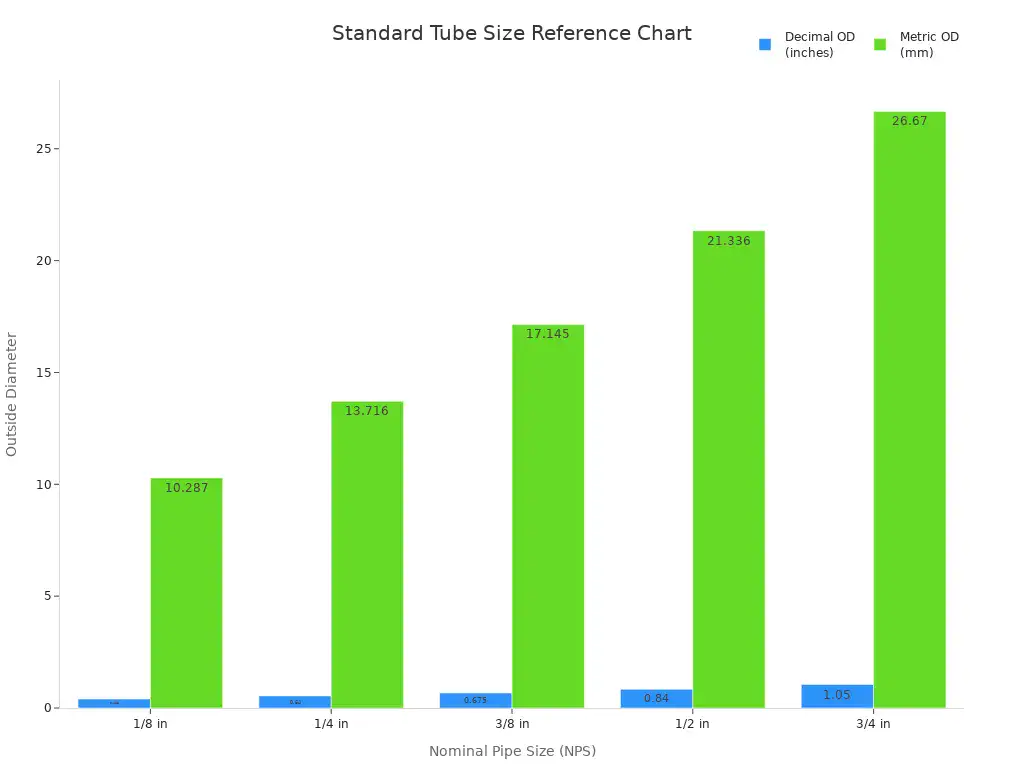
You can use these charts to pick the right pipe or tube for your project. They help you avoid confusion and make your work easier.
You now know that a Standard Of Pipe & Tube Size Chart helps you choose the right size. It also helps you avoid mistakes. These charts show NPS, OD, wall thickness, and ID. This makes it simple to compare different choices:
| Term | Description |
|---|---|
| NPS (Nominal Pipe Size) | The name used for the pipe’s size. |
| OD (Outside Diameter) | The set outside width for that NPS. This helps different wall thicknesses fit together. |
| Wall Thickness | How thick the pipe wall is. This changes with schedule and affects how much pressure it can take. |
| ID (Inside Diameter) | The space inside the pipe after you count the wall thickness. This is important for how things flow through. |
If you use these charts, you will not get the wrong fittings. You will not pick the wrong material or spend too much money. Always check your measurements, look at the chart, and ask an expert if you are not sure. This keeps your project safe and helps you save money.
FAQ
What is the difference between NPS and OD?
NPS stands for Nominal Pipe Size. It is a name for the pipe size, not the real measurement. OD means Outside Diameter. It is the actual width of the pipe.
Can I use pipe and tube sizes interchangeably?
No, you cannot. Pipe and tube sizes follow different rules. Pipes use NPS and schedule. Tubes use actual OD and wall thickness. Always check your chart before you buy.
How do I measure a pipe or tube correctly?
Use a caliper or a ruler. For pipes, measure the outside diameter. For tubes, measure the outside diameter and wall thickness. Write down your numbers before you order.
Why does wall thickness matter?
Wall thickness affects how strong the pipe or tube is. Thicker walls can handle more pressure. If you pick the wrong thickness, your system may leak or break.
What should I do if I am unsure about the size?
Tip: Ask an expert or check your project’s standards. Double-check your measurements with the size chart. This helps you avoid mistakes and saves money.