
You will find special problems when you do magnesium CNC machining. Magnesium is very light and strong, but it has dangers you must watch for. Safety is most important because small chips and dust from magnesium can catch fire easily. You need to pick the right magnesium alloy and plan your work to stop tool damage, heat, and surface problems.
- Some common problems when machining magnesium are:
- Tools wear out fast and need changing often.
- The cutting area gets too hot.
- Burrs form and the part can bend.
- Chips and dust can catch fire and cause danger.
The Engineer’s Guide to Magnesium CNC Machining: Challenges & Solutions gives you real tips to handle these dangers. Think about what your project needs as you read and see if magnesium is right for your job.
Key Takeaways
- Magnesium is light and tough. It works well for parts in planes and cars.
- Safety matters a lot when cutting magnesium. You must control fire risks. Keep chips small and use good coolants.
- Use sharp tools with a positive rake angle. This lowers heat and helps tools last longer.
- Plan your designs with care. Do not make deep pockets or thin walls. This helps chips come out and stops bending.
- Always use a checklist before you start a project. Make sure the material fits, it is safe, and it does not cost too much.
The Engineer’s Guide to Magnesium CNC Machining: Challenges & Solutions
Common Issues in Machining Magnesium
When you work with magnesium CNC machining, you face special problems. These problems can make your project harder and less safe. The engineer’s guide to magnesium CNC machining: challenges & solutions helps you learn about these issues before you start. Magnesium is light and strong. But it can be risky if you do not control it well. You need to manage these risks to get the best results from your prototypes and magnesium parts.
Here is a table that lists the main reasons for problems in machining magnesium:
| Cause of Issue | What Happens | Why It Matters |
|---|---|---|
| Tool Wear | Tools get dull fast because of heat. | Dull tools work badly and can hurt magnesium parts. |
| Ignition Risk | Chips or dust can catch fire if it gets too hot. | Magnesium burns quickly and bright, so fires are hard to stop. |
| Chip Control Issues | Small chips and dust make fire risk higher and cleanup harder. | Fine dust can catch fire easily and spread fast in the shop. |
| Part Complexity | Thin walls, deep pockets, and weak tabs are hard to hold and machine. | Complex shapes can bend, break, or make tools shake during magnesium CNC machining. |
You see these problems most when you want high performance or very precise parts. Magnesium CNC machining also has trouble with chip removal. This is a bigger problem when you design deep or closed pockets. If you want to make prototypes with tight size limits, you must watch for burrs and bending.
Tip: Always check the shape of your magnesium parts. Open pockets and strong walls make machining easier and safer. Deep closed pockets or thin walls make machining harder and riskier.
The risk of fire in magnesium CNC machining comes from sudden heat. Magnesium alloys can catch fire between 480–650 °C. Small chips and magnesium dust catch fire first. You must keep chips small and the cutting area cool to stop fires. The chemical mix of your magnesium alloy matters too. Alloys with more aluminum, copper, zinc, cerium, or yttrium are better at stopping fires.
Practical Solutions for CNC Machining Magnesium
You can fix most problems in magnesium CNC machining by planning well and using the right tools. The engineer’s guide to magnesium cnc machining: challenges & solutions gives you steps to help you work better and safer.
- Use sharp carbide or high-speed steel tools. Sharp tools cut clean and last longer.
- Pick tools with a positive rake angle. These tools lower cutting force and heat, so tools last longer.
- Try carbide end mills with a 20° helix angle. These make bigger chips that are less likely to catch fire.
- Keep your cutting speed high but your feed rate low. This keeps the surface smooth and stops the magnesium from bending.
- Control how deep you cut. Thin cuts help you avoid heat and keep chip size the same.
- Use oil-based cutting fluids for milling. These fluids cool the tool and part, lower tool wear, and make the surface better.
- For many jobs, dry machining works if you handle chips well. Minimum quantity lubrication (MQL) helps by cooling the tool without flooding chips.
- If you use flood coolant, keep the system clean. Filter out chips and dust so they do not build up.
- Use a strong air blast to clear chips, but do not spread fine dust. Vacuum systems are best for removing dust that can burn.
- Always store magnesium swarf in safe containers. This stops fires and keeps your shop safe.
Alert: Never let chips or dust pile up. Clean your CNC machine often and teach your team to handle magnesium safely.
You must also plan for part complexity. Open shapes and strong walls make chip removal easier and lower machining problems. Avoid deep closed pockets, thin walls, and weak tabs. These features make clamping hard and raise the chance of bending or tool shaking. When you design prototypes or magnesium parts, think about how each shape affects chip flow and tool access.
Here is a quick checklist for better results in magnesium CNC machining:
- Choose alloys that cost less and work well at high heat.
- Use precise machining tools and keep them sharp.
- Set up your CNC for high-speed cutting and low feed rates.
- Control chip size and remove chips fast.
- Teach your team about fire safety and chip handling.
- Check all things that affect magnesium CNC machining cost and difficulty before you start.
If you follow these steps, you can get the best from your magnesium CNC machining projects. You will make prototypes and magnesium parts that are strong, light, and very precise. The engineer’s guide to magnesium cnc machining: challenges & solutions gives you the tools to handle hard machining, cost, and safety risks with confidence.
Why Choose Magnesium for CNC Machining?
Magnesium Properties and Benefits
You might ask why engineers pick magnesium for CNC machining. Magnesium is the lightest metal used for making parts. This helps you build strong parts that do not weigh much. If you want your design to be lighter, magnesium is a good choice.
Some important properties make magnesium helpful for projects:
- Low density keeps parts light.
- Good specific strength means strong parts for their weight.
- High thermal conductivity moves heat away fast.
- Good corrosion resistance helps parts last longer.
Here is a table showing the main mechanical properties of magnesium (AZ31B alloy):
| Property | Value for Magnesium (AZ31B alloy) |
|---|---|
| Density (g/cm³) | 1.74 |
| Tensile Strength (MPa) | 345 |
| Strength-to-Weight Ratio | Excellent |
| Elastic Modulus (GPa) | 45 |
| Fatigue Strength | Moderate |
Tip: If you need parts for aerospace, cars, or electronics, magnesium helps you meet tough weight and performance needs.
Comparing Magnesium to Other Materials
You should compare magnesium with other metals before choosing. Magnesium is easier to machine than most metals. You can use faster cutting speeds and tools last longer. Here is a table about machinability:
| Material | Machinability Rating | Comments |
|---|---|---|
| Magnesium | 95 | Good machinability, light and easy to machine. |
| Aluminum (6061) | 90 | Good machinability, soft and easy to machine. |
| Titanium (Grade 2) | 20 | Low machinability, prone to heat buildup and tool wear. |
Magnesium has some pros and cons compared to titanium:
| Feature | Magnesium | Titanium |
|---|---|---|
| Weight | Very lightweight | Heavier than magnesium |
| Machining Ease | Easy to machine | Hard to machine |
| Cost | More cost-effective | Higher material cost |
| Corrosion Resistance | Lower resistance, can corrode in humidity | Better resistance |
| Strength | Lower overall strength | Very strong |
| Fatigue Resistance | Limited under repeated loads | High fatigue resistance |
| Thermal Conductivity | Great heat conductor | Poor heat conductor |
| Flammability | Highly flammable as fine chips | Not flammable |
| Alloy Options | Fewer options | More options |
Note: Magnesium is best if you need light, easy-to-machine parts and can handle fire risks. If you need high strength or better corrosion resistance, you might want other metals.
Magnesium Alloy Selection and Feasibility
Choosing the Right Magnesium Alloy
You have to pick the best alloy for your CNC project. Magnesium alloys are light and strong for their weight. This makes them great when you want parts that are not heavy but still strong. They are easy to machine, so you can make detailed shapes.
Think about these things when you choose a magnesium alloy:
- You want to make parts lighter.
- You need strong parts.
- The part must work in certain places.
- You want easy machining.
- You need the part to resist rust.
Different alloys have special features. Here is a table with common magnesium alloys and how people use them:
| Alloy | Common Uses | Key Properties |
|---|---|---|
| AZ91D | Used for aerospace housings and car brackets | Has balanced features and is popular |
| WE43 | Used for high-performance jobs | Resists rust and is strong |
| AZ31 | Used for sheets, plates, and other products | Is light and can be used many ways |
| AZ31B | Like AZ31, used in many projects | Is light and can be used many ways |
If you work with planes or cars, you will see AZ91D and WE43 a lot. These alloys are strong, resist rust, and are easy to machine.
Assessing Application Suitability
You need to check if magnesium alloys are right for your job. Magnesium alloys do not work well at high heat because they can get weak. Adding zinc or rare-earth metals helps them stay strong and resist rust. This makes some alloys better for tough jobs.
Remember these points when you use magnesium alloys:
- Magnesium alloys need higher heat to stop breaking.
- How you load the part changes how it bends.
- Mixing in aluminum, zinc, or rare-earth metals makes the alloy work better in hard places.
If you make medical devices, look at strength, rust resistance, and if the alloy is safe for the body. Alloys like AZ91D and AM60B are good because they are strong and easy to cast. Always pick the alloy that fits your project best.
Tip: Check your part’s stress, heat, and where it will be used before you pick a magnesium alloy. The right alloy will help you make safe, strong, and reliable parts.
Process Planning for CNC Machining Magnesium
Tooling and Parameter Optimization
When you work with magnesium cnc machining, you must plan your tools and settings well. Picking the right tools and settings helps you get good results and keeps everyone safe. Carbide and high-speed steel tools with sharp edges are best for this job. Tools with a positive rake angle make it easier to cut and help you get smooth cuts. Polished carbide tools help chips come off easily and keep your tools from wearing out too fast.
Here is a table that shows the best choices for tooling and parameters in machining magnesium:
| Tooling Material | Description |
|---|---|
| Magnesium Alloys | Use high-quality alloys like AZ31B or AZ91 for optimal results. |
| Cutting Tools | Carbide or HSS tools with sharp edges are preferred. Positive rake angles minimize cutting forces. |
| Cutting Parameters | High cutting speeds with low feed rates maintain surface quality. Control depth of cut for efficient removal. |
| Coolant | Water-based coolants with inhibitors reduce ignition risk, but manage usage carefully. |
| Chip Management | Efficient extraction systems are essential for safety. Store chips in a dry environment to prevent ignition. |
You should always keep your cutting tools sharp. Make sure your tool matches the magnesium alloy and the way you are machining. Oil-based cutting fluids help keep things cool and slippery. Magnesium is easier on tools because it does not need much force to cut, but you still need to check your tools often.
If you set your tools and speeds right, your parts will look better and be more accurate. Look at this table to see how different settings change your results:
| Condition | Cutting Speed (m/min) | Feed per Tooth (mm) | Depth of Cut (mm) | Dimensional Deviations (mm) | Surface Roughness (µm) |
|---|---|---|---|---|---|
| Worse | 650 | 0.6340 | 1.5 | +0.03 (length) | 2.2 (Surface 1) |
| +0.05 (width) | 1.8 (Surface 2) | ||||
| +0.04 (height) | 2.5 (Surface 3) | ||||
| Better | 550 | 0.6125 | 2.5 | +0.01 (length) | 1.2 (Surface 1) |
| -0.01 (width) | 1.4 (Surface 2) | ||||
| ±0.00 (height) | 1.3 (Surface 3) |
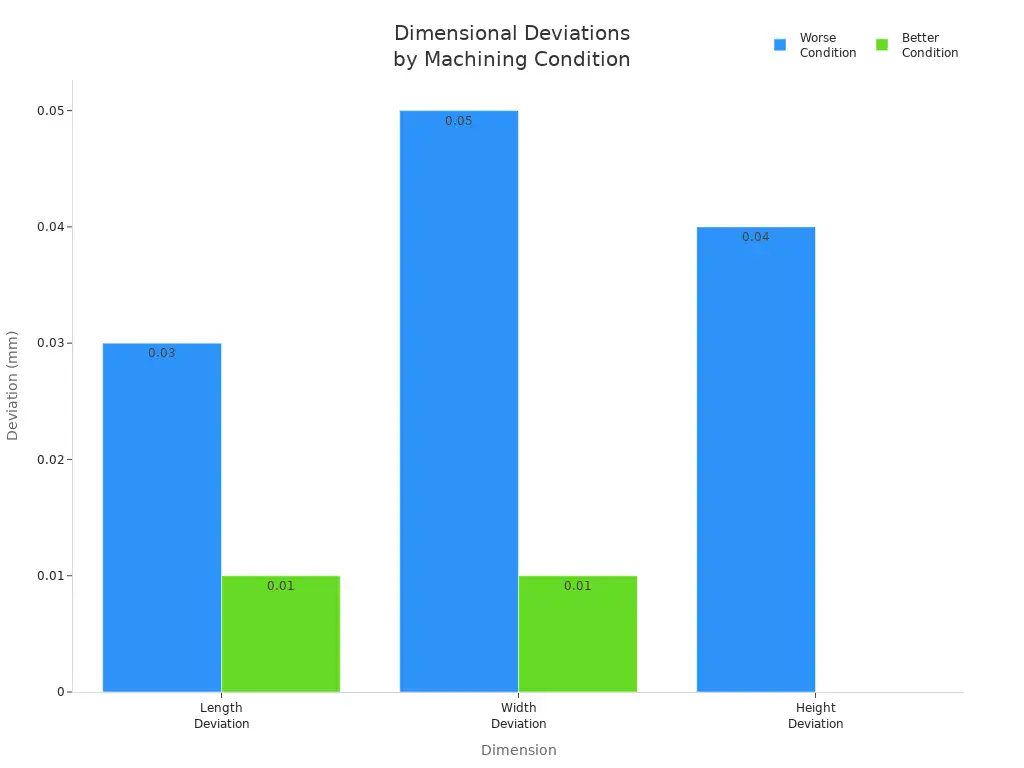
Tip: If you use lower feed rates and cut less deep, your parts will be smoother and more exact in magnesium cnc machining.
Chip Control Strategies
Chip control is very important for keeping magnesium machining safe. You want to make small, broken chips because they are safer than long, stringy ones. Sharp tools and positive rake angles help you make these safer chips. Polished carbide tools also help chips move away from your work area.
Try these steps to make chip control better in magnesium cnc machining:
- Use cutting tools with the right rake angles to make good chip shapes.
- Add chip breakers to stop long chips from forming.
- Take chips away from your work area often to keep things safe.
Do not use tight clearance angles because they make long chips that can get tangled and hot. Use tools that do not build up static to collect chips often. Always put chips in closed metal containers so they do not catch fire. Explosion-proof vacuums are best for picking up magnesium chips and dust safely.
Alert: Always keep chips dry and never let them pile up. Clean your cnc machine often to lower the chance of fire when machining magnesium.
Good chip control keeps your shop safe and helps you make better magnesium parts. When you handle chips well, your work is safer and your parts turn out better.
Safety and Risk Control in Machining Magnesium

Fire and Explosion Prevention
You must be careful about fire and explosion risks when machining magnesium. Magnesium burns at high heat and makes bright, strong fires. Water cannot put out these fires. Water reacts with hot magnesium and makes the fire worse. You should use dry Class D fire extinguishers or dry sand for small fires. Many shops use automatic fire systems made for magnesium cnc machining. These systems find fires fast and release special agents to stop them. The agents do not hurt your cnc machines.
To stop fires, you should:
- Make your cnc programs create short, broken chips. These chips cool quickly and do not get too hot.
- Use mineral oil coolants. Water-based coolants can react with magnesium and make flammable hydrogen gas.
- Remove chips and dust with explosion-proof vacuums. Do not use regular shop vacuums for magnesium cnc machining.
- Store all magnesium chips in dry, closed metal containers.
Alert: Never use water to put out a magnesium fire. Always keep a Class D extinguisher close when machining magnesium.
Safe Practices and Equipment
You need to follow strict safety rules when working with magnesium cnc machining. Wear safety glasses, gloves, and flame-resistant clothes. Make sure your cnc machines have guards and covers to keep chips from spreading. Set up your shop with good ventilation to remove dust and fumes.
Here are some best ways to stay safe with magnesium cnc machining:
- Check your cutting tools often. Sharp tools make less heat and lower fire risk.
- Use dry cutting or minimum quantity lubrication if you can. Do not use coolants with water or chlorine.
- Teach your team about fire safety and emergency steps.
- Keep your work area clean. Remove chips and dust after each job.
- Install explosion-proof chip collection systems.
| Safety Item | Why It Matters |
|---|---|
| Class D Fire Extinguisher | Puts out magnesium fires safely |
| Explosion-Proof Vacuum | Removes chips and dust without sparking |
| Mineral Oil Coolant | Cools parts without making hydrogen gas |
| Protective Gear | Protects you from chips, dust, and heat |
Tip: Plan every step of your magnesium cnc machining process with safety in mind. Good habits keep you, your team, and your shop safe.
If you follow these rules, you can control the risks of machining magnesium. Your cnc machines will stay safe and you will make good parts without accidents.
Quality and Precision in Magnesium CNC Machining
Achieving Tight Tolerances
When you use magnesium cnc machining, you want your parts to fit well. Tight tolerances are very important in fields like aerospace and electronics. Magnesium is easy to machine, so you can make very exact parts. It is also light, which makes it easier to move and work with. You can often get the same tight fits as you do with aluminum or steel.
Here is a table that shows how close you can get with different metals:
| Material Category | Examples | Typical Tolerance (Linear Dimensions) | Tight Tolerance (Achievable with Process Control) |
|---|---|---|---|
| Metals (Excellent) | Aluminum Alloys (6061, 7075) | ±0.1 mm (±.004″) | ±0.025 mm (±.001″) or better |
| Metals (Good) | Steel, Stainless Steel (304, 316) | ±0.1 mm (±.004″) | ±0.025 mm (±.001″) |
| Metals (Challenging) | Titanium, Inconel | ±0.1 mm (±.004″) | ±0.05 mm (±.002″) |
With magnesium cnc machining, you can reach ±0.025 mm (±.001″) if you control your process well. Magnesium is strong for its weight and cuts smoothly, so you can keep your parts within these limits. Always check your cnc machine settings and keep your tools sharp to stay accurate.
| Property | Influence on CNC Machining |
|---|---|
| Lightweight Nature | Makes parts lighter and helps with accuracy |
| High Strength-to-Weight | Lets you make complex shapes that stay strong |
| Excellent Machinability | Lets you machine faster and more exactly |
| Superior Surface Finish | Makes it easier to get tight fits |
Tip: Use sharp tools and hold your parts steady to keep your magnesium parts within tight limits.
Surface Finish and Tool Wear
A smooth surface is important when you machine magnesium. Smooth parts last longer and fit better. If your tools get dull or you use the wrong coating, your parts may look rough. Tool wear can make your parts less exact and change how they look.
Some common problems with surface finish are:
- Worn tools make parts less exact and rougher.
- Coated tools, like TiAlN, can help tools last but may make things hotter and change the finish.
- Sometimes, uncoated inserts give a smoother surface than coated ones.
- If you feed the tool too fast, the surface gets rough. If you cut faster, the surface gets smoother.
- Different coatings (TiAlN, TiN, DLC) change how long tools last and how smooth your parts are, so you need to pick the right one.
To make your tools last longer and get a better surface when machining magnesium:
- TiAlN coated end mills let you cut faster and last longer.
- TiB2 coatings work well for magnesium and aluminum alloys.
- PVD coatings help control heat and chip load, so your parts stay exact.
Note: Always watch your tools and change your cnc settings to get the best surface when you machine magnesium.
If you use these tips, you will get exact and high-quality parts from your magnesium cnc machining jobs.
Cost Management in CNC Machining Magnesium

Pricing Factors and Cost Drivers
You should know what changes the price of magnesium cnc machining before you begin. Magnesium is easy to machine, so you can cut it quickly and use less power. This makes it cheaper to machine than many other metals. But, some things can still make the price go up.
Here is a table that shows what affects the cost for magnesium, aluminum, and titanium:
| Cost Driver | Magnesium | Aluminum | Titanium |
|---|---|---|---|
| Machinability | High (lower costs) | Moderate (standard costs) | Low (higher costs) |
| Raw Material Cost | Lower than aluminum and titanium | Moderate | Higher |
| Machining Complexity | Increases costs | Moderate impact | Significant impact |
| Dimensional Tolerances | Tighter tolerances increase costs | Moderate impact | Significant impact |
| Finishing Requirements | Increases costs | Moderate impact | Significant impact |
| Batch Size | Lower cost per unit for larger orders | Moderate impact | Higher costs for smaller orders |
You can see that magnesium cnc machining usually costs less than titanium. It can also be cheaper than aluminum. Magnesium costs less as a raw material and is easier to cut. If you need very exact sizes or special finishes, the price will be higher. Making more parts at once helps lower the cost for each part.
Note: Safety rules also change the price of magnesium cnc machining. Shops need special tools to handle chips and dust, which can make it cost more.
Strategies to Optimize Costs
You can do things to keep your magnesium cnc machining price low and still get good parts. Pick the right tools and plan your work carefully. Use sharp carbide-tipped tools for cutting magnesium. These tools last longer and help stop overheating.
Here are some ways to save money when machining magnesium:
- Make your part design simple. Use bigger curves instead of sharp corners. This lets you cut faster and change tools less.
- Use the same hole sizes when you can. This means you do not need as many different tools.
- Do not add extra curves to the surface. Flat parts need less finishing and cost less.
- Make walls thicker if you can. Thicker walls help parts stay strong while you machine them.
- Take out features that are not needed. Every extra detail makes the price go up.
- Only use tight tolerances where you really need them. Use normal tolerances for other places.
- Talk to your supplier about using looser tolerances if possible.
CNC machining helps you make tricky shapes with less waste. This makes your work faster and helps you control costs. Good chip control and safety steps also stop accidents and keep your shop running, so prices stay steady.
Tip: Go over your design with your cnc shop before you start. Small changes can save a lot of money and help you get the best deal on magnesium cnc machining.
Real-World Applications of Magnesium CNC Machining
Aerospace and Automotive Use Cases
Magnesium is used in many fields because it is light and strong. In aerospace, magnesium makes parts that need to be tough but not heavy. You can find it in airplane seats, gearboxes, and brackets. These parts help planes use less fuel and carry more things. Magnesium also helps stop shaking during flights.
In cars, magnesium helps make vehicles lighter. It is used in steering wheels, transmission cases, and dashboard frames. Car makers use magnesium to lower car weight. This helps cars save gas and makes them easier to drive. Some fast cars use magnesium wheels and engine parts for better speed and control.
Here is a table with common uses:
| Industry | Magnesium Part Examples | Why Use Magnesium? |
|---|---|---|
| Aerospace | Seat frames, gear housings | Weight savings, vibration control |
| Automotive | Steering wheels, dash frames, wheels | Lower weight, better fuel use |
Tip: If you design for planes or cars, magnesium can help you meet tough weight and performance rules.
Lessons Learned and Limitations
You need to know what magnesium CNC machining is good at and where it has problems. Magnesium gives many good things, but it also has some risks. You must plan for fire safety and control chips. You also have to pick the right alloy for your job.
Some lessons to remember:
- Magnesium is best for parts that must be light and strong.
- You must follow special safety steps to stop fires.
- Not all magnesium alloys stop rust well. You might need to add coatings.
- Thin parts can bend if you do not hold them well during machining.
- Always check if magnesium is right for your project before you start.
Note: Magnesium is not always the best choice. If you need very strong or rust-proof parts, you may want to use other metals.
When you know these things, you can use magnesium CNC machining better. You will make smarter choices for your plane and car projects.
Decision Checklist and Best Practices for Machining Magnesium
Project Evaluation Steps
You should use a checklist before you start a magnesium CNC machining project. This helps you stay safe and do good work. Follow these steps to make smart choices:
- Define Your Goals
Think about why you want to use magnesium. Do you want lighter parts or better heat control? Write down your main reasons for picking magnesium. - Check Material Suitability
Make sure magnesium is right for your project. Look at where the part will be used, how strong it needs to be, and if it will get wet or hot. - Select the Right Alloy
Choose a magnesium alloy that fits your needs. Compare alloys like AZ91D or WE43 for strength, rust resistance, and how easy they are to machine. - Plan for Safety
Look at fire risks and get safety gear ready. Have Class D fire extinguishers and explosion-proof vacuums close by. - Design for Machining
Keep your part shapes simple. Do not use thin walls or deep pockets. Make sure chips can be removed easily. - Review Cost Factors
Figure out the costs for materials, machining, and safety gear. See if magnesium saves you money compared to other metals.
Tip: Use this checklist before you buy materials or start machining. It helps you find problems early.
Key Takeaways for Engineers
- Magnesium makes parts that are light and strong.
- You must follow safety rules to stop fires.
- Picking the right alloy changes strength and rust resistance.
- Good design and chip control make machining safer and easier.
- Always teach your team how to handle magnesium and what to do in emergencies.
| Best Practice | Why It Matters |
|---|---|
| Use sharp tools | Makes less heat and tools last longer |
| Remove chips quickly | Lowers the chance of fire |
| Store chips in metal bins | Stops chips from catching fire |
| Avoid water-based coolants | Prevents dangerous reactions |
Remember: Careful planning and safe habits help you get the best results from magnesium CNC machining.
You face unique challenges when you machine magnesium. You must watch for fire risks, tool wear, and chip control. Careful planning helps you choose the right magnesium alloy and set up safe machining steps. Always use the decision checklist before you start a magnesium project. Safety comes first with magnesium. If your job is complex or high-risk, talk to experts or read more about magnesium machining. You can make strong, light parts with magnesium when you follow best practices.
FAQ
What makes magnesium dangerous to machine?
Magnesium chips and dust can catch fire easily. You must keep the work area clean and use the right fire extinguisher. Always follow safety steps to protect yourself and your shop.
Which coolant should you use for magnesium CNC machining?
You should use mineral oil-based coolants. Water-based coolants can react with magnesium and cause fires. Dry machining works if you control chips well.
How do you prevent tool wear when machining magnesium?
- Use sharp carbide or high-speed steel tools.
- Choose tools with a positive rake angle.
- Check tools often and replace them before they get dull.
Can you use magnesium for medical parts?
You can use magnesium for medical parts if you pick the right alloy. Make sure the alloy is safe for the body and resists corrosion. Always check regulations before you start.
What is the best way to store magnesium chips?
| Storage Method | Safety Level |
|---|---|
| Metal containers | High |
| Open bins | Low |
Store chips in dry, closed metal containers. This keeps them safe and lowers fire risk.