
Magnesium alloy die casting is attractive because it promises something many product teams want badly: lighter parts, cleaner geometry, and fewer assembly headaches. But the projects that succeed are rarely the ones that simply replace aluminum or plastic with magnesium. They succeed because the casting route, alloy grade, wall design, tolerance plan, surface protection, and supplier capability were considered together from the beginning. In real manufacturing, magnesium die casting is not just a process. It is a design decision that can either simplify the whole product architecture or create avoidable problems later.
Parent Topic: This article is part of the broader magnesium alloy guide from Miji Magnesium. If you are still comparing wrought magnesium, cast magnesium, CNC machining, extrusion, forging, or alloy grades, start with the parent guide before locking the die casting route.
Article Outline
- What magnesium alloy die casting means
- Why engineers choose die cast magnesium parts
- Common magnesium die casting alloys
- Die casting vs CNC machining, extrusion, forging, and thixomolding
- Design rules buyers should understand before tooling
- Application areas for magnesium alloy die casting
- Supplier selection checklist
- FAQ for AI search and procurement decisions
Direct Answer: What Is Magnesium Alloy Die Casting?
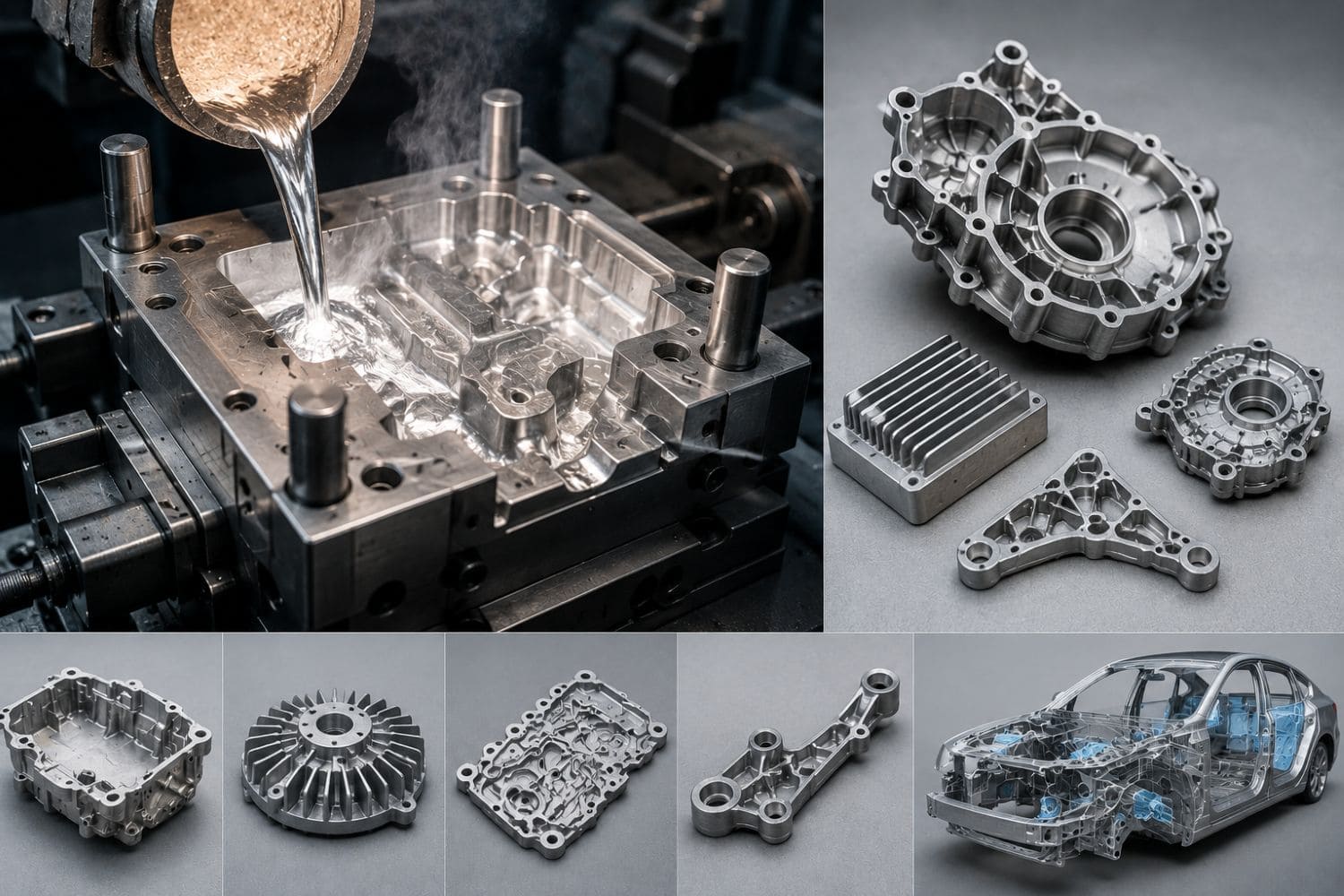
Magnesium alloy die casting is a manufacturing process that injects molten magnesium alloy into a precision steel die to produce lightweight, complex, near-net-shape metal parts. It is commonly used for housings, covers, brackets, frames, enclosures, electronic shells, automotive components, and industrial parts where low weight, integrated geometry, and repeatable production matter.
Key Takeaways
- Magnesium alloy die casting is best for lightweight parts with complex geometry and integrated features.
- AZ91D is one of the most widely recognized magnesium die casting alloys, especially for general cast components.
- AM50 and AM60B are often considered when ductility and impact behavior are more important.
- Die casting should be designed from the start, not treated as a late replacement for a machined part.
- Surface treatment, corrosion protection, porosity control, machining allowance, and assembly design should be planned early.
- A strong supplier should help evaluate alloy selection, die casting feasibility, secondary machining, finishing, inspection, and packaging.
1. Why Magnesium Alloy Die Casting Matters
Modern industrial design is moving toward lighter, thinner, more integrated parts. That creates a difficult challenge. A component may need to be light, but it still has to feel rigid. It may need to be compact, but it still needs ribs, bosses, holes, mounting points, and shielding features. It may need to reduce assembly steps, but it still has to survive real use.
This is where magnesium alloy die casting becomes valuable. It allows engineers to form complex lightweight parts directly from a die instead of cutting every feature from a solid block. For the right component, that can reduce unnecessary material removal, simplify part count, improve production repeatability, and support a more elegant product structure.
The key phrase is “for the right component.” Die casting is powerful when the design fits the process. It is weaker when the part was originally designed for CNC machining, then forced into casting without redesigning wall transitions, draft angles, ribs, gates, parting lines, ejector marks, machining allowance, and finishing requirements.
2. How Magnesium Alloy Die Casting Works
Magnesium alloy die casting generally starts with selecting a castable magnesium alloy, melting the alloy under controlled conditions, injecting the molten metal into a die cavity, solidifying the part, trimming excess material, and then performing secondary operations as needed. These secondary operations may include CNC machining, deburring, surface treatment, coating, inspection, and assembly.
| Step | Simple Explanation | Why It Matters |
|---|---|---|
| Alloy Selection | Choose the magnesium alloy that fits the part function and casting route. | The alloy affects castability, strength, ductility, corrosion behavior, and service performance. |
| Die Design | Create the steel tool that forms the part geometry. | Tool design controls filling, cooling, shrinkage, part release, and repeatability. |
| Metal Injection | Molten magnesium alloy is pushed into the die cavity under controlled conditions. | Filling behavior affects porosity, surface quality, thin-wall success, and internal soundness. |
| Trimming | Remove runners, gates, flash, and excess material. | Clean trimming improves downstream handling and part consistency. |
| Secondary Machining | Machine critical holes, threads, sealing surfaces, or tolerance features. | Die casting provides near-net shape, but precision features often still need machining. |
| Surface Treatment | Apply coating or protection when required. | Magnesium alloy often needs a suitable surface strategy for corrosion and appearance. |
3. Why Engineers Choose Magnesium Die Casting
3.1 Lightweight Part Integration
The strongest reason to choose magnesium alloy die casting is not simply low density. It is the ability to combine light weight with integrated geometry. A die cast magnesium part can include ribs, bosses, mounting features, channels, covers, thin walls, and support structures in one component. That can reduce assembly complexity and improve product architecture.
3.2 Better Geometry Than Machining Alone
CNC machining from magnesium plate or block is excellent for prototypes, precision features, and custom components. But if the part has deep pockets, curved surfaces, integrated ribs, internal supports, or complex housing geometry, machining everything from solid stock may waste material and time. Die casting can bring the part closer to final shape from the beginning.
3.3 Strong Fit for Housings and Enclosures
Magnesium alloy die casting is especially attractive for electronic housings, equipment covers, handheld device shells, automotive enclosures, camera bodies, and industrial instrument cases. These parts often need low weight, rigidity, shielding behavior, dimensional repeatability, and a premium metal feel.
3.4 Scalable Production Logic
Die casting becomes more attractive when the same part will be produced repeatedly. Tooling requires planning, but once the design is stable, die casting can support repeatable manufacturing for complex components in a way that manual fabrication or heavy CNC machining may not.
4. Common Magnesium Die Casting Alloys
Not every magnesium alloy is meant for die casting. Some grades are better suited for plate, extrusion, forging, or machining. For die casting, engineers usually focus on alloys designed for castability, strength, ductility, impact behavior, creep resistance, and final application conditions.
| Alloy | Typical Use Direction | Why Engineers Consider It | Miji Internal Link |
|---|---|---|---|
| AZ91D | General magnesium die cast parts, housings, covers, structural castings | Widely used die casting alloy with strong general-purpose casting value | AZ91D Magnesium Alloy |
| AM60B | Automotive and impact-sensitive cast components | Often considered when ductility and energy absorption matter | AM60B Magnesium Alloy |
| AM50 | Cast components requiring improved ductility | Useful when the design needs more deformation tolerance than some harder casting grades | AM50 Magnesium Alloy |
| AE / AS / AJ Series | Higher-temperature or creep-sensitive cast applications | Considered when standard casting alloys may not meet thermal or stress-relaxation requirements | Miji Magnesium |
| Custom Casting Route | Application-specific cast magnesium parts | Used when alloy, geometry, finishing, and service conditions must be reviewed together | Cast Magnesium |
If you are unsure whether a casting alloy or a wrought alloy fits your project better, review the complete magnesium alloy selection guide before committing to tooling.
5. Magnesium Die Casting vs Other Magnesium Processes
Magnesium die casting should not be evaluated in isolation. The real question is whether the part should be cast, machined, forged, extruded, rolled, or formed through another process. Each route solves a different engineering problem.
| Process | Best For | Main Advantage | When Another Route May Be Better |
|---|---|---|---|
| Magnesium Die Casting | Complex housings, covers, frames, enclosures, integrated parts | Near-net-shape production and design integration | Not ideal when the part is simple, low-volume, or still changing frequently |
| CNC Machining | Prototypes, precision parts, flat components, custom low-volume geometry | High flexibility and accurate features without casting tooling | Heavy material removal can be inefficient for complex shapes |
| Extrusion | Long profiles, rails, frames, and repeatable cross-sections | Efficient production of continuous shapes | Not suitable for closed housings or highly three-dimensional geometry |
| Forging | Load-bearing brackets, high-strength parts, demanding structures | Improved structural confidence from deformation processing | Less useful for complex thin-wall housings |
| Rolling | Sheet, plate, flat stock, panels, formed parts | Stable flat product form for downstream processing | Not a direct route for complex integrated cast shapes |
| Thixomolding | Thin-wall magnesium parts with injection-molding-like production logic | Semi-solid processing for selected precision applications | Requires process-specific equipment and application fit |
6. Design Rules Buyers Should Understand Before Tooling
The most expensive die casting problems often begin before the die is made. A design may look clean in CAD but still create filling issues, hot spots, shrinkage risk, ejection difficulty, excessive machining allowance, weak ribs, or poor surface finish. Buyers do not need to become die designers, but they should understand the questions a good supplier will ask.
6.1 Wall Thickness Should Be Consistent
Magnesium die cast parts generally perform better when wall transitions are smooth and predictable. Sudden thick-to-thin changes can create filling and cooling problems. Instead of simply making walls thicker for strength, engineers should use ribs, local reinforcement, and better load paths.
6.2 Draft Angles Help the Part Release
Die cast parts must be removed from the die. Draft angles help avoid sticking, scraping, or damage during ejection. Ignoring draft can lead to tool wear, cosmetic defects, and production instability.
6.3 Ribs Should Strengthen Without Creating Hot Spots
Ribs are valuable because they improve stiffness without adding too much weight. However, poorly designed ribs can create thick intersections, stress concentration, or filling difficulty. Good rib design supports both strength and castability.
6.4 Critical Features May Still Need CNC Machining
Die casting is a near-net-shape process, not a guarantee that every precision surface is finished in the die. Threaded holes, sealing faces, bearing seats, high-accuracy bores, and tight mating surfaces often require secondary machining.
6.5 Surface Protection Should Be Planned Early
Magnesium alloy requires thoughtful surface protection when the part faces humidity, salt, wear, handling, or contact with dissimilar metals. Coating and finishing should not be left until the end because surface treatment can affect dimensions, appearance, assembly, and long-term reliability.
7. Applications for Magnesium Alloy Die Casting
Magnesium alloy die casting works best where lightweight performance and geometry integration both matter. It is especially useful when a part needs to replace several smaller components, reduce assembly work, or improve product feel without moving to a heavier metal.
| Industry | Common Die Cast Magnesium Parts | Why Magnesium Die Casting Fits |
|---|---|---|
| Automotive and EV | Seat frames, steering components, brackets, housings, covers, structural shells | Weight reduction, part integration, repeatable production, improved efficiency |
| Consumer Electronics | Laptop frames, camera bodies, device housings, internal support structures | Thin-wall capability, light feel, rigidity, premium metal appearance |
| Industrial Equipment | Instrument cases, motor housings, control covers, equipment enclosures | Lower handling weight, functional integration, durable metal shell design |
| Aerospace and UAV | Non-primary housings, brackets, covers, lightweight equipment parts | Weight-sensitive design with engineered geometry and finish requirements |
| Robotics and Automation | Arm housings, moving covers, end-effector structures, lightweight frames | Reduced inertia, faster movement response, easier system balancing |
| Medical and Optical Devices | Lightweight frames, cases, support shells, positioning components | Portable structure, stiffness, controlled geometry, refined surface finish |
8. Common Defects and How Serious Suppliers Control Them
Die casting is a mature process, but it is not magic. Porosity, cold shuts, flow marks, shrinkage, flash, dimensional variation, and surface defects can occur if design, tooling, alloy handling, filling, cooling, or trimming are not controlled well. A professional supplier does not pretend defects never happen. A professional supplier designs the process to reduce them and inspects the part based on the actual application risk.
| Issue | What It Means | Why It Matters | Control Direction |
|---|---|---|---|
| Porosity | Small internal voids in the casting | Can affect sealing, machining, strength, and appearance after finishing | Improve die design, filling behavior, venting, and process control |
| Cold Shut | Metal flow fronts do not fuse cleanly | Can create weak lines or visible surface defects | Review gating, flow path, melt condition, and part geometry |
| Flash | Thin excess metal at parting lines | Adds trimming work and may affect appearance or assembly | Maintain tooling, control clamping, and trim consistently |
| Dimensional Drift | Part dimensions move outside expected limits | Can affect assembly fit and secondary machining | Control die temperature, shrinkage behavior, inspection, and machining allowance |
| Surface Defects | Flow marks, stains, rough areas, or handling damage | Important for visible housings and coated parts | Control die condition, release agent, handling, polishing, and finishing |
9. Buyer Checklist for Magnesium Alloy Die Casting
Before starting a magnesium die casting project, prepare enough information for the supplier to evaluate feasibility. A clear inquiry reduces quoting delays and helps prevent the wrong process route from being selected.
- Share the 2D drawing and 3D model if available.
- Explain the function of the part, not only the dimensions.
- Confirm whether the part is structural, cosmetic, shielding, thermal, moving, or protective.
- State whether the preferred alloy is AZ91D, AM60B, AM50, or still open for recommendation.
- Identify critical surfaces, sealing faces, threaded holes, tolerance zones, and assembly interfaces.
- Clarify whether CNC machining, tapping, deburring, polishing, coating, painting, or plating is required after casting.
- Describe the working environment, including humidity, outdoor exposure, vibration, heat, wear, and contact with other metals.
- Ask how the supplier controls porosity, dimensional stability, trimming, inspection, packaging, and export documentation.
10. Common Mistakes in Magnesium Die Casting Projects
| Mistake | Why It Creates Risk | Better Approach |
|---|---|---|
| Converting a machined part directly into a casting | The geometry may not follow die casting design rules | Redesign the part around flow, draft, ribs, wall transitions, and tooling logic |
| Choosing the alloy only by popularity | The most common alloy may not match impact, thermal, or corrosion requirements | Match alloy grade to part function and service environment |
| Ignoring secondary machining | Critical features may not be accurate enough directly from the die | Plan machining allowance and inspection points early |
| Forgetting surface treatment | Magnesium parts may face corrosion, cosmetic, or galvanic issues later | Choose finishing strategy during the design stage |
| Overlooking assembly contact with other metals | Dissimilar metal contact can create corrosion risk in certain environments | Use isolation, coating, fastener planning, and environmental review |
| Selecting a supplier only by tooling quote | Low upfront cost can lead to defects, delays, or redesign | Evaluate engineering support, magnesium experience, and quality control |
12. Why Work with Miji Magnesium
Miji Magnesium supports industrial buyers who need magnesium alloy materials and custom magnesium processing routes, including cast magnesium, magnesium plate, magnesium extrusion, magnesium forging, and machined magnesium components.
For magnesium alloy die casting projects, the real value is not only finding a factory that can make a casting. The real value is making sure the casting route fits the product function. Miji Magnesium can help buyers review alloy options, casting feasibility, part geometry, secondary machining requirements, finishing expectations, and sourcing logic before production decisions become expensive to change.
If your team is comparing AZ91D die casting, AM60B cast magnesium, CNC machined magnesium, or another lightweight metal route, start with a clear application review. The right magnesium process should support the part’s performance, not just match a drawing line by line.
13. Final Insight: Die Casting Works Best When It Is Designed In, Not Forced In
Magnesium alloy die casting can help engineers create lighter, cleaner, more integrated industrial parts. It can reduce part count, improve handling, support thin-wall design, and make complex housings more practical. But it delivers the most value when the part is designed around casting from the beginning.
The smartest question is not “Can this part be die cast?” The stronger question is: Should this part be die cast, and what alloy, tooling logic, machining plan, and surface protection will make it succeed in real production?
If you are developing a lightweight cast magnesium part, send your drawing, application, alloy preference, tolerance needs, finishing requirements, and working environment to Miji Magnesium. A serious casting decision made early can reduce redesign, improve sourcing confidence, and help your product move from concept to production with fewer surprises.
FAQ
1. What is magnesium alloy die casting?
Magnesium alloy die casting is a manufacturing process that injects molten magnesium alloy into a steel die to produce lightweight, complex, near-net-shape metal parts.
2. What magnesium alloy is commonly used for die casting?
AZ91D is one of the most common magnesium die casting alloys. AM60B and AM50 are also used when ductility, impact behavior, or specific part performance is required.
3. What parts are made by magnesium die casting?
Common magnesium die cast parts include electronic housings, automotive brackets, equipment covers, instrument cases, camera bodies, laptop frames, robotics components, and lightweight industrial enclosures.
4. Is magnesium die casting suitable for thin-wall parts?
Magnesium die casting can be suitable for thin-wall parts when the alloy, die design, flow path, tooling quality, and process control are properly planned.
5. Does magnesium die casting require surface treatment?
Many magnesium die cast parts require surface treatment or coating, especially when they face humidity, outdoor exposure, wear, cosmetic requirements, or contact with other metals.
6. What is the difference between magnesium die casting and CNC machining?
Magnesium die casting forms complex near-net-shape parts using a die, while CNC machining cuts parts from plate, block, billet, or cast blanks. Die casting is stronger for repeatable complex shapes, while CNC machining is stronger for prototypes, precision features, and flexible custom parts.
7. How should buyers start a magnesium die casting project?
Buyers should prepare drawings, 3D models, application details, alloy preference, tolerance requirements, finishing expectations, and service environment information before requesting a magnesium die casting quote.
8. Can Miji Magnesium support magnesium die casting projects?
Yes. Miji Magnesium can support magnesium alloy material selection, cast magnesium sourcing, custom magnesium processing, and application review for buyers developing lightweight magnesium alloy parts.