
The mold is easy to overlook when a magnesium casting fails inspection. Many teams first check the alloy, melting temperature, or pouring system.
But gas holes, burn-on, sand inclusion, cracking, and incomplete filling can all start with the molding sand.
Good Magnesium Alloy Casting Sand needs enough strength to hold the mold, enough permeability to release gas, and enough fire resistance to handle molten magnesium.
Why Molding Sand Matters
Poor sand control can cause gas porosity, burning, cracks, incomplete filling, sand inclusion, rough surfaces, and mold erosion.
The mold must stay strong during molding, handling, closing, and pouring. It must also allow gas to escape and collapse after solidification.
These needs conflict. More clay can increase strength but reduce permeability. More water activates clay but creates more vapor.
Moisture Is the First Number to Control
The source gives a suitable moisture range of approximately 4.5–5.5% for aluminum and magnesium casting sand.
Too little water leaves the clay partly inactive. Too much water weakens the bond and creates more steam.
During humid weather, moisture should stay near the lower limit. During dry periods, a slightly higher level may be needed.
How Moisture Creates Gas Defects
When liquid metal enters the mold, water becomes steam. Organic material also releases gas.
If gas pressure becomes too high, it can enter the liquid metal or stop the cavity from filling. The result may be porosity found during X-ray, leak testing, or machining.
Choose Grain Size for Finish and Venting
The source recommends 70/140 silica sand for general production and coarser 50/100 sand for large castings that are more prone to gas holes.
Finer facing sand improves surface finish. Coarser backing sand improves gas flow.
Clay and Compaction
Use only enough clay to meet the strength requirement. Excess clay blocks gas paths.
Over-ramming has the same effect. The source gives a practical rule: tight at the bottom and looser toward the top; tighter outside and more open inside.
Vents should be added in blind areas, but they should not break through the mold face.
Why Magnesium Needs Fire-Resistant Sand
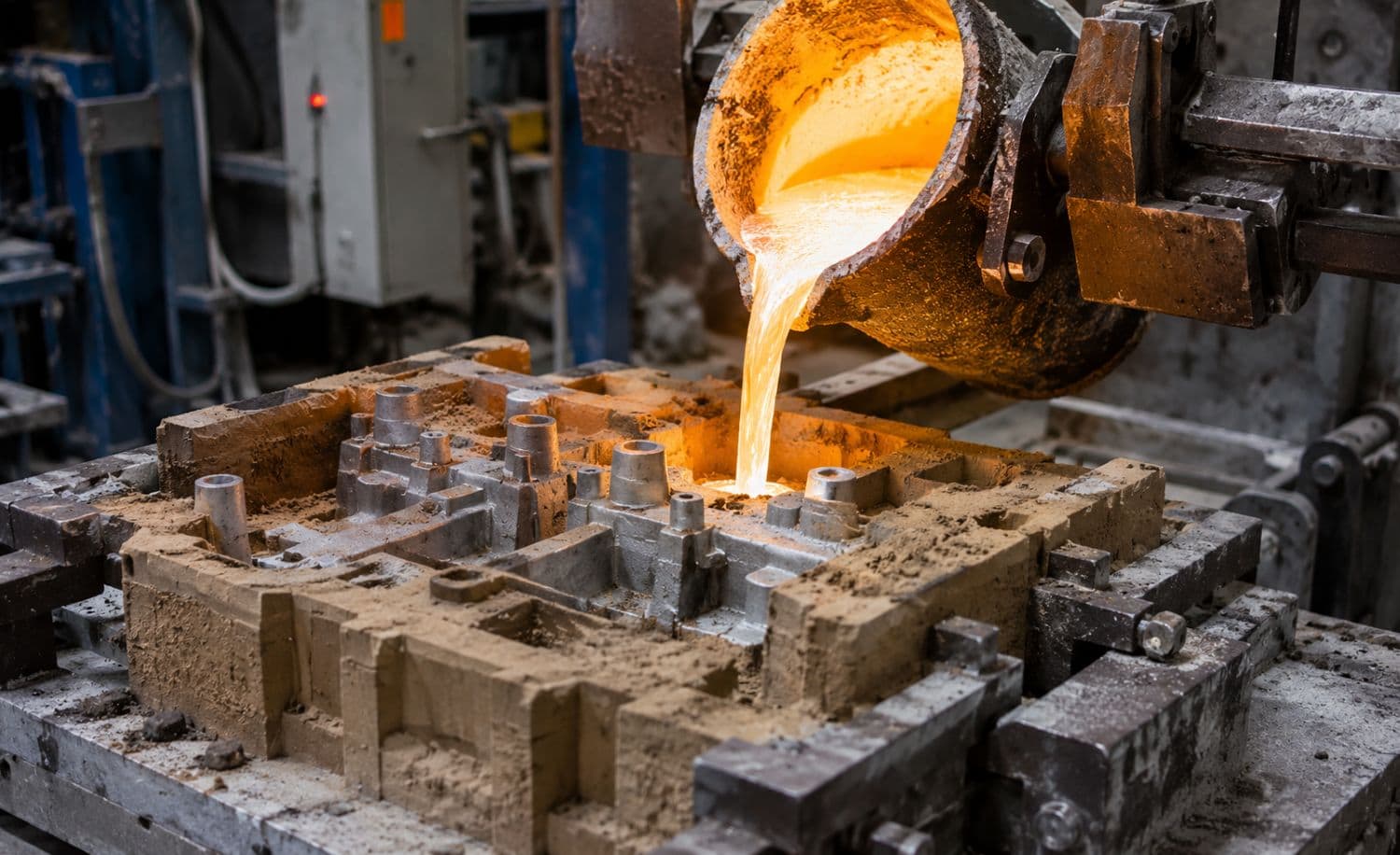
Molten magnesium reacts with oxygen, water, nitrogen, and silica. These reactions release heat and can accelerate burning.
2Mg + O2 = 2MgO + heat
Mg + H2O = MgO + H2 + heat
3Mg + N2 = Mg3N2 + heat
4Mg + SiO2 = 2MgO + Mg2Si + heat
The source states that the local reaction temperature may reach approximately 2850°C. Severe burning can leave holes, oxide wrinkles, smoke, or a scrapped casting.
How Protective Additives Work
The described additive combines sodium alkyl sulfonate and boric acid. It begins decomposing at about 270°C and releases mainly SO2, CO2, water vapor, and a small amount of H2S.
The gas layer separates magnesium from air and reactive mold material. The treatment also forms denser protective films.
| Protective film | Compactness coefficient α |
|---|---|
| MgO | 0.78 |
| Mg3N2 | >1 |
| MgS | 1.26 |
| MgO + C | 1.08 |
Two Fire-Resistant Sand Formulations
| Component/property | Formula 1 | Formula 2 |
|---|---|---|
| 70/140 silica sand | 100 | 100 |
| Bentonite | 4–5 | 4–5 |
| Magnesite powder | 7–8 | — |
| 28% sodium alkyl sulfonate solution | 2–3 | 3–4 |
| Boric acid | 1.5–2.5 | 1.5–2.5 |
| Industrial sugar | 0.6–1.0 | — |
| Permeability | >70 | >90 |
| Wet compressive strength | >0.4 kg/cm² | >0.4 kg/cm² |
| Gas evolution | 13.0 cm³/g | 10.0 cm³/g |
Reported Gas Levels
| Formulation | SO2 | H2S | HF |
|---|---|---|---|
| Formula 1 | 10.5 mg/m³ | 1.0 mg/m³ | 0 |
| Formula 2 | 9.9 mg/m³ | 0.5 mg/m³ | 0 |
| Limit stated in source | 20 mg/m³ | 10 mg/m³ | 1 mg/m³ |
These are historical measurements. Current exposure limits and ventilation requirements must be used in modern production.
Reduce Combustible Contamination
Coal dust, grass roots, and other combustible material should not enter new or reclaimed sand.
The source also recommends drying the mold surface before pouring where moisture reduction is needed.
Prevent Local Overheating
Burning often occurs in thick sections, near internal gates, and at riser roots.
Reducing hot spots, using more distributed gates, and placing chills at heavy sections can limit the metal-mold reaction.
Facing Sand, Backing Sand, and Single Sand
Facing sand contacts the metal and normally uses finer base sand. Backing sand fills the rest of the mold and can use coarser sand for better permeability.
Single sand simplifies production but must balance finish, strength, gas generation, and permeability across the entire mold.
Mixing Order and Time
- Add base sand, clay, and dry additives.
- Dry-mix for 2–3 minutes.
- Add water and liquid binder.
- Wet-mix until uniform.
| Sand type | Mixing time |
|---|---|
| Facing sand | 10–15 min |
| Backing sand | 5–6 min |
| Single sand | 8–10 min |
Hard lumps should be loosened before molding. The mixed sand also needs time for moisture to distribute and the clay to swell.
Questions Customers Should Ask
- What moisture range is used?
- How often are permeability and wet strength checked?
- Is facing sand different from backing sand?
- How is mold hardness controlled?
- Where are vents added?
- How is reclaimed sand cleaned?
- Which protective additive is used?
- How is the mold surface dried?
- How are local hot spots controlled?
- Which inspection finds gas and sand defects?
Conclusion
Magnesium alloy casting sand must balance strength, permeability, gas generation, collapsibility, and fire resistance.
Good control means fewer pores, less burn-on, cleaner surfaces, lower X-ray rejection, and fewer machining surprises.
The useful controls are simple: clean sand, the lowest workable moisture, measured strength, even compaction, clear gas paths, correct mixing, protected surfaces, and fewer hot spots.
Technical and safety note: This article is translated from historical technical pages. Molten magnesium, reactive additives, SO2, H2S, and dust create serious hazards. Historical formulas and limits are not stand-alone instructions. Modern use requires current safety data, ventilation, monitoring, regulations, and qualified supervision.