
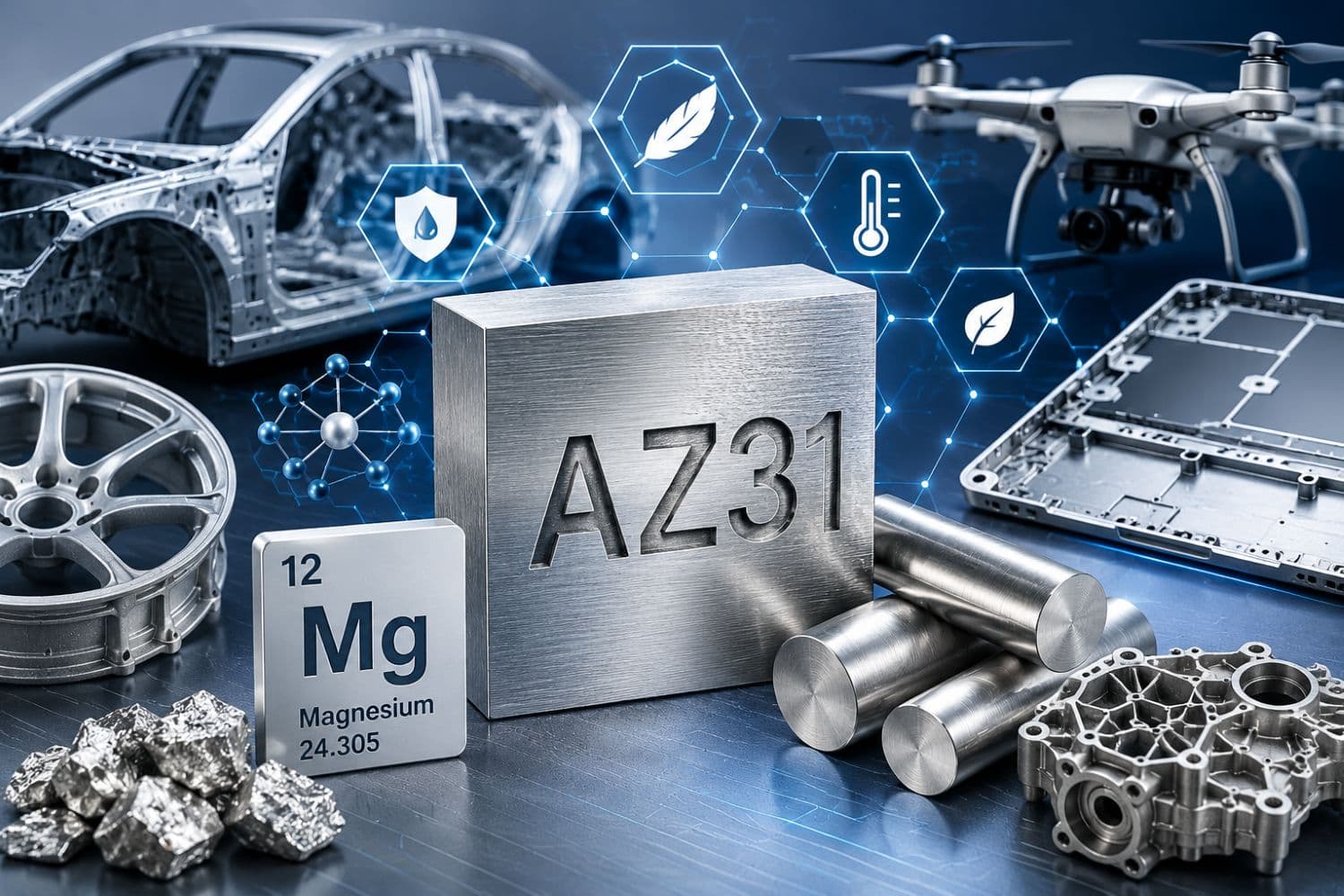
Engineers want materials that are light but also strong. AZ31 magnesium alloy is special because it has both. This alloy is made with a mix of things:
- Aluminum, about 3%
- Zinc, about 1%
The name AZ31 comes from these main parts. These features make AZ31 a great pick for many uses where being light and tough is important. Its magnesium base helps keep it light but still works well.
Key Takeaways
- AZ31 magnesium alloy is light but strong. It is good for cars and planes.
- The alloy has magnesium, aluminum, and zinc. These metals help make it strong and tough.
- AZ31 magnesium alloy is simple to cut and join. This saves time and money when making things.
- AZ31 needs to resist rust. Special coatings can help it last longer in rough places.
- This alloy works well with the body. It can be used for medical implants that dissolve and help healing.
AZ31 magnesium alloy composition
Main elements and percentages
AZ31 magnesium alloy has three main elements. These elements work together to make the alloy special. The table below shows how much of each element is in AZ31:
| Element | Percentage Range |
|---|---|
| Aluminum | ~3% |
| Zinc | ~1% |
| Magnesium | Balance |
Magnesium is the main part of the alloy. Aluminum and zinc are added in smaller amounts. Magnesium keeps the alloy light. Aluminum and zinc make it stronger and better in other ways. If the amounts of these elements change, the alloy changes too. Rolled AZ31 has fewer impurities and more magnesium oxide. This makes it easier to bend and less likely to break from repeated use. Cast AZ31 has more impurities. It can get defects like tiny holes. These defects make the alloy break easier and less hard.
Microstructure phases
The microstructure of AZ31 magnesium alloy matters for how it works. The main phase is called alpha-Mg. This phase has a hexagonal close-packed shape. It makes up most of the alloy and gives it many properties. Another phase, beta-Mg17Al12, is a secondary phase. This phase has a body-centered cubic shape. It forms when the alloy cools or gets heat treated.
Small Al-Mn compounds, like Al8Mn5, also show up in the microstructure. These particles are spread out in the alloy. Scientists use tools like Scanning Electron Microscopy (SEM), Energy Dispersive X-ray Spectroscopy (EDS), and X-ray Diffraction (XRD) to look at these phases. These tools help find the different phases by showing their shapes and what they are made of. The alpha-Mg phase has lots of magnesium. The beta-Mg17Al12 phase has more aluminum. The Al-Mn compounds are seen as separate particles.
How these phases are arranged and how much there is affects the alloy. A strong alpha-Mg matrix gives good strength and flexibility. Too much beta-Mg17Al12 can make the alloy crack easier. Al-Mn compounds help make the microstructure more stable.
Role of alloying elements
Each element in AZ31 magnesium alloy has its own job. Magnesium is the main part. It keeps the alloy light and easy to shape. Aluminum makes the alloy stronger and harder. It also helps stop wear. Zinc adds more strength and helps the alloy keep its shape when stressed.
Manganese, even in small amounts, is important. It helps stop corrosion by making a protective layer on the surface. This layer has manganese oxide and magnesium hydroxide. The layer stops bad reactions, especially in salty or wet places. Manganese also makes the alloy stronger by lowering the effects of impurities.
The right mix of these elements gives AZ31 magnesium alloy its good properties. Engineers pick this alloy when they need something light and strong. The mix of magnesium, aluminum, zinc, and manganese helps the alloy work well in many uses.
Mechanical properties
Strength and ductility
AZ31 magnesium alloy is strong and can bend well. These features help engineers use it in many ways. The alloy works well when pulled or stretched. Experts check its yield strength, ultimate tensile strength, and elongation to failure. The table below shows common values for AZ31 magnesium alloy at room temperature:
| Property | Value |
|---|---|
| Yield Strength (YS) | ~35 MPa |
| Ultimate Tensile Strength (UTS) | ~125 MPa |
| Elongation to Failure | ~25% |
Yield strength shows how much force the alloy can take before it changes shape. Ultimate tensile strength tells the highest force before it breaks. Elongation to failure means how much it can stretch before snapping. AZ31 magnesium alloy can stretch up to 25% before breaking. This makes it good at absorbing energy and stopping cracks. These features make AZ31 magnesium alloy great for parts that need to bend without breaking.
Hardness and toughness
Hardness and toughness are important for AZ31 magnesium alloy. Hardness shows how well the alloy stops scratches and dents. Toughness tells how much energy it can take before breaking. AZ31 magnesium alloy has different hardness in different spots. The table below shows some Vickers hardness values for this alloy:
| Condition | Hardness (HV) |
|---|---|
| Magnesium-enriched area | slightly over 130 |
| Areas rich in intermetallic phases | almost 350 |
| Areas enriched with zinc | 420, 383 |
| After 13 h of MA and SPS | 321 ± 30 |
| After 20 h of MA and SPS | 347 ± 29 |
| After 70 h of MA and SPS | 468 ± 27 |
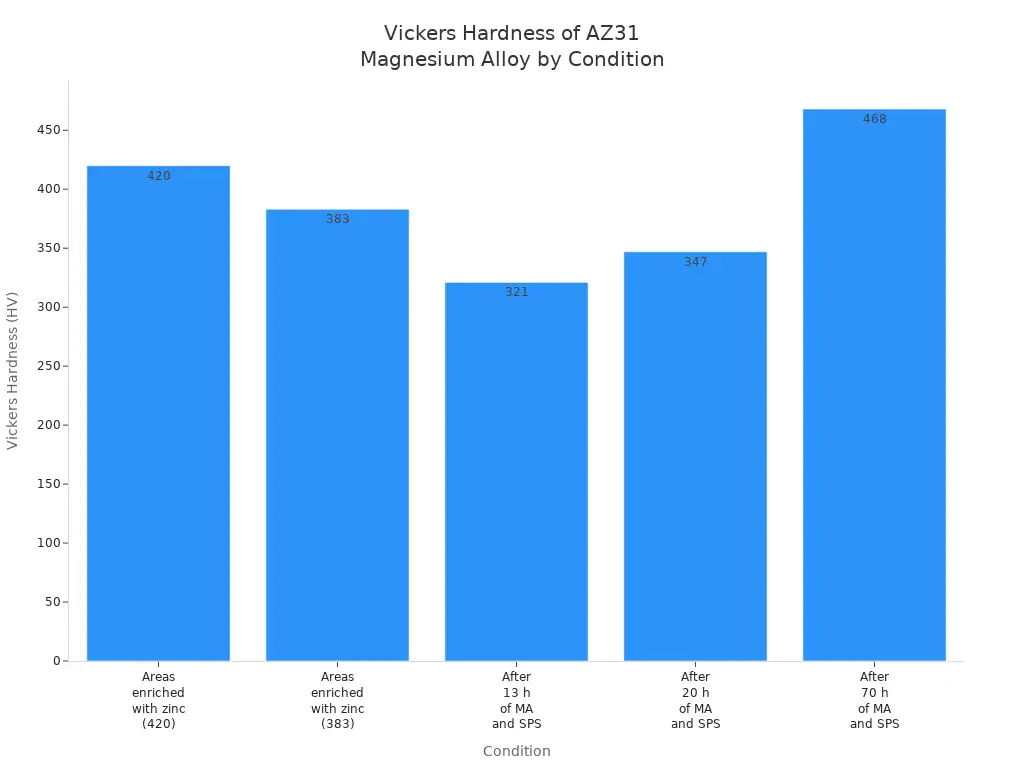
The hardness of AZ31 magnesium alloy changes with its microstructure and how it is made. Spots with more intermetallic phases or zinc are harder. This means these areas wear less. The toughness helps AZ31 magnesium alloy handle hits without breaking. This makes it good for parts that face sudden forces.
Machinability and weldability
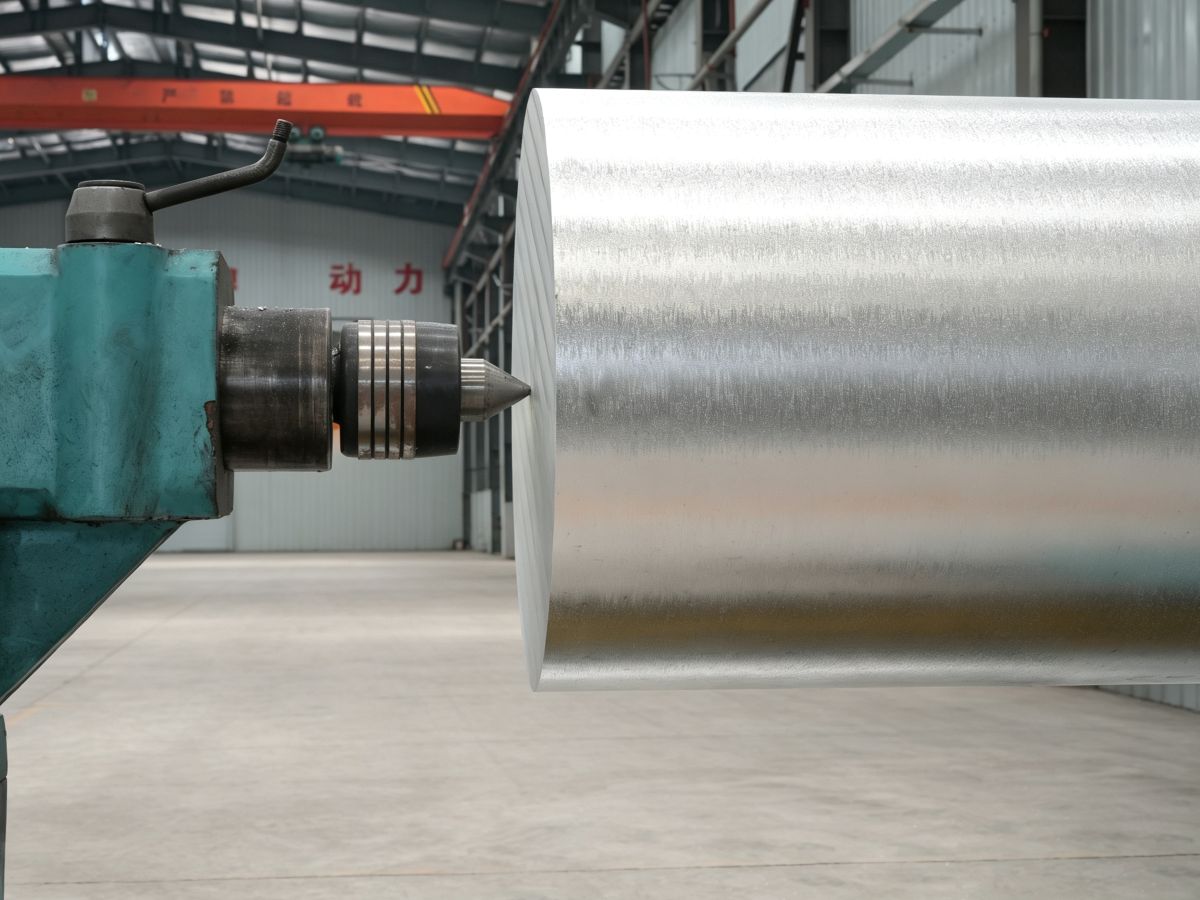
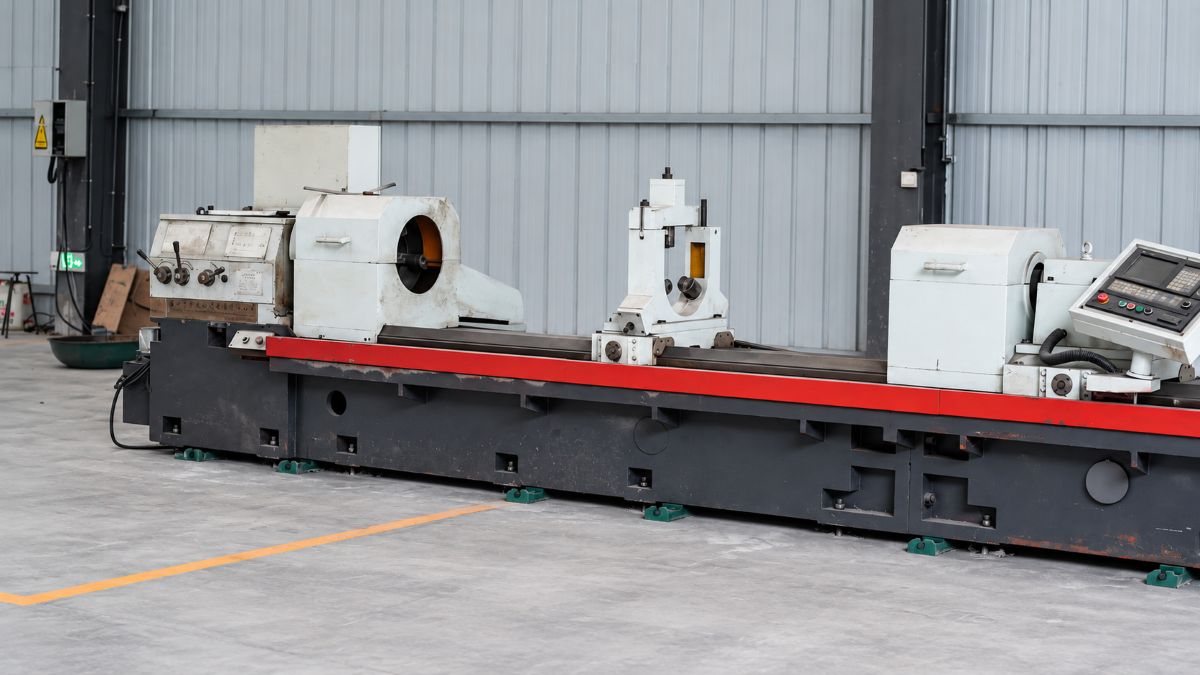
AZ31 magnesium alloy is easy to cut and shape. Machinability means it is simple to drill or work with. It is easier to machine than aluminum alloys. This saves time and tools in factories. Many industries, like cars and planes, pick AZ31 magnesium alloy because it is light and easy to use.
Weldability is also important. AZ31 magnesium alloy can be welded with gas or resistance-welding tools. It cannot be cut with an oxygen torch. The alloy should not be welded to other metals. Doing so can make weak spots or cause rust. When welding, both parts must be the same type.
Some common welding methods for AZ31 magnesium alloy are:
- Tungsten Inert Gas (TIG) Welding: This needs a skilled worker and a safe place. An inert gas keeps the alloy from burning or rusting.
- Gas Metal Arc Welding (GMAW): This also needs skill and a controlled space.
- Challenges: Welding AZ31 magnesium alloy takes skill. The area must be safe. Welding to other metals can cause weak spots or rust.
Tip: Always use the same AZ31 magnesium alloy for both parts when welding. This stops weak joints and rust.
High machinability and careful weldability make AZ31 magnesium alloy useful for many jobs. These features help engineers build strong, light, and dependable parts.
Physical properties
Density and weight
Density is important when engineers pick materials. AZ31 magnesium alloy is much lighter than most metals. The table below shows how its density compares to aluminum and steel:
| Material | Density (g/cm³) | Percentage of Aluminum Density | Percentage of Steel Density |
|---|---|---|---|
| AZ31 Magnesium | 1.74–1.81 | 64–67% | 22–23% |
| Aluminum Alloy | 2.70 | 100% | N/A |
| Structural Steel | 7.85 | N/A | 100% |
AZ31 magnesium alloy weighs about 1.74 g/cm³. This is almost two-thirds lighter than aluminum. It is nearly a quarter the weight of steel. Engineers use this low weight to make cars, planes, and electronics lighter. Lighter parts save fuel and are easier to move. Magnesium makes the alloy light. The other elements help keep it strong. These features make AZ31 magnesium alloy a top choice for many industries.
Note: Lower density does not mean weak. AZ31 magnesium alloy stays strong while being light.
Melting point and conductivity
AZ31 magnesium alloy melts at about 630 °C. This matters for factories that work with the alloy. Workers can cast or heat-treat it at this temperature. They must control the heat to stop oxidation and mix the alloy well. The right melting point keeps the properties balanced.
AZ31 magnesium alloy also lets heat and electricity move fast. These features help parts stay cool or carry electricity. Good conductivity comes from the magnesium base. It spreads heat and current better than many metals.
- Melting point: about 630 °C
- High electrical and thermal conductivity
- Useful for casting, heat treatment, and electronic parts
These physical properties help AZ31 magnesium alloy work well in many fields. Its low density, good melting point, and strong conductivity make it a smart pick for modern engineering.
Corrosion resistance
Environmental performance
Corrosion resistance is a very important property of az31 magnesium alloy. This alloy can have problems in tough places, especially where there is water or salt. In wet or salty air, different types of corrosion can happen:
- Pitting corrosion makes tiny holes on the surface.
- Intergranular corrosion spreads along the grain edges.
- General corrosion hurts the whole area that is open.
If you put the alloy in water or salty liquid, it corrodes a lot. The alloy gets lighter because the corrosion parts wash away. In salty spray, the surface can get heavier since more corrosion stays on it. The corrosion rate in salt spray is about three times faster than in water. Pitting is deeper and happens more near the edges in salt spray. These things show that az31 magnesium alloy needs extra care when used outside or near the ocean.
Tip: Check and clean the alloy often to slow down corrosion in hard places.
Surface treatments
Surface treatments help magnesium alloys fight corrosion better. Engineers use different ways to protect az31 magnesium alloy and make it last longer. Microarc oxidation (MAO) puts a strong MgF2 layer on the surface. This happens when the alloy reacts with hydrofluoric acid. Magnesium ions move out, and fluoride ions move in, making a safe MgF2 layer.
The table below shows how changing the treatment voltage changes corrosion resistance:
| Treatment Voltage (V) | Corrosion Potential (V) | Current Density (μA/cm²) |
|---|---|---|
| MAF100 | -1.XXX | 0.XXX |
| MAF150 | -1.XXX | 0.XXX |
| MAF200 | -1.262 | 0.177 |
| MAF250 | -1.XXX | 0.XXX |
| MAF300 | -1.XXX | 0.XXX |
MAF200 gives the best corrosion potential and the lowest current density. This means it protects the best.
Anodizing also helps stop corrosion. This method makes an oxide layer on the surface. The layer can have tiny holes, but adding special chemicals makes it stronger. The table below shows how untreated and anodized surfaces compare:
| Parameter | Bare AZ31 | Anodized with 0.2% organic additive | Anodized with 0.8% organic additive |
|---|---|---|---|
| Corrosion Rate | High | 200-fold decrease | 500-fold decrease |
| icorr Values | High | Much lower | Much lower |
| Polarization Resistance (Rp) | Low | Improved | Improved |
These treatments make az31 magnesium alloy much stronger in tough places.
AZ31 magnesium alloy applications
Automotive and aerospace uses
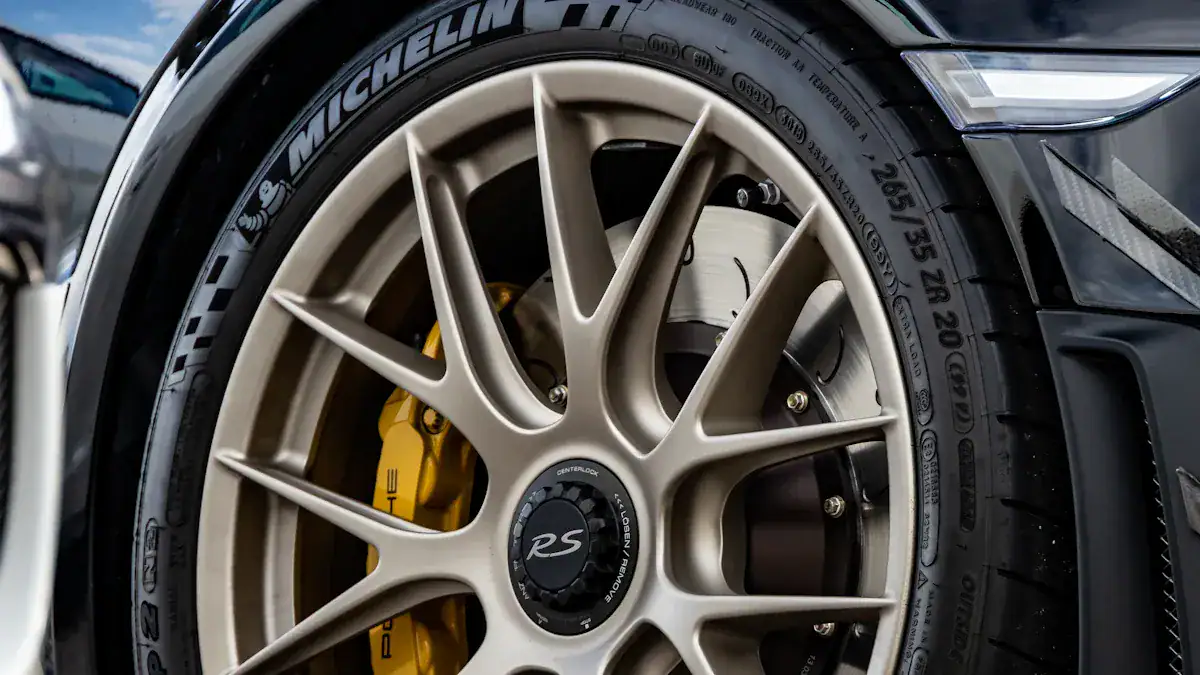
AZ31 magnesium alloy is used in cars and planes. It is much lighter than aluminum and steel. This helps vehicles use less fuel. Car makers like it because it is 33% lighter than aluminum. It is also 75% lighter than steel. Lighter cars need less energy to move. This helps companies follow fuel rules. Airplane makers use it to make parts lighter. Lighter planes can carry more stuff and fly farther.
- AZ31 magnesium alloy makes cars and planes weigh less.
- Lighter vehicles use less fuel and make less pollution.
- The alloy is strong, so parts stay safe.
Manufacturing benefits
Factories like AZ31 magnesium alloy for many reasons. It is easy to cut and shape. This saves time and money when making things. The alloy has other good features that help factories.
| Advantage | Description |
|---|---|
| Vibration Damping | Makes things quieter and more comfortable. |
| Readily Available | Easy to get as tooling plates. |
| Exceptional Strength-to-Weight Ratio | Strong but not heavy. |
| Excellent Flatness & Dimensional Stability | Keeps parts the right size and shape. |
| Electromagnetic Shielding Properties | Stops electromagnetic interference. |
| Good Formability | Simple to shape during making. |
| Non-Magnetic | Works well where magnets are a problem. |
| High Electrical & Thermal Conductivity | Moves heat and electricity easily. |
Factories pick AZ31 magnesium alloy because it is easy to use and works well.
Biocompatibility and sustainability
AZ31 magnesium alloy is used in medicine. Doctors use it for implants that go away after healing. The alloy can dissolve in the body. This means patients do not need another surgery. Its weight and stiffness are close to bone. This helps people heal better. Scientists are working to make it safer and stronger.
The alloy is good for the environment too. Factories can recycle AZ31 magnesium alloy chips. They use friction stir consolidation to do this. Recycling saves energy and lowers pollution. It also cuts waste and helps nature.
- AZ31 magnesium alloy helps make factories greener.
- Recycling makes it a smart choice for eco-friendly work.
The az31 magnesium alloy is known for its mix and steady features. The table below shows the main points:
| Key Aspect | Description |
|---|---|
| Alloying Elements | Magnesium with aluminum and zinc makes it stronger and better. |
| Microstructural Features | A fine structure helps it last longer and work well. |
| Mechanical Properties | It bends easily and is strong for many jobs. |
AZ31B is often picked first for projects that need something light and useful. Engineers use it in lots of fields because it works well.
FAQ
What makes AZ31 magnesium alloy different from other magnesium alloys?
AZ31 stands out because it mixes magnesium with aluminum and zinc. This blend gives it a strong yet light structure. Many engineers choose AZ31 for its balance of strength, weight, and easy shaping.
Can AZ31 magnesium alloy be used outdoors?
AZ31 can work outdoors, but it needs protection. Rain, salt, or moisture can cause corrosion. Surface treatments like anodizing or coatings help the alloy last longer in outdoor settings.
Is AZ31 magnesium alloy safe for medical implants?
Doctors use AZ31 for some implants. The alloy can dissolve in the body over time. This helps patients heal without a second surgery. Researchers keep testing it to make sure it stays safe and strong.
How does AZ31 magnesium alloy handle heat?
AZ31 melts at a lower temperature than many metals. It can handle normal working heat in cars or planes. Factories must control heat during shaping to keep its good properties.
What are the main uses for AZ31 magnesium alloy?
AZ31 appears in cars, planes, electronics, and medical devices. Its light weight and strength help make parts that save energy and last longer. Factories also like it because it is easy to machine and recycle.