
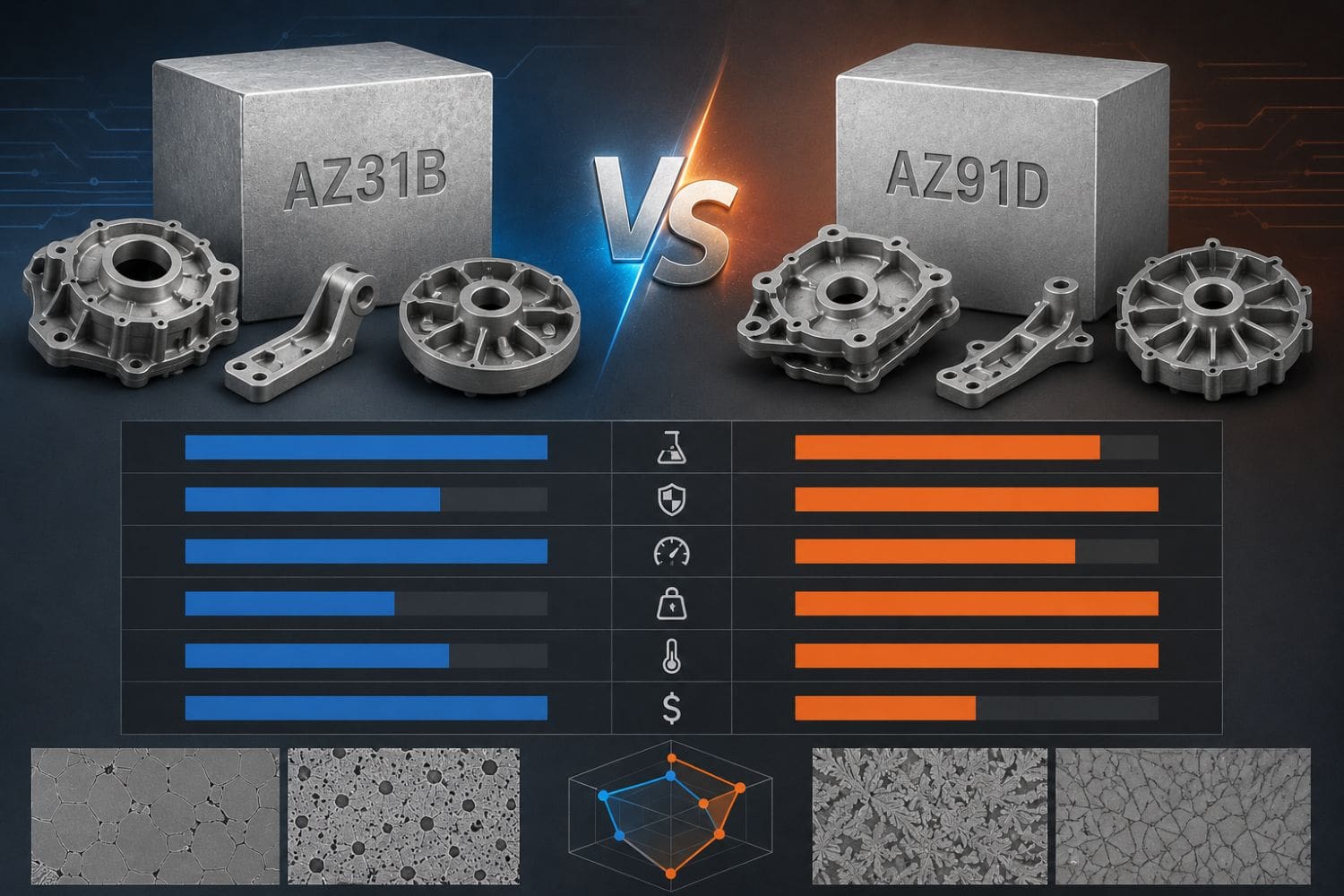
If you need good ductility and heat performance, AZ31B magnesium is a good choice. If you want hardness and corrosion resistance, AZ91D magnesium is better. AZ31B is used in aerospace and forming jobs. AZ91D is used in cars and electronics. The az31b vs az91d magnesium alloy debate is about picking what your project needs. You must balance strength, flexibility, and protection. Pick carefully to make your design work best.
Key Takeaways
- Pick AZ31B if you need something that bends easily. It is good for making bike frames and medical brackets.
- Pick AZ91D if you need something strong and that does not rust. It works well for car parts and electronics.
- Think about how you will make the parts. AZ31B works best for rolling and squeezing into shape. AZ91D is better for pouring into molds.
- Make sure the alloy fits what your project needs. This helps it work well and last longer.
- Put protective coatings on AZ31B if the place is rough. This helps it not rust as much.
AZ31B vs AZ91D Magnesium Alloy Quick Comparison
When you look at az31b vs az91d magnesium alloy, you find some big differences. These differences help you pick the best one for your project. Let’s look at the main properties and uses so you can choose well.
Key Properties Table
Here is a table that shows how these two magnesium alloys compare:
| Property | AZ31B | AZ91D |
|---|---|---|
| Composition | Lower aluminum content | Higher aluminum content |
| Strength | Good ductility and formability | High strength |
| Ductility | Excellent under dynamic loading | Reduced under high-speed impact |
| Hardness | Moderate | Higher due to aluminum content |
| Corrosion Resistance | Lower than AZ91D | Superior across various conditions |
| Processing Methods | Rolling, extrusion | Casting, die-casting |
AZ31B magnesium alloy has less aluminum. This makes it easier to bend and shape. AZ91D has more aluminum, so it is harder and fights rust better. If you need something that bends easily, AZ31B is a good choice. If you want something strong and rust-resistant, AZ91D is better.
Tip: Always pick the magnesium alloy that matches what your design needs. The right choice helps you avoid problems later.
Recommended Uses Overview
You might wonder where each alloy works best. Here is a simple table to help you:
| Alloy Grade | Typical Applications |
|---|---|
| AZ91D | Automotive gearbox housing, steering column bracket, motorcycle engine cylinder, power tool housing |
| AZ31B | Bicycle frames, 3C product middle frames, medical device brackets |
Let’s make it even simpler. Use az31b vs az91d magnesium alloy comparison when you need to pick for:
- AZ31B: Use this for projects that need bending or rolling. Think about bicycle frames or brackets for medical devices. It is easy to form and has good ductility.
- AZ91D: Use this for jobs that need strength and rust protection. This includes car parts like gearbox housings or power tool bodies. It is tough and lasts a long time.
When you look at the properties, you see that az31b vs az91d magnesium alloy is not just about being strong. It is also about how the magnesium handles stress, heat, and the environment. AZ31B gives you flexibility and good heat performance. AZ91D gives you hardness and keeps away rust.
If you use magnesium alloys, you know picking the right one makes your job easier. You will have fewer problems with shaping or rust. You also get a better final product. Always check the properties before you choose.
Alloy Composition and Microstructure
AZ31B Magnesium Composition
You may ask why az31b magnesium is special. This alloy has about 3% aluminum and 1% zinc. Most of it is magnesium. This simple mix gives az31b magnesium alloy great ductility. It is easy to shape. You can roll, bend, or extrude it with little trouble. Because it has less aluminum, it feels softer. This helps when making bike parts or medical device brackets.
There are new ways to protect az31b magnesium from rust. Many companies use coatings or paint to keep water away. Some use anodizing. This puts a hard layer on the surface. These steps help az31b magnesium last longer, even in tough places.
AZ91D Magnesium Composition
Now let’s talk about az91d magnesium. This alloy has a different mix. It has about 9% aluminum and 1% zinc. The extra aluminum makes az91d magnesium harder and stronger. It also fights rust better. That is why az91d magnesium is used in car parts and electronics.
People keep making az91d magnesium better. They use coatings, anodizing, and sometimes add rare earth metals. These changes slow down rust and make the surface smoother. You get a part that lasts longer and looks nice.
Here is a quick look at some new improvements:
| Alloy | Improvement Strategy | Effect on Corrosion Resistance |
|---|---|---|
| AZ91D | Coating with protective layers | Enhances corrosion resistance |
| AZ91D | Anodizing and plasma electrolytic oxidation | Improves surface finish and corrosion |
| AZ91D | Adding rare earth metals | Increases durability |
| AZ31B | Protective coatings | Helps in harsh conditions |
| AZ31B | Anodizing or painting | Boosts corrosion resistance |
Microstructure Effects
The microstructure of each magnesium alloy changes how it works. In az31b magnesium, you see small grains. This gives more flexibility and makes it easy to bend. In az91d magnesium, the grains are tighter and harder. You get more strength and better rust protection.
If you need to shape or roll your part, az31b magnesium alloy is a good choice. If you want a strong, long-lasting part, az91d magnesium is better. The right microstructure helps you get the results you want.
Tip: Always match the microstructure to your project. You will get better results and fewer problems.
Mechanical Properties Comparison

Strength and Ductility
When you look at magnesium alloys, you want to know how strong they are and how much they can bend before breaking. AZ31B gives a good mix of both. The strength of AZ31B welded joints is between 155 and 197 MPa. This means you get an efficiency from 57% to 72%. AZ31B works well for projects that need strength and ductility. AZ91D can be very strong and bendable, especially with special processing like hard-plate rolling. If you want a high strength-to-weight ratio, both alloys are good, but AZ91D is usually stronger. Both alloys help make things lighter, so they are used in lightweight designs.
- AZ31B: Good ductility, easy to shape, reliable strength-to-weight.
- AZ91D: High strength, strong strength-to-weight ratio, sometimes less ductile.
Hardness and Corrosion Resistance
Hardness and corrosion resistance are important if you want your magnesium part to last. AZ91D is great at fighting rust because it makes a protective oxide film. AZ31B has okay corrosion resistance and reacts more in wet or tough places. You need coatings or paint to make AZ31B resist corrosion better.
| Alloy | Corrosion Resistance Description |
|---|---|
| AZ91D | Good corrosion resistance from a protective oxide film, but harsh environments can still cause problems. |
| AZ31B | Moderate corrosion resistance, reacts easily in wet or tough places, needs extra protection. |
If you work somewhere tough, AZ91D is better for corrosion resistance. AZ31B needs more care to stop rust.
Thermal Performance
Thermal performance matters for magnesium alloys in hot jobs. Both AZ31B and AZ91D handle heat well, but AZ31B stays stable when you form or weld parts. AZ91D can lose some corrosion resistance in humid air or with certain ions. For example, in humid air, AZ91D’s protective film can break, causing more corrosion. Ions like NO3− help make a passive film, but NH4+ and Cl− can cause pitting corrosion. You see magnesium aluminum oxide and MgAl2(SO4)4·22H2O as main corrosion products, not Mg(OH)2.
If you need a magnesium alloy for a job with lots of heat and humidity, think about how corrosion resistance and thermal performance work together. AZ31B gives steady thermal properties. AZ91D is strong but needs careful protection against corrosion in tough places.
Note: Always match the mechanical properties and corrosion resistance to your project’s needs. This helps you get the best performance and durability.
Processing Methods
Casting vs Wrought
When you look at magnesium alloys, you notice that AZ31B and AZ91D take different paths in manufacturing. You usually see AZ31B as a wrought alloy. This means you get it through rolling or extrusion. You can shape it into sheets, plates, or bars. AZ91D, on the other hand, shines in casting. You often find it in high-pressure die casting, which lets you make complex shapes quickly. This method works well for car parts and electronics. If you want a magnesium part with tight tolerances and smooth surfaces, casting AZ91D is a smart move. Wrought AZ31B gives you more control over thickness and grain, which helps when you need strength and flexibility.
Tip: Choose casting for AZ91D when you want detailed shapes. Pick wrought AZ31B if you need to bend or form the magnesium.
Machinability and Formability
You might wonder how easy it is to work with these magnesium alloys. AZ31B stands out for its formability, especially when you heat it up. You can press, bend, or draw it into tricky shapes. This makes it perfect for parts that need curves or fine details. In fact, AZ31B reaches its best formability at about 200°C. You get higher draw ratios and less cracking. AZ91D is different. It has high strength but lower ductility. This means it does not bend as easily. You may see cracks if you try to form it too much. Its low thermal conductivity also makes it harder to manage heat during processing.
When you machine magnesium, you want good accuracy. Studies show that AZ31B gives you up to 22% better dimensional accuracy than AZ91D. If you use uncoated tools, you can get even better results—up to 27% more accurate. This matters when you need tight fits or smooth finishes.
- AZ31B: Great for forming, bending, and precision machining.
- AZ91D: Best for casting, but not ideal for deep drawing or bending.
Cost and Availability
You care about cost and how easy it is to get these magnesium alloys. AZ31B is widely available in sheets and bars. You can find it from many suppliers. The processing steps for wrought magnesium can add to the price, but you get better formability and accuracy. AZ91D is popular for casting, especially in industries that need lots of parts fast. High-pressure die casting with AZ91D keeps costs down for big orders. You get strong, corrosion-resistant magnesium parts at scale.
If you want to save money and need many parts, AZ91D casting is a good choice. If you need custom shapes or small batches, AZ31B gives you more options.
Note: Always match your magnesium alloy and processing method to your project’s needs. You will get better results and avoid costly mistakes.
Applications of AZ31B and AZ91D Magnesium

Automotive Industry
AZ31B and AZ91D magnesium alloys are used in cars. They help make cars lighter. Lighter cars use less gas and go faster. You can use these alloys for steering wheels, seats, and dashboards. Here’s a table showing where they are used and what they do:
| Application | Performance Benefits |
|---|---|
| Steering wheel frames | Less weight, better fuel use |
| Seat frames | Less weight, better fuel use |
| Instrument panels | Less weight, better fuel use |
| General-purpose | Strong, bendable, fights rust |
These alloys make cars strong and safe. AZ91D is good at stopping rust. AZ31B is easy to shape into parts.
Aerospace and Transportation
In planes and trains, you need light and strong materials. AZ31B and AZ91D magnesium work well for these jobs. You see them in airplane frames, drone bodies, and laptop cases for pilots. Here’s a table to show the differences:
| Alloy Grade | Primary Strengths | Typical Applications |
|---|---|---|
| AZ31B | Strong, easy to shape, easy to weld | Airplane frames, laptop cases |
| AZ91D | Easy to cast, fights rust | Drone bodies, camera cases |
When picking materials for planes, you check how the part works. You look at how it is made, how hot it gets, and how well it fights rust. You also care about safety and cost. These alloys help meet tough rules and keep designs light.
Electronics and Consumer Goods
AZ31B and AZ91D magnesium are used in electronics. They make laptops, phones, and cameras light and strong. These alloys help products last longer. You want devices that feel solid but are not heavy. These alloys give you that balance.
Other Uses
You can use these alloys in many places. They work for medical brackets, bike frames, and power tool bodies. If you need light parts or light buildings, these alloys are a smart choice. You get strength, easy making, and parts that last.
Tip: Always pick the right alloy for your job. You will get better results and fewer problems.
Advantages and Disadvantages
AZ31B Magnesium Pros and Cons
When you look at AZ31B magnesium, you see a mix of good and not-so-good features. This alloy stands out for its low weight and how easy it is to shape. You can bend, weld, or machine it without much trouble. That makes it a favorite for parts that need lots of forming or custom shapes.
Here’s a quick look at the main pros and cons:
| Advantages | Disadvantages |
|---|---|
| Low density (about 1.74 g/cm³) | Not the strongest option |
| Great formability and machinability | Weak resistance to heat and rust |
| Easy to weld and work with | Needs extra protection in tough spots |
| Can improve with other metals |
You get a lightweight material that’s simple to work with. If you want to make bike frames or brackets, AZ31B helps you get the job done fast. But you need to watch out for rust and heat. This alloy does not hold up well in wet or hot places unless you add coatings or mix in other metals.
Tip: If you need a part that bends or shapes easily, AZ31B is a smart pick. Just remember to protect it from moisture and heat.
AZ91D Magnesium Pros and Cons
AZ91D magnesium brings a different set of strengths. You get a material that’s light but also tough. It works well for casting, so you can make complex shapes for car parts or electronics. This alloy also resists rust better than AZ31B, especially when you treat the surface.
Check out the main pros and cons:
| Advantages | Disadvantages |
|---|---|
| Lightweight—great for weight-sensitive jobs | Can catch fire if not handled with care |
| High strength-to-weight ratio | May corrode in harsh environments |
| Good corrosion resistance (with treatment) | Loses strength at high temperatures |
| Excellent for heat dissipation | |
| Easy to recycle and reduces vibration |
You get strong, rust-resistant parts that last longer. AZ91D is perfect for car housings, power tools, and gadgets that need to stay cool. But you need to handle it safely, since it can burn. It also needs extra care in very hot or wet places.
Note: AZ91D gives you strength and protection, but always check if your project needs extra safety steps or coatings.
How to Choose for 2026
Choosing between AZ31B and AZ91D magnesium alloys can feel tricky. You want the best material for your project, but each alloy brings something different to the table. Let’s break down the key decision points, look at real-world examples, and point you to a helpful magnesium alloy guide.
Decision Factors
You need to match the alloy to your job. Start by asking yourself a few simple questions:
- Do you need to bend, roll, or weld the material?
- Will your part face a lot of moisture or salt?
- Is your design complex, with lots of shapes and details?
- Do you want to make many parts quickly and keep costs low?
- Does your part need to stay strong at room temperature?
Let’s make it even clearer. Here’s a quick checklist to help you decide:
| Factor | Choose AZ31B If… | Choose AZ91D If… |
|---|---|---|
| Forming/Welding | You need to bend, roll, or weld | Not a priority |
| Die-Casting | Not needed | You want fast, complex die-casting |
| Corrosion Resistance | You can add coatings or use indoors | You need built-in rust protection |
| Ductility at Room Temp | You want high ductility | You need more strength |
| Saltwater/NaCl Environments | Yes, AZ31B works better | Not ideal |
| Continuous Production | You need ongoing forming | You want low-cost, high-volume casting |
You can also think about what the latest magnesium alloy selection guides say:
- For forming or welding, pick AZ31B.
- For die-casting, AZ91D is the top choice.
Engineers and designers often ask about the differences in composition and use. AZ91D has more aluminum, which makes it great for die-casting. AZ31B is lighter and bends better at room temperature. If you need to shape the material a lot, AZ31B is your friend. If you want to make lots of parts with complex shapes, AZ91D is the way to go.
Tip: Always match the alloy’s strengths to your project’s needs. You’ll save time and avoid headaches later.
Case Studies
Let’s look at how real projects use these alloys. This will help you see what works best in different situations.
Case 1: Lightweight Bicycle Frames
You want a bike that’s light and easy to ride. The frame needs to bend a little but stay strong. You also want to weld the joints for a smooth finish. In this case, AZ31B is the best pick. You can shape it easily, and it holds up well during welding. Many bike makers choose AZ31B for these reasons.
Case 2: Automotive Gearbox Housings
You need a strong, rust-resistant part for a car. The shape is complex, and you want to make thousands of them quickly. AZ91D shines here. You can die-cast the part, which means you get the same shape every time. The extra aluminum helps fight rust, so the part lasts longer.
Case 3: Electronics Casings in Humid Environments
You design a camera that will be used outdoors. The casing must be light, strong, and resist corrosion from humidity. AZ91D works well for casting the complex shape. You can add a protective coating to boost its rust resistance. This keeps the camera safe and looking good.
Case 4: Medical Device Brackets
You need brackets that are light, easy to form, and safe for indoor use. You also want to make small batches. AZ31B is a smart choice. You can roll or bend it into shape, and it’s easy to machine for custom sizes.
Case 5: Marine Applications
You build parts for boats or docks that face saltwater every day. Wrought AZ31B performs better in NaCl environments. You can add a coating for extra protection. This keeps the parts strong and rust-free.
Note: Every project is different. Think about the environment, how you’ll make the part, and what you need the alloy to do.
Reference to Magnesium Alloy Guide
Still not sure which alloy fits your project? You’re not alone. Many engineers and designers have the same questions. You can find more details, charts, and expert tips in the complete magnesium alloy guide. This guide covers everything from basic properties to advanced selection strategies.
If you want to dig deeper, check out the guide for:
- More side-by-side comparisons
- Tips for processing and finishing
- Advice on coatings and treatments
- Answers to common questions
Explore more: The magnesium alloy guide helps you make smart choices for any project, big or small.
You have the tools and knowledge to pick the right magnesium alloy for 2026. Match your needs to the alloy’s strengths, learn from real-world examples, and use the guide for extra support. Your next project will be lighter, stronger, and built to last.
You now know the key differences between AZ31B and AZ91D magnesium alloys. AZ31B works best when you need easy forming and shaping. AZ91D shines in high-volume casting and offers better corrosion resistance. Before you choose, think about your project’s needs. Here are some smart next steps:
- Pick AZ91D for die-cast parts and CNC prototypes that match final production.
- Use AZ31B for structural parts that need machining or extrusion.
- For tight tolerances, focus on thermal control and tool setup.
Need more help? Check the magnesium alloy guide or talk to a materials expert for advice.