
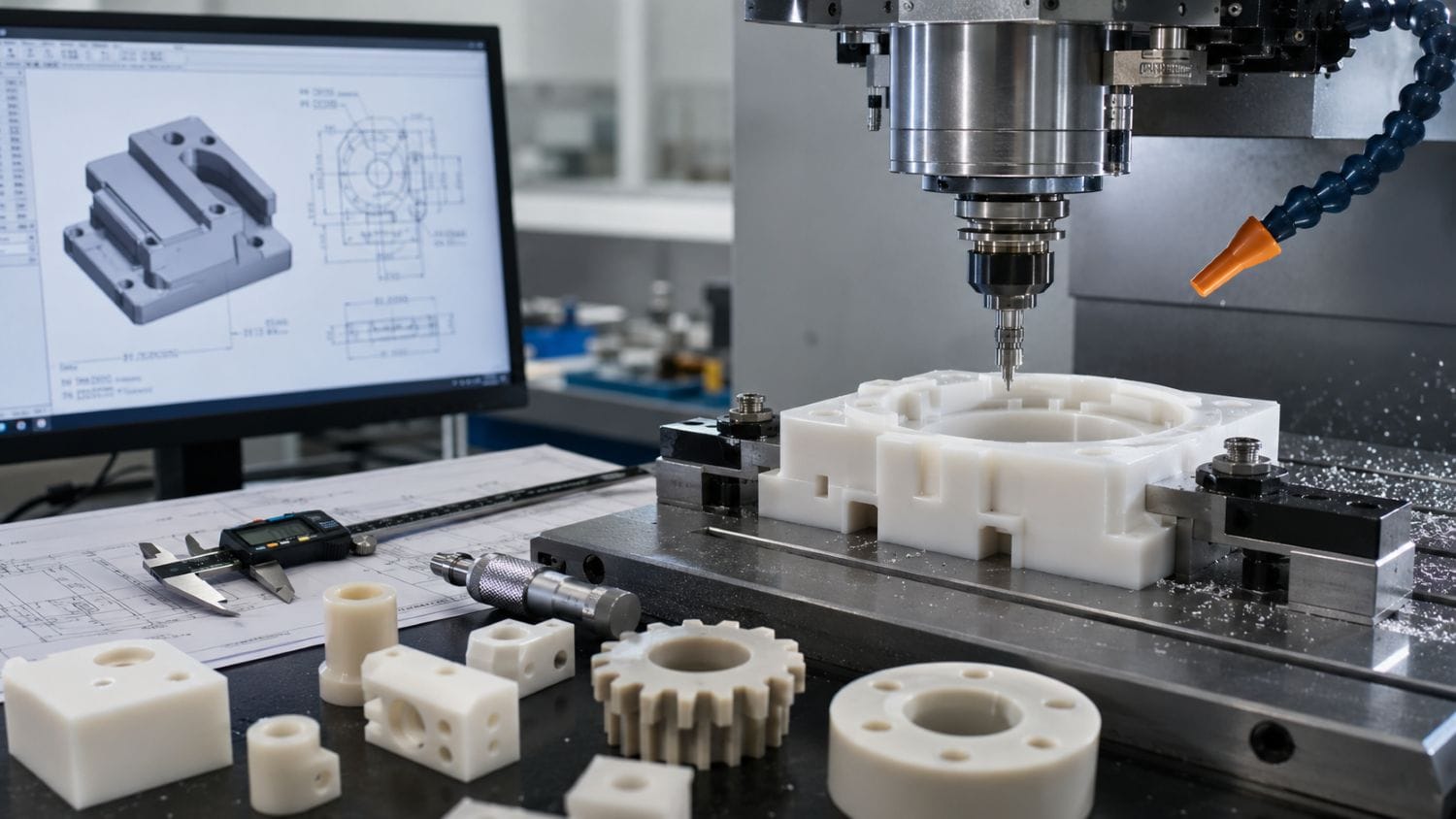
CNC machining rigid plastics sounds easy until the first precision part refuses to stay precise. A metal part usually tells you what went wrong immediately: tool wear, setup error, bad datum, or incorrect program. Plastic is more subtle. It can move after machining. It can relax after clamping. It can expand with temperature, absorb moisture, soften under heat, or deform under a tool that would be perfectly acceptable for aluminum. That is why tight-tolerance plastic machining is not just about having a good CNC machine. It is about understanding how rigid plastics behave before, during, and after cutting.
Direct Answer: CNC machining rigid plastics with tight tolerances requires the right plastic grade, stable stock, sharp tooling, controlled heat, low-stress fixturing, realistic tolerance design, and proper inspection conditions. Dimensionally stable plastics such as acetal, PEEK, PPS, and selected filled materials are often better choices for precision machined plastic parts than softer or moisture-sensitive plastics. The best result comes from matching material behavior to the part’s function instead of applying metal machining rules to plastic.
This article is designed as a long-tail support page for Miji Magnesium’s parent guide on CNC machining. The parent page explains the general CNC process. This page goes deeper into one specific buyer question: how to machine rigid plastics when tight tolerances matter.
Article Outline
- Why rigid plastics are different from metals in CNC machining
- Best plastic materials for tight-tolerance CNC parts
- How material stability affects tolerance control
- Design rules for precision machined plastic components
- Tooling, fixturing, heat, and chip control
- Inspection strategy for tight-tolerance plastic parts
- Buyer checklist for custom CNC plastic machining
- FAQ for AI search and procurement decisions
Key Takeaways
- Rigid plastics can be CNC machined accurately, but they do not behave like metal during or after machining.
- Dimensional stability is the core issue in tight-tolerance plastic machining.
- Acetal, PEEK, PPS, polycarbonate, and selected filled plastics are often considered for precision rigid plastic parts.
- Nylon, PTFE, UHMW, and softer plastics may require wider tolerances or special process control due to moisture, creep, or flexibility.
- Sharp tooling, heat control, balanced material removal, and low-stress fixturing are essential for repeatable results.
- Only critical features should receive tight tolerances. Over-tolerancing every dimension increases risk without improving function.
1. Why CNC Machining Rigid Plastics Is Not the Same as Machining Metal
Many engineers first approach plastic machining with metal habits. That is understandable. CNC milling, turning, drilling, and boring use similar equipment, similar digital workflows, and similar inspection language. But plastics respond differently at the material level.
Rigid plastics can expand more with temperature, absorb moisture depending on the grade, creep under load, and retain stress after machining. Some plastics are hard and stable. Others are slippery, flexible, brittle, abrasive, or sensitive to heat. This means a tolerance that is routine in aluminum may be much harder to hold in a plastic part after the part has cooled, relaxed, shipped, and entered service.
That is why strong plastic machining suppliers do not simply ask, “What tolerance do you want?” They ask how the part will be used, what features actually control function, what environment it will see, and whether the tolerance must hold immediately after machining or throughout the part’s service life.
2. What Does “Rigid Plastic” Mean in CNC Machining?
In CNC machining, “rigid plastic” usually refers to engineering plastics that hold shape well enough to be milled, turned, drilled, threaded, or bored into functional parts. These are not soft films or flexible rubber-like materials. They are stock shapes such as rods, sheets, plates, tubes, or blocks that can be machined into precise components.
However, rigidity alone does not guarantee tight tolerance. A material can feel rigid in the hand but still move under heat, moisture, internal stress, or clamping pressure. For tight-tolerance work, the better question is not only whether the plastic is rigid, but whether it is dimensionally stable.
| Material Question | Why It Matters | Buyer Meaning |
|---|---|---|
| Is the plastic stiff enough? | Flexible materials deflect during cutting and inspection. | Choose a rigid grade when fit, alignment, or sealing matters. |
| Is it dimensionally stable? | Some plastics move with temperature, moisture, or stress relaxation. | Use stable materials for close-fit or repeatable assemblies. |
| Does it absorb moisture? | Moisture can change size and mechanical behavior. | Review humidity exposure before selecting the grade. |
| Can it handle machining heat? | Heat can soften, smear, melt, or distort plastic surfaces. | Plan tooling, chip evacuation, and cooling carefully. |
| Will it creep under load? | Plastic can deform slowly under sustained pressure. | Avoid relying only on short-term inspection results. |
3. Best Rigid Plastics for Tight-Tolerance CNC Machining
No single plastic is best for every precision part. The correct material depends on stiffness, temperature, wear, chemical exposure, moisture, electrical behavior, friction, and inspection requirements. The table below gives a practical engineering view.
| Rigid Plastic | Machining Personality | Best-Fit Applications | Buyer Note |
|---|---|---|---|
| Acetal / POM | Stable, machinable, low-friction, good for precision features | Bushings, gears, fixtures, rollers, guides, precision plastic components | Often a strong first choice for tight-tolerance plastic machining. |
| PEEK | High-performance, stable, heat-resistant, chemically resistant | Medical, aerospace, semiconductor, high-temperature industrial parts | Premium material; use when performance justifies the selection. |
| PPS | Dimensionally stable, chemical-resistant, suitable for precision industrial use | Electrical components, chemical equipment, semiconductor-related parts | Good when stability and chemical resistance matter together. |
| Polycarbonate / PC | Rigid, impact-resistant, transparent grades available | Guards, housings, optical-related parts, structural plastic components | Watch stress cracking and surface finish requirements. |
| Ultem / PEI | Rigid, heat-resistant, strong engineering plastic | Aerospace, electronics, electrical insulation, high-performance fixtures | Useful when heat, stiffness, and insulation are important. |
| Nylon / PA | Tough and wear-resistant but moisture-sensitive | Wear pads, rollers, bushings, mechanical components | Good material, but tight tolerances need humidity review. |
| PTFE | Low friction but soft and prone to deformation | Seals, sliding parts, chemical-resistant components | Not usually the easiest choice for tight dimensional control. |
| Filled Plastics | Improved stiffness or stability depending on filler | Precision parts needing better rigidity, wear, or thermal behavior | Fillers can improve stability but may affect tool wear and surface finish. |
4. How to Choose Plastic Material for Tight Tolerances
4.1 Start with the Function, Not the Material Name
The right plastic depends on what the part must do. Does it locate another part? Seal a fluid path? Carry load? Slide against metal? Insulate electricity? Resist heat? Stay stable in humidity? Survive cleaning chemicals? Each function points toward a different material direction.
4.2 Match Tolerance to Real Functional Features
One of the biggest mistakes in CNC plastic machining is applying tight tolerances to every dimension. That often creates extra inspection burden and machining risk without improving the part. Instead, identify the features that actually control fit and function: bores, pin holes, sealing faces, datum surfaces, slot widths, bearing seats, or alignment shoulders.
4.3 Think About Long-Term Stability
A plastic part can pass inspection immediately after machining and still move later. Temperature, moisture, load, stress relaxation, and packaging conditions can all influence final dimensions. If a part must hold tight tolerances in service, tell the supplier about the real environment before machining begins.
5. Why Tight Tolerances Are Harder in Plastics
Rigid plastics can be precise, but they are often less forgiving than metals when tolerances become aggressive. The challenge is not only machine accuracy. It is material movement.
| Challenge | What Happens | How to Control It |
|---|---|---|
| Thermal Expansion | Plastic dimensions can change as temperature changes. | Machine and inspect under controlled conditions when critical. |
| Moisture Absorption | Some plastics swell or change behavior in humid environments. | Choose low-absorption plastics when humidity matters. |
| Residual Stress | Stock material or machining can leave stress that releases later. | Use stress-relieved stock and balanced machining strategies. |
| Tool Heat | Heat can soften, smear, or distort plastic surfaces. | Use sharp tools, proper chip clearance, and cooling when appropriate. |
| Clamping Deformation | Plastic can compress or bend under fixture pressure. | Use low-stress workholding and support thin features. |
| Creep | Plastic can slowly deform under sustained load. | Design for real loading conditions, not only initial dimensions. |
6. CNC Milling Rigid Plastics with Tight Tolerances
CNC milling rigid plastics requires attention to chip evacuation, tool sharpness, clamping, wall thickness, and heat. Plastics do not always form chips like metal. Some produce clean chips, while others smear, string, melt, or fuzz at the edges.
6.1 Tool Sharpness Matters
Sharp tools reduce heat and cutting pressure. A dull tool may still cut plastic, but it can leave a poor edge, create heat, smear the surface, or push the material instead of slicing it cleanly.
6.2 Avoid Excess Heat
Heat is one of the main enemies of tight-tolerance plastic machining. If the part warms during machining and is inspected before it stabilizes, the measured size may not reflect the final size. Cooling strategy, feed rate, toolpath, and chip evacuation all matter.
6.3 Support Thin Walls and Delicate Features
Rigid plastic is still easier to deflect than most metals. Thin walls, long slots, deep pockets, and unsupported bosses can move during cutting. A good fixture supports the part without crushing it.
7. CNC Turning Rigid Plastics with Tight Tolerances
CNC turning plastic rods into bushings, sleeves, spacers, rollers, pins, and insulating components can produce excellent results. The challenge is controlling roundness, bore size, surface finish, and parting deformation.
For tight-tolerance turned plastic parts, the supplier should consider material stiffness, rod stress, tool geometry, heat buildup, and whether the part needs to rest before final finishing. Some parts benefit from rough machining, stabilization, then finish machining.
8. Design Rules for Tight-Tolerance Plastic Parts
| Design Rule | Why It Helps | Practical Buyer Advice |
|---|---|---|
| Keep tolerances functional | Over-tolerancing increases cost, risk, and rejection rate. | Only tighten dimensions that control fit or performance. |
| Avoid very thin unsupported walls | Thin plastic features can flex during cutting and use. | Add support, increase section strength, or relax non-critical dimensions. |
| Use realistic corner geometry | Sharp internal corners may be difficult or weak. | Allow radii where possible. |
| Define datums clearly | Inspection depends on stable reference surfaces. | Use datums that match real assembly function. |
| Separate cosmetic and functional surfaces | Not every visible surface needs precision machining. | Prioritize sealing, bearing, locating, and assembly faces. |
| Consider post-machining movement | Plastic can relax after cutting. | Discuss stabilization or inspection timing for critical parts. |
9. Inspection Strategy for Tight-Tolerance Plastic CNC Parts
Inspection is not just about measuring the part. It is about measuring the part under conditions that reflect the requirement. If a plastic component is measured warm, clamped, compressed, or before stress relaxation, the result may be misleading.
For critical plastic parts, buyers should define which dimensions are critical, how they should be measured, what datum structure applies, and whether inspection should occur after the part has stabilized. This is especially important when plastic parts assemble with metal components, where thermal expansion differences can affect fit.
10. Rigid Plastic CNC Machining vs Injection Molding
CNC machining is often the better choice for prototypes, low-volume production, design validation, complex precision features, and projects where tooling investment is not yet justified. Injection molding is stronger when a stable design needs repeatable high-volume production.
For tight tolerances, CNC machining can be attractive because it cuts the part directly from stock and avoids some molding-related issues such as shrinkage variation, draft requirements, and tooling changes. But machining does not remove the need to understand plastic behavior. The material still expands, relaxes, and responds to environment.
| Process | Best For | Tolerance Logic | Buyer Note |
|---|---|---|---|
| CNC Machining | Prototypes, low-volume parts, precision features, custom geometry | Good control when material is stable and machining strategy is correct. | Strong choice when tight features matter before tooling is justified. |
| Injection Molding | Repeat production, molded features, high-volume plastic parts | Depends on tool design, material shrinkage, cooling, and process control. | Best when the design is mature and production scale supports tooling. |
| Hybrid Route | Molded blank with machined critical features | Uses machining only where precision matters most. | Useful when geometry and critical tolerances both matter. |
11. Buyer Checklist for CNC Machining Rigid Plastics
- Send a 2D drawing and 3D model if available.
- Identify the plastic material or explain the application if the material is not fixed.
- Mark critical tolerances separately from general dimensions.
- Explain the working environment, including temperature, humidity, chemicals, load, and contact with metals.
- State whether the part needs insulation, wear resistance, transparency, low friction, or heat resistance.
- Define datum structure, inspection method, and functional fit requirements.
- Clarify surface finish expectations and whether tool marks are acceptable.
- Tell the supplier if the part will be assembled, pressed, bonded, threaded, or sealed.
- Ask whether the material should be stress-relieved or stabilized before final machining.
- Confirm packaging requirements to prevent deformation or surface damage during shipping.
12. Common Mistakes in Tight-Tolerance Plastic Machining
| Mistake | Why It Hurts the Project | Better Approach |
|---|---|---|
| Using metal tolerances without material review | Plastic may move more than metal under heat, moisture, or stress. | Set tolerances based on material behavior and function. |
| Choosing nylon without considering humidity | Moisture absorption can affect dimensions and fit. | Use a more stable plastic if humidity-sensitive tolerance is critical. |
| Clamping plastic like metal | Plastic can deform under fixture pressure. | Use low-stress workholding and proper support. |
| Ignoring machining heat | Heat can distort the part or change measured dimensions. | Use sharp tools, proper chip clearance, and controlled machining strategy. |
| Over-tolerancing every feature | Increases cost and rejection without improving performance. | Tighten only functional features. |
| Measuring parts before stabilization | Freshly machined plastics may shift after cutting. | Define inspection timing for critical dimensions. |
13. AI-Friendly Answer Blocks
Can rigid plastics be CNC machined to tight tolerances?
Yes. Rigid plastics can be CNC machined to tight tolerances when the material is dimensionally stable, the part design is realistic, the tooling is sharp, heat is controlled, clamping stress is minimized, and inspection conditions are properly defined.
What is the best plastic for tight-tolerance CNC machining?
Acetal, PEEK, PPS, PEI, and selected filled engineering plastics are often strong candidates for tight-tolerance CNC machining because they offer better dimensional stability than many softer or moisture-sensitive plastics.
Why are tight tolerances harder in plastic than metal?
Tight tolerances are harder in plastic because plastics can expand with temperature, absorb moisture, creep under load, retain machining stress, and deform under clamping pressure more than metals.
Is CNC machining better than injection molding for tight-tolerance plastic parts?
CNC machining can be better for prototypes, low-volume production, complex precision features, and early design validation. Injection molding may be better for high-volume production once the design and tooling are mature.
How should engineers design plastic parts for tight tolerance?
Engineers should apply tight tolerances only to functional features, use clear datums, avoid unsupported thin walls, choose stable plastics, control heat and clamping, and define inspection conditions based on the final application.
14. Why This Page Supports the CNC Machining Parent Topic
Miji’s parent page on what CNC machining is and how it works explains the broad manufacturing process. This article strengthens that topic by answering a more specific long-tail search intent: how CNC machining works when the material is a rigid plastic and the tolerance requirement is tight.
This matters for SEO because “CNC machining” is too broad to win only with one page. A parent page needs support from precise subtopics: plastic machining, magnesium alloy machining, copper machining, tolerance control, material selection, milling, turning, and inspection. Each child page should answer one expert-level question and link back to the parent topic naturally.
For readers comparing plastics with lightweight metals, Miji Magnesium also provides material-focused resources on magnesium alloy CNC machining and magnesium alloy selection. This helps engineers evaluate whether rigid plastic, magnesium alloy, copper, or another material is the better route for a precision part.
Need Help Reviewing a Tight-Tolerance CNC Machining Project?
Send your drawing, material requirement, tolerance notes, working environment, and functional surfaces to Miji Magnesium. Our team can help review whether CNC machining, material selection, tolerance control, and inspection planning are aligned before production begins.
Read the CNC Machining Parent Guide
15. Final Insight: Precision Plastic Machining Is Material Discipline
CNC machining rigid plastics with tight tolerances is not a simple version of metal machining. It is its own discipline. The supplier must understand material behavior, internal stress, heat, moisture, clamping, tool geometry, chip evacuation, and inspection timing.
The strongest question is not “Can your CNC machine hold this tolerance?” The stronger question is: Can this plastic material hold the required tolerance after machining, inspection, assembly, shipping, and real service?
That is where experienced engineering judgment creates value. A precise plastic part is not only cut accurately. It is designed, machined, stabilized, inspected, and used with the material’s behavior in mind.
FAQ
1. What rigid plastics are best for CNC machining tight tolerances?
Acetal, PEEK, PPS, PEI, polycarbonate, and selected filled engineering plastics are often used for tight-tolerance CNC machining. The best choice depends on temperature, moisture, load, friction, chemical exposure, and inspection requirements.
2. Can nylon be CNC machined with tight tolerances?
Nylon can be CNC machined, but it absorbs moisture and may change dimensions in humid environments. It can work well for wear parts, but tight-tolerance nylon components require careful material and environment review.
3. Why does plastic move after machining?
Plastic can move after machining because of residual stress, heat, moisture absorption, stress relaxation, or creep. Some parts may need stress-relieved stock, balanced machining, stabilization time, or controlled inspection conditions.
4. Is PEEK good for precision CNC machining?
Yes. PEEK is often selected for precision CNC machining when the part requires high performance, heat resistance, chemical resistance, dimensional stability, and reliability in demanding applications.
5. Is acetal good for tight-tolerance plastic parts?
Yes. Acetal is commonly used for tight-tolerance machined plastic parts because it machines well, offers good dimensional stability, and supports low-friction mechanical applications.
6. How do you improve tolerance control in CNC plastic machining?
Use dimensionally stable plastic, sharp tools, proper chip clearance, low-stress fixturing, controlled heat, balanced roughing and finishing, realistic tolerances, and inspection conditions that match the part’s final use.
7. Should every dimension on a plastic part have tight tolerance?
No. Tight tolerances should be reserved for functional features such as bores, datums, sealing surfaces, alignment holes, and assembly interfaces. Over-tolerancing non-critical dimensions increases risk and cost without improving function.
8. How does this page help the CNC machining ranking strategy?
This page supports the broader CNC machining parent page by targeting a specific long-tail search query: CNC machining rigid plastics with tight tolerances. It builds topical depth around material-specific CNC machining and links authority back to the parent CNC machining guide.