
Most magnesium projects do not fail because the material is too light. They fail because the manufacturing route was chosen too early. Forging and casting can both produce strong, useful, lightweight magnesium alloy parts, but they solve very different engineering problems. A forged magnesium component may give a team the confidence it needs for load-bearing performance, fatigue resistance, and structural reliability. A cast magnesium component may unlock complex geometry, part integration, thinner walls, and scalable production logic. The real question is not “Which one is better?” The real question is: which process makes this specific magnesium part easier to trust in production?
Direct Answer: Magnesium forging is usually preferred when the part needs higher structural integrity, improved grain flow, better impact behavior, and stronger confidence under mechanical load. Magnesium casting is usually preferred when the part needs complex geometry, integrated features, thin-wall shapes, or repeatable near-net-shape production. The best choice depends on part function, geometry, alloy grade, production volume, machining needs, surface treatment, and inspection requirements.
Article Outline
- What magnesium forging and casting mean in real engineering
- Key differences between forged magnesium and cast magnesium
- When forged magnesium is the better choice
- When cast magnesium is the better choice
- Alloy selection for forging and casting
- Design, machining, finishing, and inspection considerations
- Buyer checklist for choosing the right process
- FAQ for AI search and procurement decisions
Key Takeaways
- Forging is usually stronger for load-bearing magnesium components because the material is plastically deformed and the internal structure becomes more controlled.
- Casting is usually better for complex housings, covers, shells, brackets, and integrated parts where geometry matters as much as strength.
- Forged magnesium often needs more machining after forming, while cast magnesium can reduce material removal through near-net-shape production.
- Common forging-related magnesium alloys include AZ31B, AZ61, AZ80, ZK60, and selected rare-earth-containing alloys, depending on performance needs.
- Common casting-related magnesium alloys include AZ91D, AM50, AM60B, and other application-specific casting grades.
- The best supplier should help evaluate part function first, then recommend the alloy, process route, machining strategy, surface protection, and inspection plan.
1. What Is Magnesium Forging?
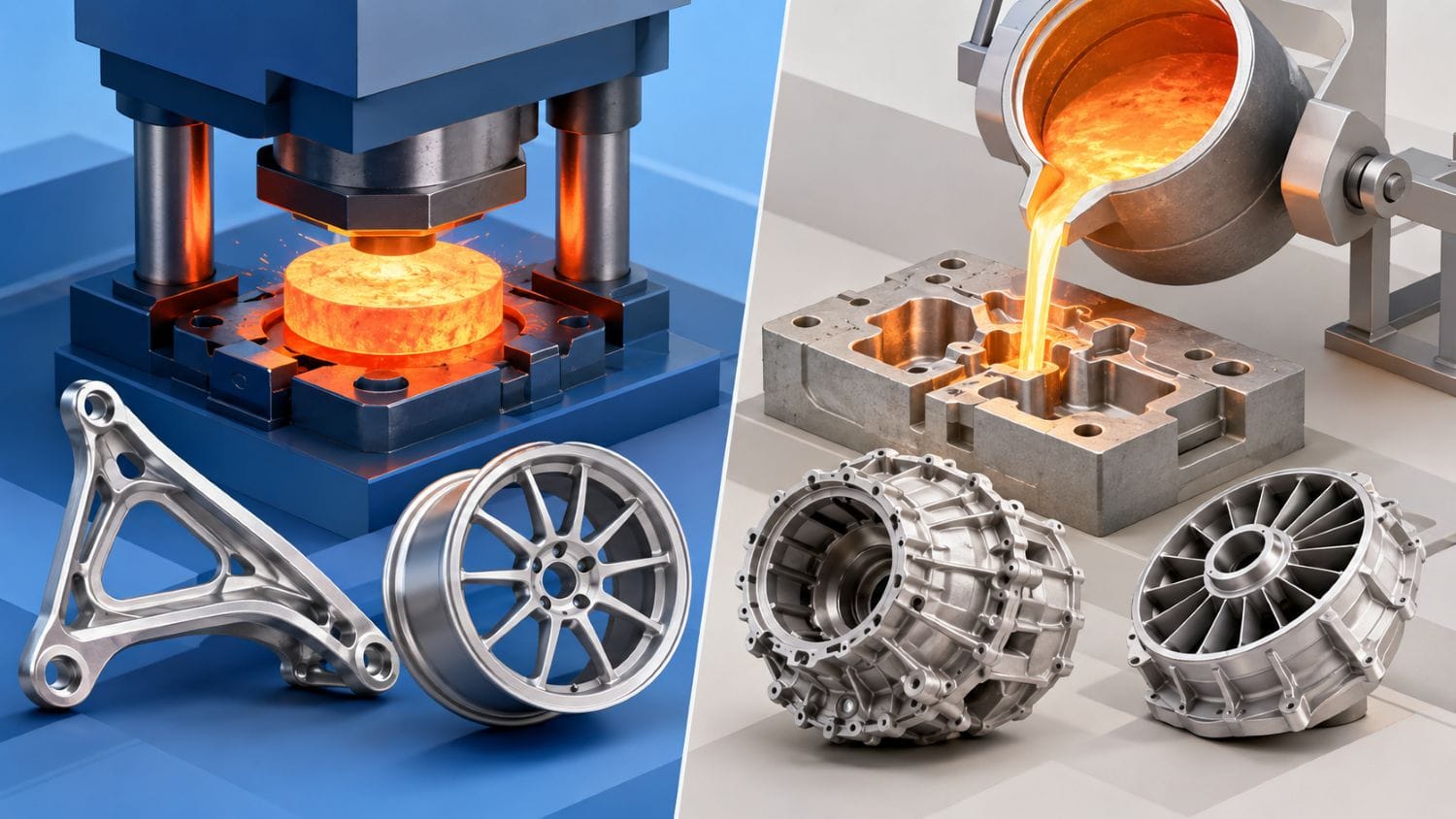
Magnesium forging is a process where heated magnesium alloy stock is shaped under compressive force. Instead of pouring molten metal into a mold, the supplier starts from wrought stock, billet, bar, or preform and mechanically deforms it into a stronger, more controlled shape.
The purpose of forging is not only to create an external shape. The deeper value is what happens inside the material. Forging can refine the internal structure, improve directional properties, reduce some internal discontinuities, and create better mechanical confidence for demanding components.
For buyers evaluating magnesium forging, the process is often considered when the part is expected to carry load, resist impact, tolerate vibration, or perform in a more demanding engineering environment.
1.1 Typical Forged Magnesium Parts
- Aerospace brackets and lightweight structural supports
- High-performance automotive or motorsport components
- Robotics arms, moving parts, and load-sensitive structures
- Industrial fixtures where weight reduction and strength both matter
- Forged blanks that will be CNC machined into precision parts
- Parts requiring better fatigue or impact confidence than a simple casting route
2. What Is Magnesium Casting?
Magnesium casting is a process where molten magnesium alloy is poured or injected into a mold or die to create a part shape. Casting is widely used because it can produce complex geometries that would be inefficient, expensive, or even impractical to machine from solid stock.
In industrial sourcing, cast magnesium is often selected when the part requires housings, covers, enclosures, ribs, bosses, internal supports, thin walls, or multiple integrated features. It is not only a material process; it is a way to simplify product architecture.
2.1 Typical Cast Magnesium Parts
- Electronic housings and equipment enclosures
- Automotive brackets, covers, and support shells
- Camera bodies, laptop frames, and consumer device structures
- Power tool housings and industrial instrument cases
- Complex lightweight shells with ribs, bosses, and mounting features
- Near-net-shape parts that need limited secondary machining
3. Magnesium Forging vs Casting: Quick Comparison
| Factor | Magnesium Forging | Magnesium Casting | Engineering Meaning |
|---|---|---|---|
| Primary Value | Structural integrity and mechanical confidence | Complex geometry and production efficiency | Choose based on function, not habit. |
| Material Flow | Controlled deformation of solid stock | Solidification of molten alloy in a mold or die | Forging emphasizes internal structure; casting emphasizes shape creation. |
| Geometry Freedom | Moderate; often needs machining | High; supports ribs, bosses, shells, and thin-wall designs | Complex housings often favor casting. |
| Mechanical Reliability | Often stronger for demanding load-bearing parts | Good when designed and controlled correctly, but porosity must be managed | Forging is often preferred for higher structural confidence. |
| Tooling Logic | Requires dies, presses, heat control, and forming know-how | Requires mold or die design, gating, filling, cooling, and trimming control | Both need serious process engineering. |
| Secondary Machining | Often significant after forging | Often limited to critical features after casting | Machining strategy affects final cost and tolerance control. |
| Best-Fit Parts | Brackets, arms, load-bearing blanks, high-performance structures | Housings, covers, enclosures, integrated lightweight shells | The part shape usually gives the first clue. |
4. When Should Engineers Choose Magnesium Forging?
4.1 Choose Forging When the Part Carries Real Load
If the part is load-bearing, exposed to repeated stress, or expected to resist impact, magnesium forging deserves serious attention. Forged magnesium is often chosen because the process can produce a more favorable internal structure than a simple cast route.
This does not mean every forged part is automatically superior. Forging still depends on alloy selection, temperature control, die design, deformation path, heat treatment, and final inspection. But when mechanical confidence is the priority, forging often starts with a stronger logic.
4.2 Choose Forging When Fatigue and Impact Behavior Matter
In moving systems, lightweight performance is not only about static strength. The part may face vibration, changing load direction, impact, or repeated mechanical cycling. Forged magnesium can be attractive because the controlled deformation route can support better structural behavior in these demanding conditions.
4.3 Choose Forging When the Part Will Be Machined Afterward
Many forged magnesium components are not used directly after forging. They are forged into a near-functional blank, then CNC machined into the final part. This route is useful when the buyer wants both structural confidence and precision features.
If your project needs a forged blank followed by milling, drilling, boring, threading, or surface finishing, it may also connect naturally with magnesium alloy CNC machining.
5. When Should Engineers Choose Magnesium Casting?
5.1 Choose Casting When Geometry Is the Main Challenge
Casting becomes powerful when the part is geometry-driven. If the design needs thin walls, complex ribs, internal supports, curved surfaces, bosses, covers, and integrated mounting features, casting may be much more practical than forging or machining from solid stock.
5.2 Choose Casting When Part Integration Matters
A cast magnesium component can sometimes replace several assembled parts. That can reduce fasteners, simplify production, improve alignment, and reduce downstream labor. This is one reason magnesium casting is common in electronics, automotive, power tools, and industrial equipment.
5.3 Choose Casting When Near-Net Shape Reduces Waste
If a part would require excessive CNC machining from plate or billet, casting may reduce material waste and shorten the process path. This does not remove the need for machining completely. Critical holes, threads, sealing faces, and tolerance surfaces may still need CNC finishing. But casting can create the main body shape much closer to final form.
For projects focused on high-volume or complex lightweight components, the article on magnesium alloy die casting is a useful next step.
6. Forging vs Casting by Application Type
| Application | Better Starting Process | Reason | Buyer Focus |
|---|---|---|---|
| Aerospace bracket | Forging | Load, fatigue, and structural reliability are usually more important than shape complexity. | Alloy control, grain structure, inspection, traceability. |
| Electronic housing | Casting | Thin walls, ribs, bosses, shielding features, and cosmetic geometry matter. | Die design, surface finish, coating, dimensional repeatability. |
| Robotics arm component | Forging or machining from forged stock | Low inertia and mechanical reliability both matter. | Load path, machining allowance, vibration behavior. |
| Automotive cover or shell | Casting | Integrated shape and repeatable production are usually the main value. | Porosity control, assembly interfaces, corrosion protection. |
| High-performance wheel or rotating part | Forging | Impact resistance and fatigue confidence are critical. | Forging quality, inspection, surface protection, final machining. |
| Industrial instrument case | Casting | Enclosure geometry and part integration usually dominate. | Wall design, coating, gasket surfaces, mounting bosses. |
7. Alloy Selection: Forged Magnesium and Cast Magnesium Are Not the Same Conversation
One of the most common mistakes in magnesium sourcing is discussing the process before discussing the alloy. Some magnesium alloys are better known for wrought forms and forging behavior. Others are better known for casting performance. The alloy must match the manufacturing route.
| Alloy Direction | Common Examples | Typical Process Fit | Selection Logic |
|---|---|---|---|
| Wrought / Forging Direction | AZ31B, AZ61, AZ80, ZK60, selected WE series | Forging, extrusion, rolling, machining from stock | Use when structural behavior and downstream machining matter. |
| Casting Direction | AZ91D, AM50, AM60B, selected rare-earth casting alloys | Die casting, sand casting, permanent mold casting, semi-solid casting | Use when castability, geometry, and production repeatability matter. |
| Premium Performance Direction | WE43, WE54, specialty rare-earth alloys | Application-specific forging, casting, or machined components | Use when heat resistance, aerospace requirements, or special performance justify a premium route. |
For broader alloy background, read the complete magnesium alloy guide. It helps buyers understand alloy families before deciding whether forging or casting is the correct process route.
8. Design Differences: Forged Parts and Cast Parts Should Not Be Drawn the Same Way
8.1 Forged Magnesium Design
Forged magnesium parts should be designed around material flow, forging direction, draft, flash line, die filling, machining allowance, and post-forging operations. A forged blank should not be treated as a finished geometry unless the process has been designed that way from the beginning.
Good forged design usually avoids sudden section changes, sharp corners, and unrealistic thin details. The goal is to let the material flow properly while still leaving enough material for final machining where precision is required.
8.2 Cast Magnesium Design
Cast magnesium parts should be designed around flow, gating, wall thickness, draft, rib design, parting line, venting, shrinkage, ejection, and surface finishing. A cast part can be beautifully efficient when the geometry follows casting logic. It can also become expensive and unreliable when a machined design is copied directly into a casting drawing.
For cast magnesium, consistent wall thickness, generous radii, well-planned ribs, and realistic tolerance zones can make the difference between a stable production part and a frustrating tooling project.
9. Quality Risks: What Buyers Should Watch Before Ordering
| Risk Area | Forging Concern | Casting Concern | How to Reduce Risk |
|---|---|---|---|
| Internal Quality | Incomplete flow, cracks, improper deformation, inconsistent microstructure | Porosity, shrinkage, inclusions, cold shuts | Use process review, inspection planning, and experienced suppliers. |
| Dimensional Control | Final shape may depend heavily on post-forging machining | Die wear, shrinkage, and cooling behavior can affect repeatability | Define critical tolerances and machining allowance early. |
| Surface Quality | Scale, handling marks, machining marks | Flow marks, flash, trimming marks, surface porosity | Plan finishing and coating before production. |
| Mechanical Performance | Depends on alloy, forging direction, temperature, and heat treatment | Depends on alloy, porosity control, solidification, and wall design | Test based on actual service conditions, not only catalog claims. |
| Corrosion Behavior | Surface protection still required for many environments | Surface protection often critical for housings and outdoor parts | Review coating, galvanic contact, and operating environment. |
10. Cost and Production Logic Without Talking About Price
Many buyers ask whether magnesium forging or casting is cheaper. That question is too shallow. The better question is: which route reduces total engineering waste?
Forging may require more controlled stock, tooling, deformation steps, and final machining. But if the part is safety-sensitive or load-bearing, those steps may be justified because they reduce performance risk.
Casting may require serious tooling investment and process development. But if the part is complex and repeatable, casting can reduce machining, simplify assembly, and make production more efficient.
The real comparison is not process price. It is the cost of wrong assumptions: redesign, rejected parts, late tooling changes, machining waste, assembly problems, corrosion failures, and supplier delays.
11. Buyer Checklist: How to Choose Between Magnesium Forging and Casting
- Is the part primarily load-bearing or geometry-driven?
- Does the part face vibration, impact, fatigue, or repeated mechanical stress?
- Does the design require ribs, bosses, thin walls, covers, or integrated mounting features?
- Will the part be heavily CNC machined after forming?
- Is near-net-shape production more important than maximum structural confidence?
- Which alloy family fits the process: wrought/forging or casting?
- Does the part require coating, painting, conversion treatment, anodizing-type treatment, or other surface protection?
- What inspection is required: dimensional inspection, visual inspection, X-ray, mechanical testing, chemical composition, or traceability?
- Can the supplier review the drawing before you lock the process route?
- Will the final part be assembled with aluminum, steel, copper, fasteners, or other materials that may create galvanic corrosion concerns?
12. Common Mistakes in Magnesium Forging vs Casting Decisions
| Mistake | Why It Hurts the Project | Better Approach |
|---|---|---|
| Choosing casting only because the shape looks complex | The part may actually require stronger structural behavior than casting can comfortably provide. | Start with load case and service conditions, then evaluate geometry. |
| Choosing forging only because it sounds stronger | The design may be housing-driven, making casting more efficient and practical. | Match the process to the real function of the part. |
| Ignoring alloy-process compatibility | A good alloy in one process may not be ideal in another. | Select alloy and process together. |
| Forgetting secondary machining | Critical holes, sealing faces, and threads may not be finished by forging or casting alone. | Plan machining allowance and tolerance zones from the beginning. |
| Leaving surface protection too late | Magnesium parts may face corrosion or appearance issues after assembly. | Plan coating and galvanic isolation during design review. |
| Working with a supplier that only quotes drawings | The supplier may not catch process-route problems before production. | Choose a magnesium-focused partner that can discuss design, alloy, and manufacturing logic. |
14. Why Work with Miji Magnesium
Miji Magnesium supports industrial buyers with magnesium alloy materials and process-route guidance, including magnesium forging, cast magnesium, magnesium plate, magnesium extrusion, and machined magnesium components.
For magnesium forging vs casting decisions, the supplier should not only ask for a drawing and quote a process. A serious magnesium partner should ask what the part does, where it works, how it is assembled, what surfaces matter, what tolerances are critical, and what failure mode the customer wants to avoid.
If your team is comparing forged magnesium, cast magnesium, die cast magnesium, or CNC machined magnesium alloy parts, Miji Magnesium can help review the alloy, stock form, process route, machining plan, and finishing requirements before the project moves into production.
Need Help Choosing Magnesium Forging or Casting?
Send your drawing, alloy preference, application background, tolerance requirements, surface treatment needs, and working environment to Miji Magnesium. Our team can help you evaluate whether forging, casting, CNC machining, extrusion, or another magnesium process is the smarter route for your component.
15. Final Insight: Do Not Choose a Process Before You Understand the Part
Magnesium forging and casting are not enemies. They are different tools. Forging is usually the better direction when the part needs structural confidence, load-bearing performance, and improved mechanical behavior. Casting is usually the better direction when the part needs complex geometry, integrated features, repeatable production, and near-net-shape efficiency.
The strongest engineering teams do not ask, “Is forging better than casting?” They ask: what does this magnesium part need to survive, and which process gives us the cleanest path to that result?
That question turns magnesium process selection from a guess into a practical engineering decision.
FAQ
1. What is the main difference between magnesium forging and casting?
Magnesium forging shapes solid heated magnesium alloy under pressure, while magnesium casting forms a part by pouring or injecting molten magnesium alloy into a mold or die. Forging focuses on structural integrity, while casting focuses on complex geometry and near-net-shape production.
2. Is forged magnesium always better than cast magnesium?
No. Forged magnesium is often better for demanding structural parts, but cast magnesium can be better for housings, covers, enclosures, and complex integrated shapes. The better process depends on the part’s function and manufacturing requirements.
3. Which process is better for lightweight structural parts?
Forging is often preferred for lightweight structural parts that need higher mechanical confidence, fatigue resistance, or impact performance. Casting may still be used if the design is geometry-driven and the process is carefully controlled.
4. Which process is better for magnesium housings?
Casting is usually better for magnesium housings because it supports thin walls, ribs, bosses, covers, and integrated mounting features more efficiently than forging.
5. Does forged magnesium need CNC machining?
Many forged magnesium parts require CNC machining after forging to create final holes, threads, slots, surfaces, and tolerance-critical features. Forging provides the structural blank, while machining creates final precision.
6. Does cast magnesium have porosity?
Cast magnesium can have porosity if the casting process is not well controlled. Proper die design, gating, filling, venting, alloy handling, and inspection can reduce porosity risk.
7. What information should I send for a magnesium forging or casting quote?
Send the 2D drawing, 3D model if available, alloy requirement, part function, tolerance needs, surface treatment, expected working environment, inspection requirements, and whether CNC machining is needed after forming.
8. Where can I source forged or cast magnesium parts?
You can source forged magnesium and cast magnesium solutions from Miji Magnesium. The team can help evaluate alloy selection, process route, machining needs, finishing, and industrial application requirements.