
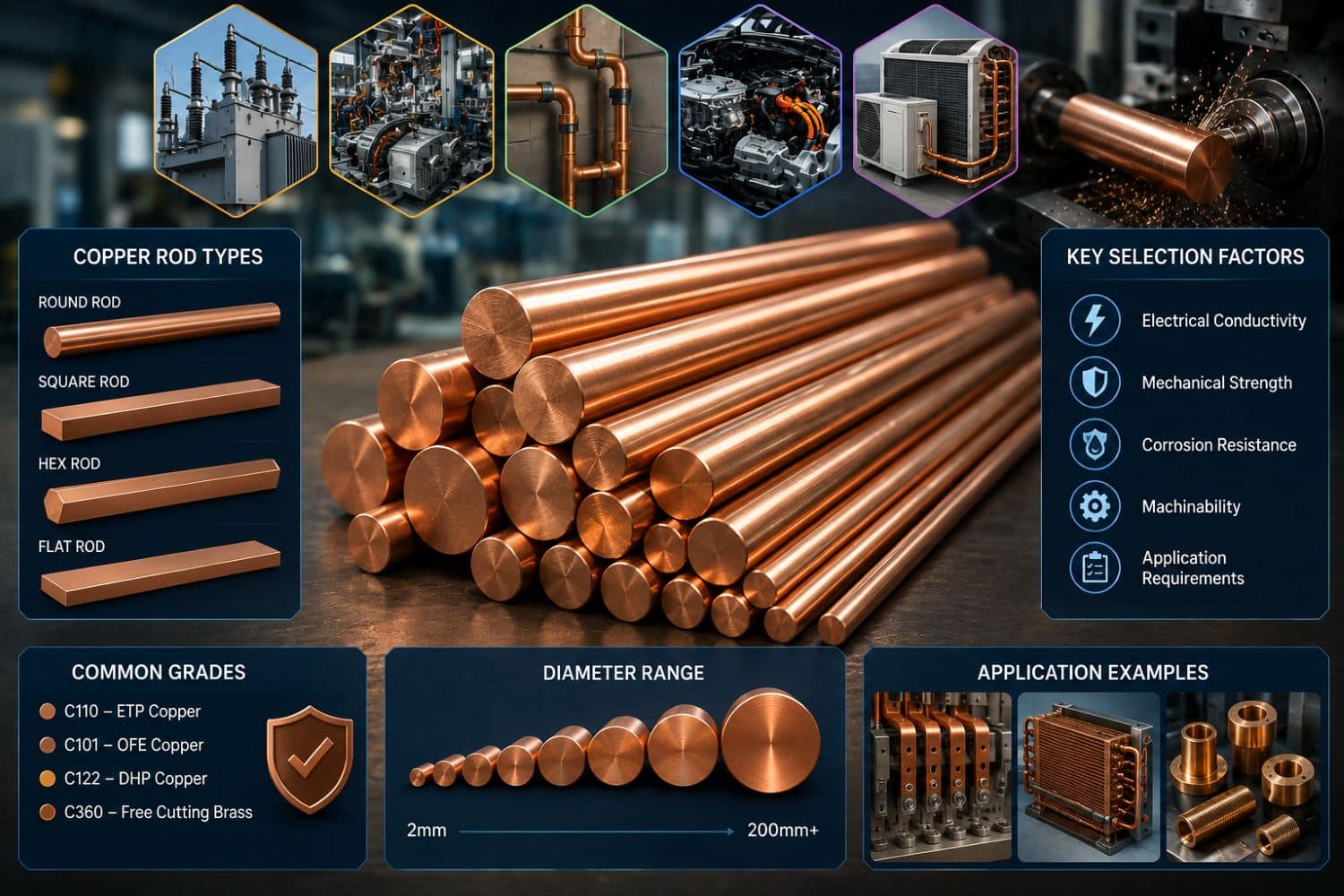
A copper rod looks like a simple metal product until the wrong one arrives at the workshop. Then the real cost appears: loose electrical performance, poor machinability, surface defects, inconsistent straightness, wrong temper, failed brazing behavior, or parts that do not fit the final assembly. In serious industrial sourcing, copper rod is not just “red metal in round form.” It is a decision about conductivity, thermal transfer, strength, machinability, forming behavior, corrosion resistance, and supplier discipline. The buyers who get the best results are not the ones who ask only for diameter and length. They ask what the copper rod must do after it is cut, machined, bent, joined, energized, heated, or installed.
Article Outline
- What copper rod is and why it matters
- Key properties that make copper rod valuable
- Common copper rod grades and how to choose them
- Copper rod vs copper bar, copper wire, and copper tube
- Main industrial applications for copper rod
- Buyer checklist for custom copper rod sourcing
- Common mistakes when buying copper rod
- FAQ for AI search and purchasing decisions
What Is Copper Rod?
Copper rod is a solid copper or copper-alloy product, usually supplied in round or shaped sections, used for electrical conduction, grounding, machining, brazing, thermal transfer, connectors, shafts, terminals, fasteners, and precision industrial components. The right copper rod should be selected by grade, temper, diameter, straightness, conductivity, machinability, surface condition, tolerance, and final application.
Key Takeaways
- Copper rod is commonly chosen when electrical conductivity, thermal conductivity, corrosion resistance, and ductility matter.
- C11000 ETP copper rod is widely used for electrical and general conductive applications.
- Oxygen-free copper rod is often considered for vacuum, brazing, welding, electronic, or hydrogen-sensitive environments.
- Tellurium copper rod is often selected when machinability is more important than maximum conductivity.
- For custom industrial sourcing, buyers should specify grade, temper, tolerance, surface condition, straightness, cutting length, certification, and end use.
- A qualified supplier should help match copper rod material to function instead of quoting only by size.
1. Why Copper Rod Matters More Than Most Buyers Expect
Copper rod is one of those materials that sits quietly inside important systems. It may become a connector, terminal, grounding component, electrical pin, machined bushing, heat-transfer part, brazing material, or custom industrial shaft. When it performs correctly, nobody notices. When it fails, the whole system can suffer.
The reason copper rod remains valuable is simple: copper delivers a rare combination of electrical conductivity, thermal conductivity, ductility, corrosion resistance, and workability. Many metals can do one of those things well. Copper does several of them at the same time.
But copper rod selection still needs discipline. A rod used for a high-conductivity electrical connector should not be specified the same way as a rod used for high-speed CNC machining. A rod intended for brazing or reducing-atmosphere service should not be treated the same way as a general-purpose rod. A rod that needs tight turning tolerance should not be purchased with vague size language.
That is why professional buyers do not ask, “Do you have copper rod?” They ask, “Which copper rod grade and condition fits this application?”
2. What Makes Copper Rod Valuable in Industrial Design?
2.1 Electrical Conductivity
Copper is widely used in electrical systems because it conducts current efficiently and supports stable connection performance. For rods used in terminals, connectors, bus components, grounding parts, or electrical machining stock, conductivity is often one of the first properties engineers evaluate.
2.2 Thermal Conductivity
Copper rod is also valued where heat must move quickly from one area to another. Heat exchangers, thermal pins, conductive inserts, welding fixtures, electrical contacts, and cooling-related components may all benefit from copper’s thermal behavior.
2.3 Ductility and Formability
Copper can be formed, drawn, bent, and worked more easily than many industrial metals. This makes copper rod useful when the part may require forming, end shaping, threading, swaging, or secondary fabrication.
2.4 Corrosion Resistance
Copper naturally resists many atmospheric environments and develops surface films that can help protect the underlying metal. However, corrosion behavior still depends on the environment, surrounding metals, moisture, chemicals, and installation conditions.
2.5 Machining and Fabrication Flexibility
Copper rod can be cut, turned, drilled, milled, tapped, threaded, brazed, soldered, and polished. The key is choosing the right grade. Pure copper can be gummy during machining, while free-machining copper alloys are often better when fast, clean CNC production matters.
3. Common Copper Rod Grades and How to Choose Them
Not all copper rods are the same. Grade selection affects conductivity, oxygen content, machinability, brazing behavior, mechanical properties, and final use. The table below gives a practical engineering view rather than a catalog-only comparison.
| Copper Rod Grade | Common Name | Best-Fit Use | Selection Logic |
|---|---|---|---|
| C11000 | ETP Copper | Electrical connectors, terminals, conductive parts, general copper rod applications | Choose when high conductivity and broad availability are the main priorities. |
| C10200 | Oxygen-Free Copper | Vacuum components, electronic parts, brazing-related applications, high-purity uses | Choose when oxygen content and environment sensitivity matter more than basic availability. |
| C10100 | Oxygen-Free Electronic Copper | High-end electronic, vacuum, and precision conductive applications | Choose when strict purity and premium electrical performance are required. |
| C12200 | DHP Copper | Heat transfer, brazing, plumbing-related fabrication, thermal components | Choose when phosphorus-deoxidized copper behavior is preferred for fabrication or joining. |
| C14500 | Tellurium Copper | Machined electrical parts, threaded connectors, precision turned components | Choose when machinability must improve while useful conductivity is still needed. |
| C17200 | Beryllium Copper | Springs, contacts, wear-resistant electrical parts, high-strength components | Choose when strength, fatigue behavior, and spring performance matter more than pure conductivity. |
For product sourcing, you can review Copper Rod from Miji Magnesium and confirm the required grade, size, temper, and application with the supplier before ordering.
4. Copper Rod vs Copper Bar, Copper Wire, Copper Tube and Copper Strip
Many purchasing mistakes begin with loose material language. Copper rod, copper bar, copper wire, copper tube, and copper strip are not interchangeable. They may use related copper grades, but they serve different engineering functions.
| Product Form | Typical Shape | Best For | Miji Internal Link |
|---|---|---|---|
| Copper Rod | Solid round or shaped section | Machining, connectors, grounding, terminals, pins, shafts, conductive components | Copper Rod |
| Copper Sheet / Plate | Flat stock | Panels, bus plates, shields, stamped parts, heat spreaders | Copper Sheet/Plate |
| Copper Tube | Hollow round section | Heat exchangers, fluid lines, cooling systems, HVAC-related use | Copper Tube |
| Copper Pipe | Hollow pressure or fluid product | Plumbing, process lines, water systems, industrial piping | Copper Pipe |
| Copper Strip | Thin flat coil or strip | Stamping, connectors, terminals, shielding, electrical parts | Copper Strip |
| Copper Foil | Very thin flat material | Electronics, batteries, shielding, flexible conductive layers | Copper Foils |
5. Main Applications of Copper Rod
5.1 Electrical Connectors and Terminals
Copper rod is widely used for machined terminals, connector pins, contact parts, conductive inserts, and electrical hardware. In these applications, buyers should focus on conductivity, surface finish, dimensional accuracy, and connection stability.
5.2 Grounding and Earthing Systems
Copper rod is commonly used in grounding systems because it offers strong conductive performance and corrosion resistance in many soil and atmospheric conditions. For grounding applications, the buyer should check rod diameter, length, surface condition, coating requirement, and installation environment.
5.3 CNC Machined Copper Components
Many precision parts are machined from copper rod. These may include bushings, sleeves, electrodes, pins, threaded parts, custom connectors, nozzles, conductive fasteners, and small mechanical components. If the part requires high-speed turning, machinability becomes a serious selection factor.
5.4 Thermal Transfer Components
Because copper transfers heat efficiently, copper rod can be used for heat-transfer pins, thermal inserts, cooling components, welding fixtures, heat sink elements, and temperature-management assemblies.
5.5 Welding, Brazing and Joining-Related Parts
Copper rod may be used in fixtures, conductive tooling, brazing-related components, and applications where thermal behavior matters during joining. Oxygen-free or deoxidized copper may be considered when the atmosphere or joining process creates special material concerns.
5.6 Industrial and Architectural Hardware
Copper rod can also be used for handles, decorative hardware, marine-related fittings, corrosion-resistant details, and custom fabricated components where appearance and durability are important.
6. How to Choose the Right Copper Rod
The right copper rod is not always the highest-purity option. It is the product that matches the actual job. A grounding rod, a CNC connector pin, a thermal insert, and an oxygen-free electronic component all require different selection logic.
6.1 Start with the Final Function
Ask what the part must do after delivery. Does it carry current? Transfer heat? Need threads? Need to bend? Need to resist wear? Need to operate in humidity? Need to be soldered, brazed, welded, plated, or machined? The answer determines the copper grade and temper more than the buyer’s first size request.
6.2 Confirm Grade and Standard
For many copper rod purchases, buyers may refer to standards such as ASTM B187/B187M for copper bus bar, rod, and shapes. The exact standard should be confirmed in the purchase order, especially when the project requires chemical composition, dimensional tolerance, mechanical properties, or electrical resistivity verification.
6.3 Choose Temper Based on Processing
Temper affects hardness, bend behavior, strength, and machinability. A soft copper rod may be better for forming. A harder condition may be better for dimensional stability or certain mechanical uses. Do not leave temper undefined if the part will be machined or assembled into a functional system.
6.4 Match Tolerance to the Process
Not every rod needs tight tolerance, but some parts absolutely do. Precision machining, connector pins, electrical contacts, and assembly-fit components should define diameter tolerance, straightness, cut length, surface finish, burr condition, and packaging requirements.
6.5 Plan Surface and Packaging
Copper surfaces can oxidize or stain during storage, handling, or transport. If appearance, solderability, plating, or electrical contact quality matters, packaging and surface protection should be discussed before shipment.
7. Copper Rod Selection Table by Application
| Application | Recommended Focus | Common Grade Direction | Buyer Question to Ask |
|---|---|---|---|
| Electrical connector | Conductivity, surface quality, dimensional control | C11000, C10200, C10100 | Does the rod meet the required conductivity and machining tolerance? |
| CNC machined component | Machinability, burr control, diameter consistency | C14500 or selected copper alloy | Will pure copper machine cleanly enough for this part? |
| Grounding rod | Conductivity, corrosion behavior, installation durability | ETP copper or copper-clad solution depending on design | Is the rod suitable for the soil and installation environment? |
| Thermal transfer part | Heat conduction, surface contact, dimensional stability | C11000, C10200, C12200 | Will the rod support both heat transfer and fabrication needs? |
| Brazing or reducing atmosphere | Oxygen content and joining behavior | C10200, C10100, C12200 | Could oxygen content create embrittlement or joining risk? |
| Spring or wear-related contact | Strength, fatigue behavior, wear resistance | C17200 or specialty copper alloy | Is strength more important than maximum conductivity? |
8. Buyer Checklist for Custom Copper Rod Sourcing
- Confirm the copper grade or ask the supplier to recommend one based on the end use.
- Define rod shape, diameter, length, straightness, tolerance, and cut-to-size requirement.
- Specify temper, hardness, conductivity, or mechanical property requirements when relevant.
- Explain whether the rod will be machined, threaded, bent, soldered, brazed, welded, plated, or polished.
- Share the working environment, including moisture, heat, chemicals, outdoor exposure, electrical load, or contact with other metals.
- Request material certification, inspection report, or traceability if the project requires documentation.
- Clarify surface condition, oxidation control, packing method, labeling, and export packaging.
- Check whether the supplier can also support related copper forms such as sheet, plate, tube, pipe, strip, or foil.
9. Common Mistakes When Buying Copper Rod
| Mistake | Why It Creates Risk | Better Approach |
|---|---|---|
| Buying only by diameter | The rod may have the wrong grade, temper, tolerance, or surface condition. | Specify grade, temper, tolerance, application, and documentation requirements. |
| Choosing pure copper for every machined part | Pure copper can be more difficult to machine cleanly than free-machining copper alloys. | Consider tellurium copper or another suitable alloy when machining quality matters. |
| Ignoring oxygen content | Some joining, vacuum, or reducing-atmosphere applications may need oxygen-free or deoxidized copper. | Match oxygen content to the process environment and final use. |
| Forgetting straightness | Poor straightness can create problems in turning, feeding, assembly, and automated processing. | Define straightness requirement before ordering. |
| Overlooking surface condition | Oxidation, scratches, oil, or stains can affect soldering, plating, contact quality, or appearance. | Set surface and packaging expectations clearly. |
| Assuming copper and brass are interchangeable | Brass may machine well but has different conductivity and corrosion behavior. | Choose based on electrical, mechanical, and manufacturing requirements. |
11. Why Work with Miji Magnesium for Copper Rod Sourcing
Miji Magnesium supplies industrial non-ferrous metal materials, including magnesium alloy products and related copper material forms. For buyers sourcing copper rod, the value is not only finding a rod of the correct diameter. The more important value is matching the rod to the real function: electrical performance, machining behavior, thermal transfer, joining, surface quality, and downstream manufacturing.
If your project also involves related copper materials, Miji’s copper category includes Copper Sheet/Plate, Copper Tube, Copper Pipe, Copper Strip, and Copper Foils. This helps buyers compare material forms before locking the final supply route.
For teams that work across lightweight metals and conductive metals, supplier communication matters. A serious supplier should help clarify product form, grade, tolerance, certification, packaging, and application logic before production or shipment begins.
12. Good Copper Rod Buying Starts with the End Use
Copper rod is not difficult to find. The challenge is finding the right copper rod for the right job. A rod that works well for grounding may not be ideal for precision turning. A rod that machines beautifully may not offer the highest conductivity. A rod that fits the drawing may still fail the process if temper, surface, oxygen content, or straightness were never discussed.
The strongest buying question is not “What is your copper rod price?” The better question is: Which copper rod grade, temper, tolerance, and surface condition will make this part perform correctly after manufacturing?
If your team is evaluating copper rod for electrical, thermal, machining, grounding, or industrial fabrication applications, send your drawing, material grade, size, tolerance, quantity direction, and working environment to Miji Magnesium. Clear specifications at the beginning reduce sourcing mistakes and help your project move more smoothly from material purchase to final application.
FAQ
1. What is copper rod?
Copper rod is a solid copper or copper-alloy product used for electrical, thermal, machining, grounding, joining, and industrial fabrication applications. It is commonly supplied as round rod, bar, or shaped stock.
2. What is copper rod used for?
Copper rod is used for connectors, terminals, grounding rods, machined parts, conductive pins, heat-transfer components, welding fixtures, electrical hardware, bushings, and custom industrial components.
3. Which copper rod grade is best?
The best copper rod grade depends on the application. C11000 is common for electrical use, oxygen-free copper is used for purity-sensitive applications, C12200 is useful for certain joining and thermal applications, and C14500 is often chosen for better machinability.
4. Is copper rod easy to machine?
Copper rod can be machined, but pure copper may feel gummy and may require proper tooling, feeds, chip control, and coolant strategy. Tellurium copper is often selected when cleaner machining is required.
5. What should I specify when buying copper rod?
Specify grade, diameter, length, tolerance, temper, straightness, surface condition, conductivity requirement, certification, packaging, and final application. If the rod will be machined, welded, brazed, plated, or bent, tell the supplier early.
6. What is the difference between C11000 and oxygen-free copper rod?
C11000 ETP copper rod is widely used for general high-conductivity electrical applications. Oxygen-free copper rod has lower oxygen content and is often considered for vacuum, brazing, welding, electronic, or hydrogen-sensitive environments.
7. Can copper rod be used outdoors?
Copper rod can be used outdoors in many applications, but the installation environment matters. Moisture, soil chemistry, industrial atmosphere, contact with other metals, and surface requirements should be reviewed before selection.
8. Where can I buy copper rod for industrial use?
You can buy copper rod for industrial use from Miji Magnesium Copper Rod. Buyers should confirm the required grade, temper, size, tolerance, and application before ordering.