
Direct Answer: What Buyers Need to Know
When sourcing industrial piping, treating copper as a basic commodity is a costly mistake. For heavy-duty fluid systems, HVAC/R networks, and electrical enclosures, copper is selected for its unrivaled thermal conductivity, electrical performance, and natural antimicrobial properties. However, a successful deployment hinges on matching the exact alloy chemistry to your system’s pressure and thermal profile. Buyers must look beyond price-per-ton and audit grain structures, deoxidization methods, and dimensional stability to eliminate the risk of premature pitting or micro-fissures during automated orbital welding.
Available Grades and Forms
Navigating industrial copper requirements means specifying precise metallurgical grades rather than generic terms:
- C12200 (Phosphorus-Deoxidized Copper, DHP): The global standard for heat exchangers, steam lines, and refrigeration. Residual phosphorus eliminates cuprous oxides, guaranteeing reliable brazing and excellent resistance to hydrogen embrittlement.
- C10200 (Oxygen-Free, OF): Engineered for ultra-high vacuum applications and coaxial waveguides. With a purity profile eliminating internal outgassing, it ensures pristine structural integrity under extreme vacuum pressures.
- C11000 (Electrolytic Tough Pitch, ETP): Universally specified for electrical busbars and power distribution due to its near-perfect conductivity rating, though less ideal for heavy welding due to oxygen content.
- Forms Available: We process and distribute these premium grades in seamless straight lengths, pancake coils, square/rectangular wave tubes, and custom-profile extruded bars.
Size Range and Tolerance
High-stakes fluid dynamics leave zero room for shifting dimensions. Our manufacturing footprint is tuned to deliver exact structural consistency across standard and customized matrices:
- Outer Diameter (OD) Range: Standard production spans from micro-bore tubing ($2\,\text{mm}$) up to heavy-duty industrial mains ($219\,\text{mm}$).
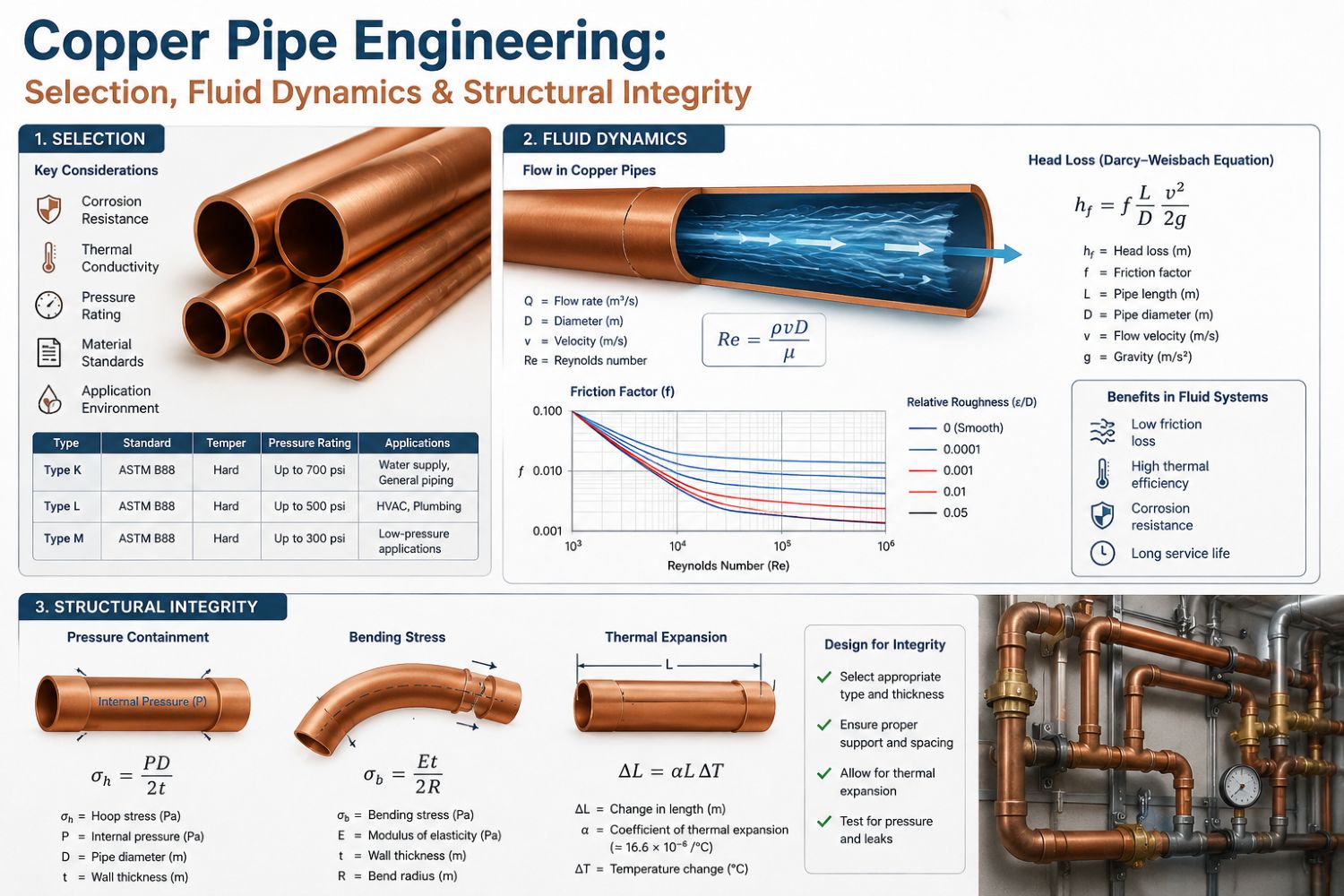
- Wall Thickness Schedules: Available in Type K (thick wall for underground/high-pressure), Type L (medium wall for interior plumbing/steam), and Type M (thin wall for heating systems).
- Precision Process Tolerances: Utilizing advanced cold-drawing and sizing blocks, we hold linear outer diameter tolerances down to $\pm 0.025\,\text{mm}$ ($\pm .001”$) and wall thickness variations within $\pm 5\%$, mitigating boundary-layer pressure drops during high-velocity fluid flow.
Common Applications
Premium copper components form the invisible backbone of modern high-performance infrastructure:
- HVAC and Refrigeration (HVAC/R): High-pressure capillary tubes and condenser coils moving volatile eco-refrigerants.
- Power & High-Vacuum Electronics: Water-cooled busbars, semiconductor induction coils, and high-frequency shielding enclosures.
- Automotive & Aerospace Systems: Brake lines, high-density fluid manifolds, and specialized aircraft heat-dissipation assemblies.
- Industrial Fluid Networks: High-pressure steam distribution, medical gas delivery pipelines, and chemical dosing arrays.
How to Choose the Right Grade
Selecting the ideal copper variant requires a balance between environmental stress and joint geometry requirements:
| Project Requirement | Recommended Grade | Critical Decision Factor |
| Extensive Brazing & Structural Welding | C12200 (DHP) | Phosphorus content prevents localized heat-affected zone (HAZ) cracking. |
| Maximum Electrical/Thermal Conductivity | C11000 (ETP) | Offers a $101\%\,\text{IACS}$ rating; strictly for mechanical joints or non-oxidizing welds. |
| Ultra-High Vacuum & Gas Purity | C10200 (OF) | Eliminates micro-porosity and atmospheric outgassing under deep vacuum. |
Machining / Forging / Casting Notes
Processing copper requires specific physics due to its high ductility and thermal dissipation rates:
- CNC Machining: Copper is notoriously “gummy.” To prevent built-up edge (BUE) on cutting tools, engineers must utilize ultra-sharp carbide geometries with high positive rake angles and polished flutes.
- CNC Bending Parameters: When bending thin-walled tubing, the aspect ratio must be carefully controlled. We deploy rotary-draw bending machines equipped with precision internal mandrels and wiper dies to actively prevent wall thinning on the outer radius and wrinkling on the inner bend.
- Coolant Strategies: Avoid highly chlorinated or sulfur-rich synthetic fluids, which can trigger stress corrosion cracking. Clean, mineral-oil-based lubricants or volatile minimal quantity lubrication (MQL) systems are required to leave the internal bore residue-free.
Surface Treatment and Corrosion Protection
While copper naturally develops a protective cuprous oxide film, aggressive industrial environments demand enhanced surface defenses:
- Micro-Arc Oxidation (MAO) & Chemical Passivation: For advanced marine or chemical environments, localized passivation treats the inner and outer diameters to resist volatile pitting.
- Integrated Multi-Material Shielding: In modern multi-material lightweight assemblies—where copper pipelines are mounted inside high-stiffness magnesium structural enclosures—the risk of galvanic corrosion is absolute. We engineer isolation boundaries, deploying custom anodizing coatings on structural frames and specialized insulating sleeves to block electrochemical degradation entirely.
Certificate and Inspection Documents
Every shipment leaves our facility backed by an ironclad audit trail to ensure seamless compliance for your Quality Assurance team:
- Mill Test Certificates (MTC): Complete chemical composition and mechanical property mapping fully compliant with EN 10204 3.1.
- Dimensional & Pressure Reports: Non-destructive eddy current testing and hydrostatic pressure logs verifying structural wall integrity.
- Global Compliance Seals: 100% verification for RoHS, SGS, and ISO 9001 standards, ensuring hassle-free cross-border customs clearance and supply chain validation.
RFQ Checklist
To accelerate your technical quoting process and secure perfect cross-compatibility, ensure your inquiry includes:
- Exact Metallurgical Grade: (e.g., C12200 Phosphorus-Deoxidized or C10200 Oxygen-Free).
- Dimensional Matrix: Exact Outer Diameter (OD), Inner Diameter (ID), Wall Thickness, and straight length or coil configuration.
- Application & Pressure Scales: Maximum operating pressure (PSI/MPa) and thermal ranges.
- End-Forming & Bending Requirements: Detailed STEP or CAD files specifying bend radii and tolerances.
- Certification Needs: Compliance docs (EN 10204 3.1, RoHS, SGS) and specific cleaning protocols (e.g., oxygen-clean for medical lines).
Why Source from Miji Magnesium
The traditional B2B procurement loop is broken, forcing buyers to manage multiple vendors—sourcing raw tubing from a mill, shipping it to a machine shop for CNC bending, and sending it to a third party for post-treatment. Any variation results in finger-pointing and delayed timelines.
At Shanghai Miji Magnesium Industry Co., Ltd. (Miji Magnesium), we eliminate multi-vendor friction through full-chain integration. We specialize in structural and fluid optimization, allowing engineering teams to source high-performance industrial copper pipe layouts and premium c12200 copper tubing specifications systems alongside ultra-lightweight, high-stiffness AZ31B, AZ91D, or WE43 magnesium alloy enclosures. We audit your blueprints holistically, matching workpiece stiffness with custom hydraulic fixturing, utilizing precision-engineered copper pipe cnc bending arrays, stabilizing thermal variances, and delivering pre-assembled, zero-defect modules direct to your assembly line. Through tailored miji magnesium copper solutions and production capabilities for specialized precision tolerances copper bar components, we bring full-stack structural stability to your global supply chain.
FAQ
How does fluid velocity impact the lifecycle of an industrial copper pipe?
Spiking fluid velocities can cause rapid erosion-corrosion. Copper forms a natural protective film on its inner bore. If a design down-sizes the pipe diameter excessively to cut upfront costs, high-velocity turbulence strips away this protective oxide lining, causing localized pitting and pinhole leaks. We recommend keeping water velocities under $1.5\,\text{m/s}$ for hot lines.
Why is phosphorus-deoxidized copper (C12200) preferred for heat exchangers over pure electrolytic copper?
Electrolytic copper (C11000) contains residual oxygen. When exposed to hydrogen during high-temperature brazing or welding, this oxygen reacts to form high-pressure water vapor pockets within the grain boundaries, causing severe hydrogen embrittlement. C12200 uses trace phosphorus to scavenge oxygen, ensuring defect-free, reliable welded joints.
What is the best way to prevent galvanic corrosion when mounting copper tubing to magnesium or aluminum chassis components?
Because copper is a highly noble metal, mounting it directly to active metals like magnesium creates a strong galvanic cell. To prevent severe galvanic corrosion, the metals must be electrically isolated using non-conductive polymer bushings, specialized zinc-rich primers, or by applying advanced surface treatments like Micro-Arc Oxidation (MAO) to the structural mating interfaces.
Stop wrestling with unintegrated suppliers and volatile prototype tolerances. Let’s optimize your fluid networks and lightweight structures today. Explore our engineered solutions at mijimg.com or upload your STEP files directly to our engineering desk for a comprehensive technical and DFM audit.
“Repost if this technical checklist helps your sourcing workflow. Someone in your engineering feed is balancing a thermal fluid layout right now and needs this blueprint data.”