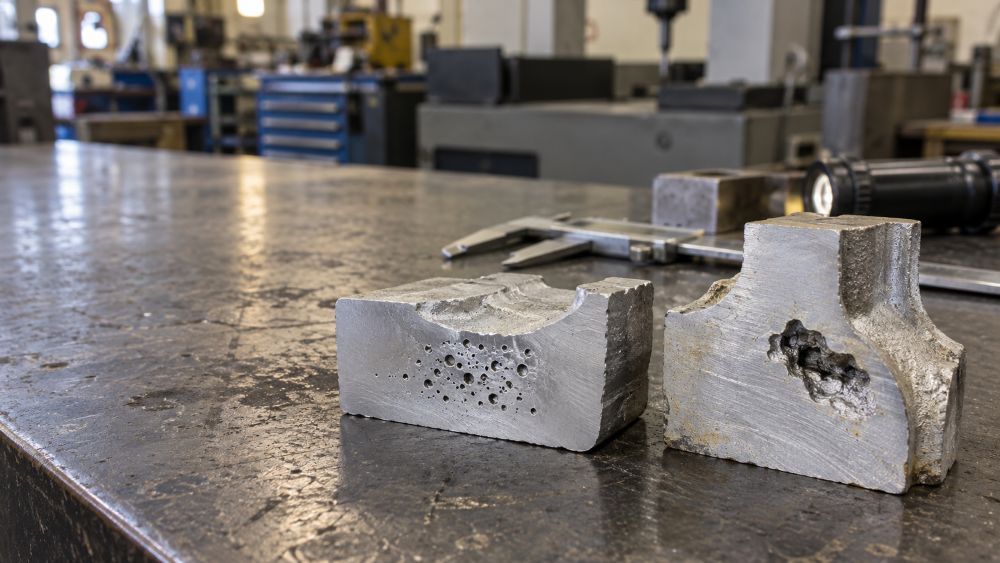

Gas porosity is frustrating because the casting can look fine at first. The problem may only appear during X-ray inspection, leak testing, or machining.
In many cases, the cause is not the metal. It is the mold.
This article is a practical extension of our Magnesium Alloy Casting Sand guide. It focuses on one question: how does sand control affect gas defects in magnesium castings?
Where the Gas Comes From
When molten metal enters a sand mold, moisture becomes steam. Organic matter can also break down and release gas. Existing air in the cavity expands.
If the gas cannot escape fast enough, pressure builds. Gas can enter the liquid metal and leave pores in the casting. It can also slow the metal flow and cause incomplete filling.
Moisture Is Usually the First Check
Clay-bonded sand needs water to develop wet strength. But water also creates steam.
The source material gives a reference range of 4.5–5.5% moisture for aluminum and magnesium casting sand.
During humid conditions, keep closer to the lower limit. The practical target is the lowest moisture level that still gives safe mold strength.
Strength and Permeability Pull in Different Directions
More clay can raise wet strength. It also blocks the gaps between sand grains. Gas then has fewer paths out.
Over-ramming does the same thing. A strong mold that traps gas can still make bad castings.
The Sand Grain Matters
| Casting situation | Suggested silica-sand grade in source | Why it helps |
|---|---|---|
| General production | 70/140 | Balances finish and permeability |
| Large castings with higher gas-hole risk | 50/100 | Larger grain openings improve venting |
Finer facing sand gives a smoother surface. Coarser backing sand creates a better gas path through the rest of the mold.
Compaction and Venting
Over-ramming reduces the empty space between grains. Steam and reaction gas then escape more slowly.
The source gives a practical rule: compact more firmly at the bottom and near the outside of the flask, then keep upper and internal areas more open and uniform.
Blind pockets, cross runners, and hard-to-fill sections may need dedicated vents. Vents should not break through the mold face.
Surface Drying Helps
For large or moisture-sensitive castings, surface drying with torch or gas heating reduces moisture where metal first contacts the mold.
It helps, but it cannot correct poor permeability, contaminated reclaimed sand, or excessive ramming.
Real Data: Two Fire-Resistant Sand Formulations
| Component/property | Formula 1 | Formula 2 |
|---|---|---|
| 70/140 silica sand | 100 | 100 |
| Bentonite | 4–5 | 4–5 |
| Magnesite powder | 7–8 | — |
| 28% sodium alkyl sulfonate solution | 2–3 | 3–4 |
| Boric acid | 1.5–2.5 | 1.5–2.5 |
| Permeability | >70 | >90 |
| Wet compressive strength | >0.4 kg/cm² | >0.4 kg/cm² |
| Gas evolution | 13.0 cm³/g | 10.0 cm³/g |
Formula 2 shows higher permeability and lower reported gas evolution. It is not automatically right for every part, but it shows the data a foundry should balance.
A Simple Porosity Checklist for Buyers
- What was the mold moisture for this batch?
- What was the permeability result?
- What wet strength was recorded?
- Was facing sand different from backing sand?
- Was the mold surface dried?
- Were vents added near blind pockets?
- Was reclaimed sand checked for combustible contamination?
- Was mold hardness consistent across the cavity?
What Good Sand Control Delivers
Good sand control lowers hidden porosity, machining interruptions, leak-test failures, rework, and late delivery.
The best foundries treat moisture, permeability, strength, compaction, and venting as one system. They record the data and connect it to casting results.
Conclusion
Start with moisture. Then check permeability, grain size, clay content, compaction, venting, and surface drying.
That is how a sand process becomes a quality tool instead of a source of hidden defects.
Technical and safety note: Numerical values were translated from supplied historical technical pages. They are reference information, not stand-alone operating instructions. Modern work requires current safety data, ventilation, exposure control, regulations, and qualified foundry supervision.