

Good casting quality depends on more than getting metal into the mold. During filling and solidification, the foundry has to consider pouring temperature, pouring rate, risers, chills, gating, and the temperature field inside the casting. These factors affect how the casting solidifies and whether a dense, sound structure can be obtained.
Each aluminum or magnesium alloy casting solidifies in its own way. Alloy type, part geometry, size, wall thickness, and process conditions all matter. Even so, the same basic rules apply: understand the temperature distribution, understand where solidification finishes last, and choose a solidification pattern that suits the part.
Temperature Distribution During Solidification
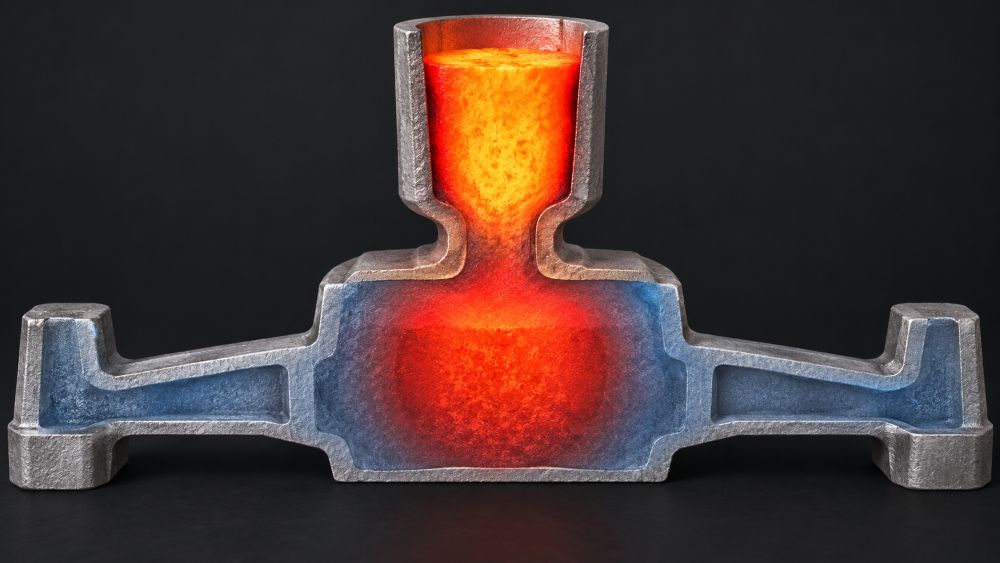
The temperature distribution in a casting changes as the metal freezes. It is affected by heat transfer through the mold, casting wall thickness, and the cooling conditions around each part of the casting.
Different casting processes create different temperature conditions. The mold material, the rate of heat removal, and the section thickness all influence the temperature gradient across the casting wall. A thin section and a thick section do not solidify at the same rate.
The alloy also matters. Aluminum-silicon alloys generally have a relatively narrow freezing range. Aluminum-copper and aluminum-magnesium alloys may have a wider freezing range. These differences affect the temperature gradient and the width of the solidification zone during freezing.
In production, the freezing range cannot be changed by the foundry. What can be changed is the pouring temperature, cooling condition, gating layout, and metal entry position. These are used to influence the temperature pattern in the casting and reduce the unfavorable parts of the solidification zone.
Why the Last-to-Solidify Area Matters
When looking at a casting, it is not enough to consider one local freezing front. Each section is connected to the surrounding metal. A local area may look ready to freeze, but the sections above, below, or beside it can change the actual order of solidification.
Metal contracts as it solidifies. If the last area to freeze cannot receive feed metal, shrinkage cavities or shrinkage porosity can appear. The solidification pattern therefore has to match the alloy, casting shape, and quality requirement.
For some castings, the preferred approach is sequential solidification. For others, simultaneous solidification is more practical. These two methods are different, but one casting can use both in different areas.
Sequential Solidification
Sequential solidification means the casting freezes in a planned direction. For aluminum and magnesium alloy castings with a large solidification shrinkage, this makes it possible to use the riser to feed the metal as the casting contracts.
The usual objective is to make the casting solidify toward the riser. In a vertical arrangement, the casting can be designed to freeze from bottom to top so the riser feeds the final area to solidify.
Section changes, riser location, chills, and the entry of metal all affect this sequence. The arrangement should guide the final freezing area toward a location where feeding can continue.
This method is especially important where internal soundness is required. It is used to reduce the risk of shrinkage cavities and shrinkage porosity in heavy or complex areas of a casting.
Simultaneous Solidification
Simultaneous solidification aims to make several areas of the casting freeze at roughly the same time. It is often used for thin-walled parts or castings where a long directional feed path is difficult to establish.
In a thin casting, shrinkage porosity can be difficult to eliminate by relying only on a long feeding route. A more even temperature pattern across the part can be the more practical choice.
Simultaneous solidification does not mean that every point in a real casting freezes at exactly the same moment. Wall thickness, local shape, and heat transfer are never completely uniform. The practical goal is to avoid a large difference in solidification time between connected areas.
For a casting with several regions, the overall part may be treated as a simultaneous-solidification casting while each local region is arranged to freeze sequentially toward a riser.
Equivalent Thickness and Solidification Time
The time required for a section to solidify can be expressed by the relationship:
τ = R² / k²
Where:
τis solidification time, in minutes.Ris equivalent thickness, in centimeters.kis the solidification coefficient, in centimeters per square root of minute.
A section with a longer solidification time will freeze later. Equivalent thickness is also called the casting modulus or volume-to-surface ratio. For a whole casting or a local area, it can be expressed as volume divided by surface area. For a cross-section, it can be expressed as section area divided by perimeter.
This gives the foundry a way to compare different parts of a casting. A larger equivalent thickness usually means a longer solidification time and a greater need to consider feeding and temperature control.
Choosing the Solidification Pattern
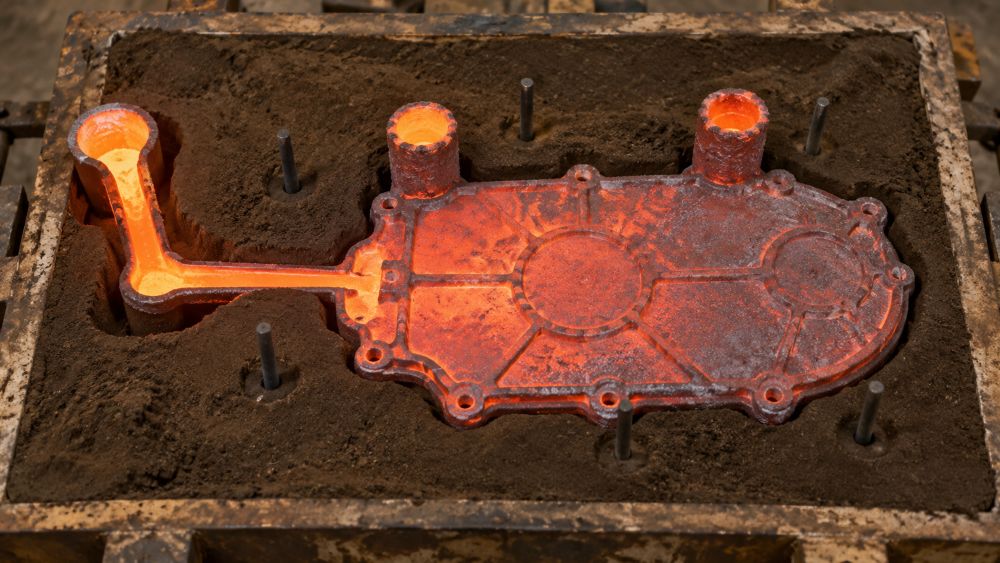
The solidification method should be selected from the alloy characteristics, part shape, technical requirements, and the defects most likely to occur. A simple rule is not enough for every casting.
Complex aluminum and magnesium alloy castings can use both approaches. Engine-block-type castings, for example, may require bottom-to-top sequential solidification in the vertical direction so the riser can feed the final freezing areas. Across the horizontal direction, the casting may be treated as several regions that solidify more evenly.
Thin magnesium alloy cover castings are another example. They are often poured horizontally. Because the walls are thin and shrinkage porosity is difficult to remove, the overall casting may use simultaneous solidification in the horizontal direction. Within a local region, the metal can still be arranged to freeze toward the riser.
The casting design should therefore be based on the actual part, not on one fixed rule. Temperature distribution, wall thickness, feeding, and solidification order have to be considered together.