
What Does CNC Mean?
CNC stands for Computer Numerical Control. In manufacturing, CNC describes a system in which programmed instructions control the movement of a machine tool. CNC machines can mill, turn, drill, and shape metal or plastic parts repeatedly from a digital design. For a buyer, CNC usually means a part is made from a CAD file, a specified material, and an agreed inspection plan rather than by hand layout alone.
The acronym tells you how the machine is controlled. It does not tell you which machine is used, how accurate every feature will be, or whether the part is inexpensive to make. Those answers come from the drawing and the manufacturing route.
What Is CNC Machining?
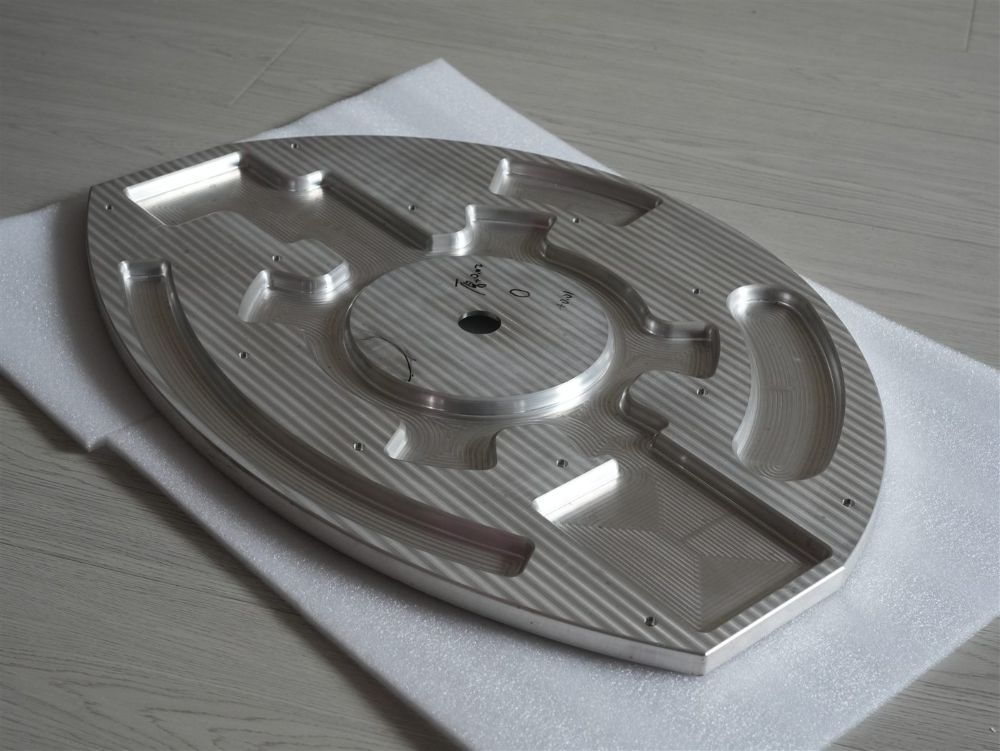
CNC machining is a material-removal process. A cutting tool, abrasive, electrical discharge, laser, or waterjet removes material under program control until the part matches the intended geometry. Milling and turning are the two routes most buyers see, but they are not the whole story.
In a CNC mill, the cutter normally rotates while the workpiece is held in a vise, fixture, or pallet. The machine can make faces, pockets, holes, slots, and contoured surfaces. In a CNC lathe, the workpiece rotates and the tool cuts the outside diameter, bores internal features, or produces threads. A shop may use both machines on the same part.
CNC is broader than machining. The same kind of programmed control can run grinders, wire EDM machines, lasers, routers, waterjets, and measuring equipment. The U.S. Manufacturing.gov definition describes CNC as digital control of a physical machine through integrated actuators, electronics, sensors, and a dedicated real-time computer. Its CNC overview is a useful plain-language reference.
How a CAD File Becomes a Finished Part
The job starts with a 3D model, but a usable quote usually needs more than that. The drawing tells the shop what material to buy, which dimensions matter, what surface finish is required, and how the part will be inspected.
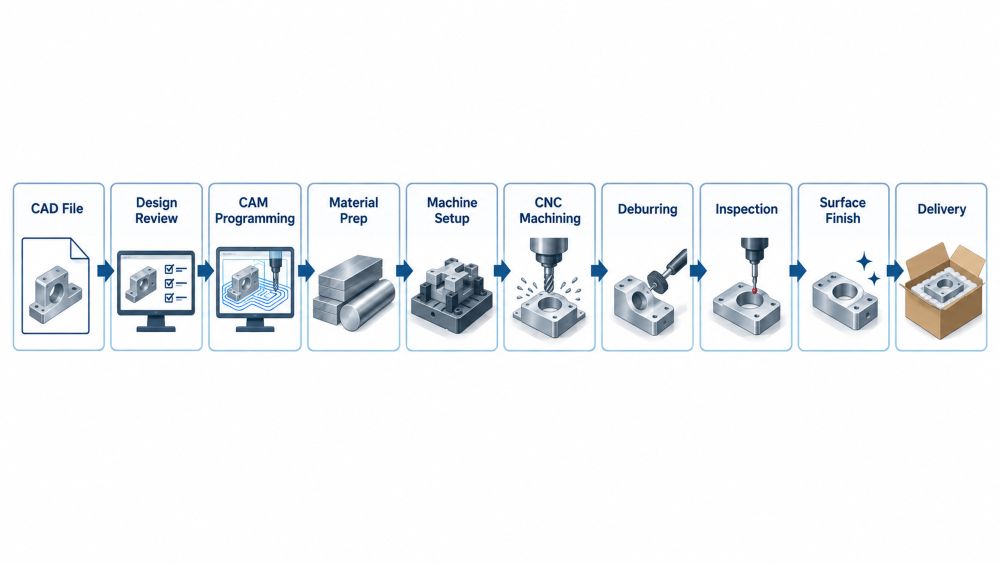
The usual path looks like this:
CAD file → design review → CAM programming → material preparation → machine setup → CNC machining → deburring → inspection → surface finishing → delivery
During design review, the shop looks for small details that have a large effect on cost or risk. A deep narrow pocket may require a long tool. A sharp inside corner may not be reachable with a standard end mill. A thin wall can move after the material around it is removed. These are normal issues, but they are cheaper to resolve before the first setup.
CAM software then creates the toolpaths. The programmer chooses cutters, approach directions, cutting strategy, speeds, feeds, and where the part can be held. Material is cut to a manageable blank, then clamped. The first article is normally checked before the job moves into a larger quantity.
Deburring is not cosmetic cleanup that can be ignored. Drill exits, milled edges, and tapped holes can leave burrs that affect fit, sealing, electrical contact, or safe handling. Surface finishing, such as anodizing, plating, coating, or passivation, is handled after machining when the specification calls for it.
CAD, CAM, G-Code, and the Controller
These four terms are often used together, but they do different jobs.
CAD means computer-aided design. It is the digital part geometry: the holes, faces, radii, pockets, threads, and overall shape. A STEP file is common for sending the model to a supplier. A 2D PDF drawing still matters because it carries tolerances, notes, datums, material callouts, and inspection requirements that may not exist in the model.
CAM means computer-aided manufacturing. CAM software uses the model to build a cutting plan. The program may use a large face mill first, then smaller end mills for pockets, drills for holes, and a finishing tool for a critical wall. CAM is where a reasonable design can become an efficient setup—or an expensive one.
G-code gives the machine its motion instructions. It tells an axis where to move, at what feed rate, and along what path. M-codes handle machine functions such as spindle start and stop, coolant, tool changes, and clamps. Exact code conventions vary by controller and machine.
The controller reads the program and coordinates motors, feedback systems, and safety logic. That does not make the process unattended by default. An operator still loads material, checks tools, verifies the first piece, watches chip buildup, and responds when the process does not behave as expected.
Main Types of CNC Machines
The right machine follows the part shape. A housing with pockets and threaded holes usually begins on a mill. A shaft usually begins on a lathe. A hard conductive feature with a fine internal slot may need EDM.
| Machine | What it does in practice | Parts it commonly suits |
|---|---|---|
| CNC mill | A rotating cutter removes material from a held workpiece | Housings, brackets, plates, manifolds, fixtures |
| CNC lathe | The workpiece rotates while a tool cuts its diameter or bore | Shafts, bushings, threaded adapters, rings |
| 5-axis machining center | The cutter or part approaches features from several directions in one setup | Complex structural parts, impellers, medical and aerospace components |
| CNC router | High-speed cutting, usually with lighter duty than a metal machining center | Plastics, foam, wood, composites, light sheet work |
| Wire EDM | A controlled electrical discharge cuts conductive material with a wire | Narrow slots, punch profiles, hardened-tool details |
A 3-axis mill is often enough for a plate, a simple bracket, or a block with features on the top and sides. If the part needs work on several faces, the shop may turn it over or use a different fixture. Each additional setup creates another chance for a small positional shift.
Four-axis equipment adds rotary movement for parts such as round features or work around a cylinder. Five-axis machining can tilt and rotate the part or tool so more faces are reached without repeatedly taking the part out of the fixture. That is often its real value. It can reduce accumulated location error and shorten a complicated setup.
Five-axis is not automatically the cheapest choice. A simple flat part with through holes does not need a five-axis program just because a five-axis machine exists. The additional capability earns its cost when it removes difficult setups, tool-access problems, or hand repositioning.
Materials That Can Be CNC Machined
CNC machining works with a wide range of materials. The machine itself is only part of the decision; cutting behavior, available stock, finishing route, and required properties also matter.
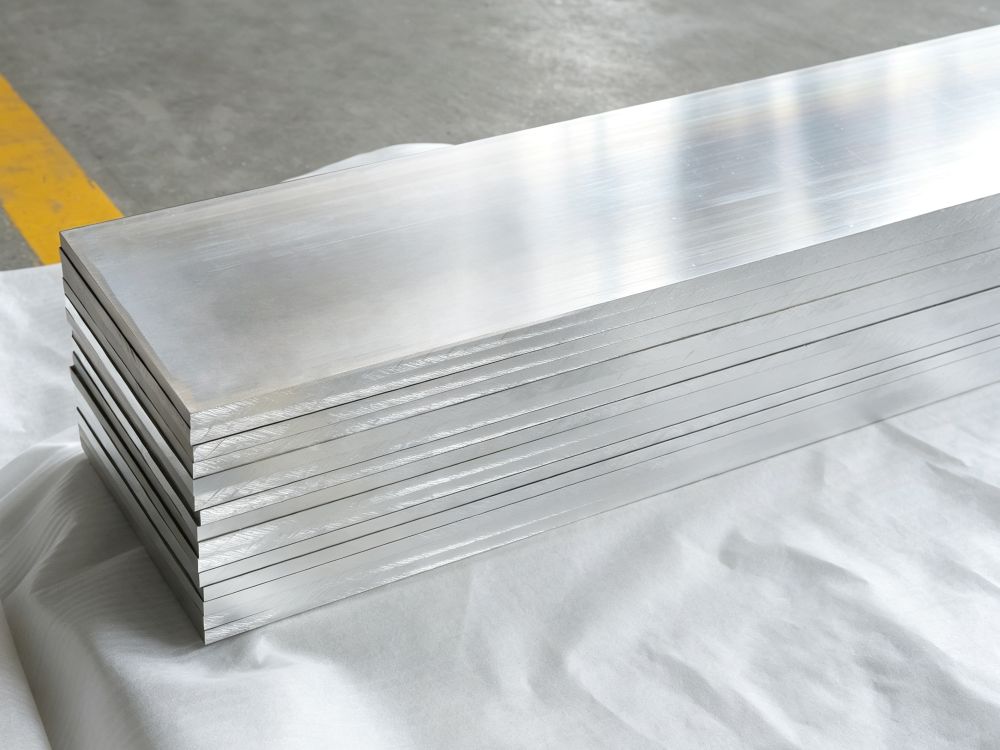
Aluminum is commonly used for housings, fixtures, frames, and lightweight machined parts. It machines efficiently in many grades. Stainless steel gives corrosion resistance and strength but usually takes longer to cut than aluminum. Titanium is selected for high strength-to-weight performance and corrosion resistance, though its machining route requires careful heat and tool management.
Copper and brass are common where electrical conductivity, thermal performance, or corrosion behavior matters. Copper is soft and ductile, so burr control and workholding deserve attention. Engineering plastics such as POM, nylon, PEEK, and polycarbonate can be CNC machined when the application needs insulation, low mass, chemical resistance, or a quick prototype.
Magnesium alloys are highly machinable, but chip control, heat management, housekeeping, and fire-safety procedures require special attention. Grade, product form, and surface-treatment requirements should be confirmed before production. This is not a material to send to a shop that treats every chip bin the same way. Our magnesium CNC machining page covers the project information worth settling before a magnesium order moves ahead.
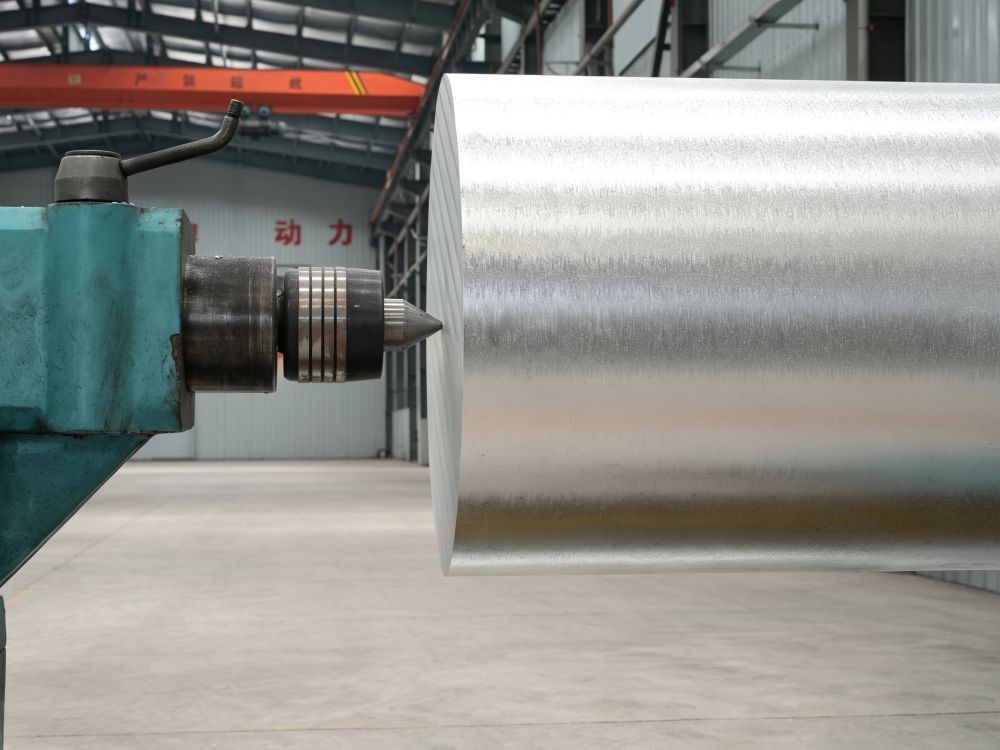
Material choice also affects the blank size. A part machined from a near-net forging or an extrusion may need far less cutting than the same part made from a large rectangular block. On a part with a lot of material removal, that change can affect both price and lead time.
Tolerances Are Feature-Specific
There is no single tolerance that every CNC machine can hold on every part. A short, well-supported bore can be controlled differently from a thin wall at the end of a long part. Material stability, part size, cutter reach, wall thickness, thermal growth, workholding, and measurement method all matter.
General tolerances keep a drawing readable and economical. Critical dimensions should be called out where they serve a real function: a press fit, a bearing location, a sealing face, a threaded interface, or a controlled gap. Placing the same very tight tolerance on every outside dimension often adds inspection and machining time without improving the assembly.
Flatness needs the same discipline. A broad thin plate may read differently when clamped to a fixture than when it rests freely on a surface plate. If free-state flatness matters, state that. If a feature is inspected under support, the drawing should say so.
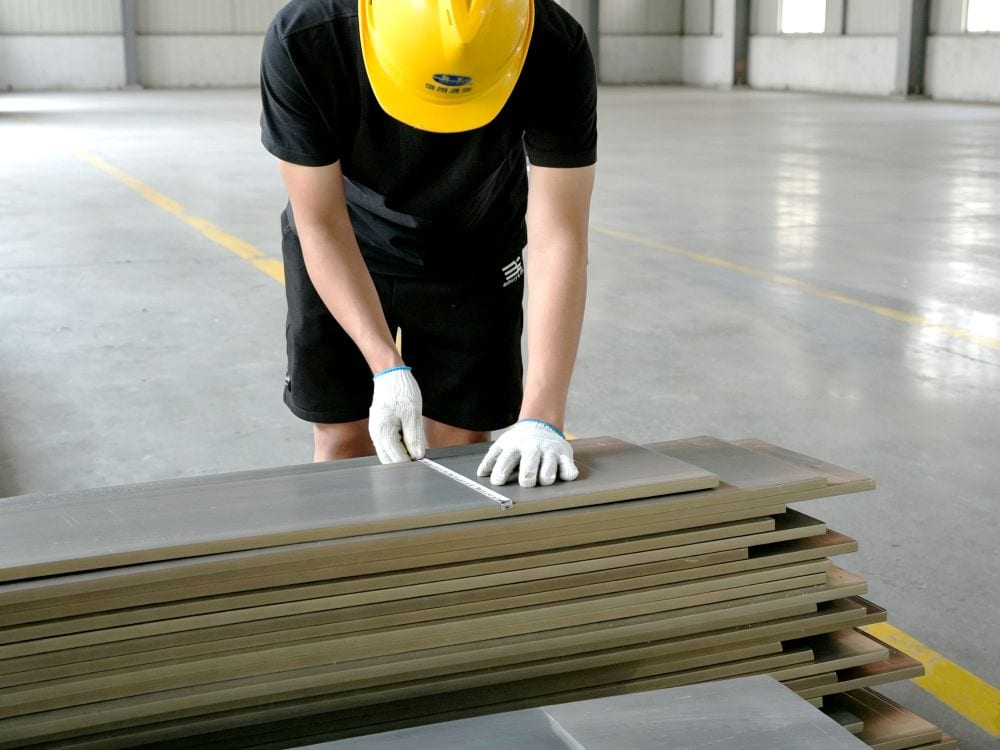
Inspection has to match the requirement. Calipers work for many ordinary features. Micrometers, height gauges, bore gauges, optical systems, or a CMM may be needed for more demanding work. See our CNC machining tolerance chart before using a tight number as a default note.
What Drives CNC Machining Cost?
The part price is not only “machine time per hour.” Material and blank size matter first. A large billet that will become a small part can carry substantial material cost and cutting time. A forging, casting, or extrusion may reduce that waste once volumes are high enough to justify its tooling.
Setups are another major factor. A part that can be completed in one or two stable holds is usually easier to quote than one that must be turned several times, supported with custom jaws, or re-indicated after each operation. Tool access matters too. Deep cavities, tiny internal radii, long threads near walls, and hard-to-reach features can extend the program and cycle time.
Surface finish, coating, deburring, special packaging, material certificates, and inspection reports belong in the quote request. They are real process steps. Leaving them off the first request may produce an attractive number that changes later.
Quantity changes the answer. CNC is usually a strong fit for prototypes, low-volume parts, and complex components. At very high volumes, simple parts may be better evaluated against casting, forging, stamping, or a dedicated forming process. There is no need to force CNC into a production route that is no longer competitive.
When CNC Is the Right Route
| Requirement | Is CNC usually a good fit? | What to check first |
|---|---|---|
| One prototype | Yes | Material availability and the drawing revision |
| Low-volume complex metal parts | Usually | Setup count and reachable features |
| Tight functional dimensions | Yes | Datum scheme and inspection method |
| Very high-volume simple parts | Compare with forming or casting | Tooling cost, cycle time, and material waste |
| Large amount of material removal | Needs a cost review | Near-net stock, forging, or extrusion options |
| Sharp internal corners | Sometimes not | EDM, a corner-radius change, or another process |
The choice is often obvious after a short design review. A prototype housing, a precision bracket, or a custom adapter may be ideal for CNC. A simple part needed in hundreds of thousands per year should be priced against other routes before a production commitment is made.
What a CNC Supplier Needs Before Quoting
Send the 3D model and the current 2D drawing when both are available. Include the material grade, quantity, critical tolerances, finish or coating, and the delivery location. If a report is required, say whether you need basic dimensional records, a material certificate, first-article documentation, or another specified format.
For an ongoing program, annual demand is more useful than a single release quantity. It helps the supplier decide whether a dedicated fixture, near-net blank, or different manufacturing route is worth considering. A note about mating parts can also prevent the wrong assumption about a fit or a cosmetic surface.
Frequently Asked Questions
It stands for Computer Numerical Control: programmed digital control of machine movement and related functions.
Is CNC machining the same as milling?
No. Milling is one CNC machining process. Turning, grinding, EDM, routing, laser cutting, and waterjet cutting can also be CNC-controlled.
Does a CNC machine need an operator?
Yes. The degree of hands-on work varies, but operators and technicians load parts, verify setups, manage tools and chips, inspect parts, and handle exceptions.
What file format is needed for CNC machining?
A STEP model is widely useful for the 3D geometry. A PDF drawing is still important for tolerances, material, finish, notes, and critical dimensions.
Can magnesium be CNC machined?
Yes, when the shop has the right chip-management, housekeeping, and fire-safety procedures for the material and the machining plan.
Is CNC for prototypes or production?
Both. It is especially useful for prototypes and low-to-medium-volume complex parts. For high-volume simple parts, compare it with other processes.