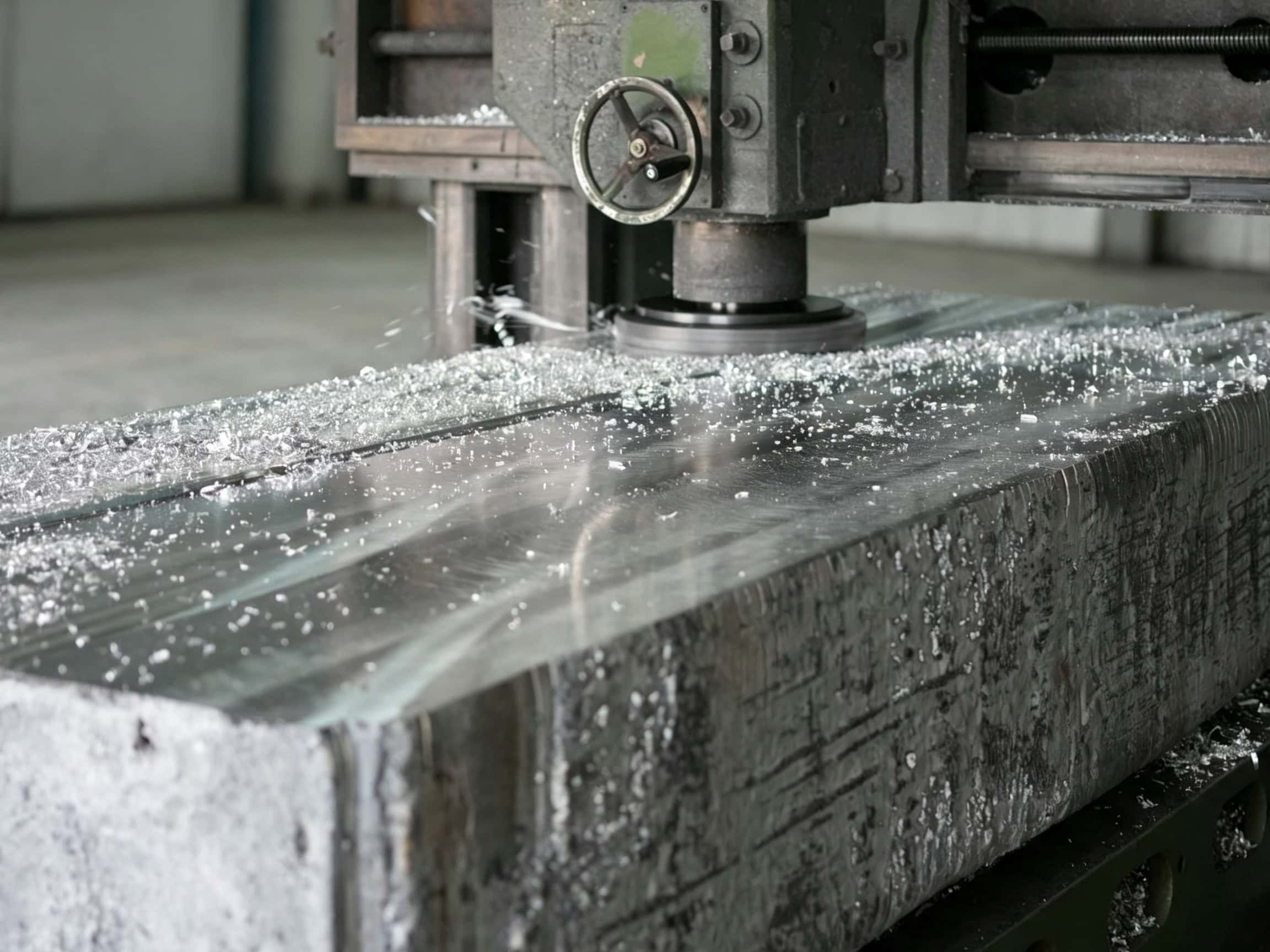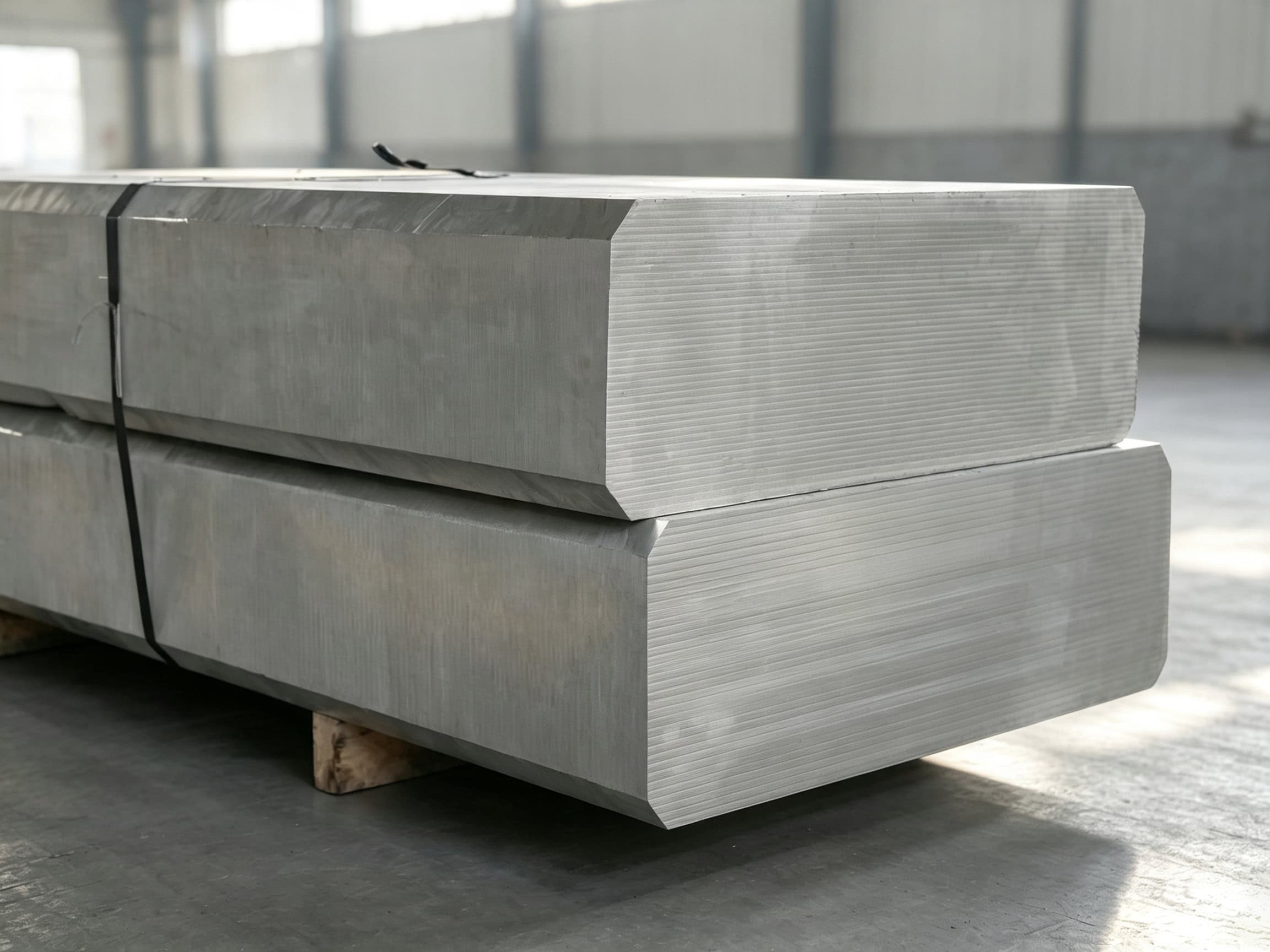

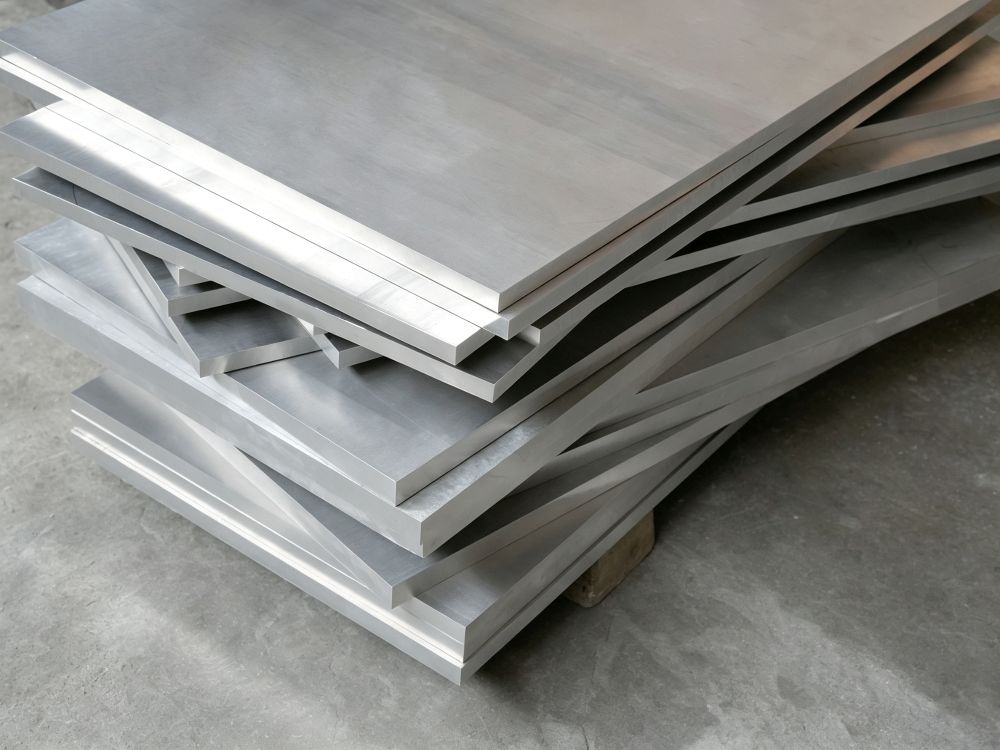
In robotics, aerospace, and EVs, lightweighting is everything. When engineers want to cut weight without sacrificing strength, the choice usually comes down to four materials: Magnesium, Aluminum, Carbon Fiber, or Titanium.
However, selecting the optimal material requires far more than comparing raw density. Engineering teams must evaluate specific strength, stiffness, vibration damping, thermal conductivity, electromagnetic shielding (EMI), CNC machinability, cycle time, and total manufacturing economics. This comprehensive technical guide provides an objective, data-backed comparison across all critical performance parameters to help engineering teams make precise, cost-effective material decisions.
1. Core Material Properties & Physical Comparison Matrix
The table below summarizes the key mechanical, thermal, and physical properties of Magnesium AZ31B/ZK60 versus Aluminum 6061/7075, Carbon Fiber (CFRP), and Titanium TC4 under standard room temperature conditions:
| Property / Parameter | Magnesium (AZ31B / ZK60) | Aluminum (6061-T6 / 7075-T6) | Carbon Fiber (CFRP Quasi-Isotropic) | Titanium (Ti-6Al-4V Gr 5) |
|---|---|---|---|---|
| Density (g/cm³) | 1.78 – 1.83 (Lightest metal) | 2.70 – 2.81 (+50% heavier) | 1.50 – 1.60 (-15% lighter) | 4.43 (+145% heavier) |
| Tensile Yield Strength (MPa) | 220 – 310 | 276 – 503 | 450 – 800 (Directional) | 880 – 1,100 |
| Elastic Modulus (GPa) | 45 | 69 – 72 | 70 – 140 (Layup dependent) | 114 |
| Specific Yield Strength (kN·m/kg) | 120 – 170 | 102 – 180 | 300 – 500 | 198 – 248 |
| Specific Damping Capacity (SDC %) | 40% – 60% (10× Aluminum) | 1% – 5% | 2% – 8% | <1% |
| Thermal Conductivity (W/m·K) | 96 – 120 | 130 – 170 | 5 – 15 (Poor thermal sink) | 6.7 (Very poor) |
| EMI Shielding Effectiveness | >60 – 85 dB (Excellent) | >70 – 90 dB | Low / Requires metallic mesh | Moderate |
| Machinability Rating | Superior (100% baseline) | Good (50% – 70%) | Poor (Abrasive / delamination) | Difficult (20% – 30%) |
| Raw Material Cost Index | Moderate ($$) | Low ($) | Very High ($$$$) | High ($$$) |
2. Magnesium vs. Aluminum: Weight Reduction & Vibration Damping
Aluminum (particularly 6061-T6 and 7075-T6) has long been the standard benchmark for lightweight metal fabrication. However, transitioning from Aluminum to Magnesium yields profound engineering advantages:
- 33% to 36% Direct Weight Reduction: Magnesium alloys have a density of only $1.78\text{ g/cm³}$, compared to $2.70\text{ g/cm³}$ for 6061 aluminum. In structural components where wall thickness is dictated by minimum casting or machining limits, switching to magnesium instantly cuts one-third of the component weight.
- 10× Higher Vibration Damping Capacity: Magnesium exhibits the highest internal friction and damping capacity of all structural metals. While aluminum rings and transmits high-frequency harmonics, magnesium absorbs mechanical vibrations within its lattice dislocations, dampening motor resonance, suppressing drone camera jitter, and extending fatigue life in dynamic machinery.
- Dent Resistance & Impact Absorption: For an equal weight panel, a magnesium plate is thicker than an aluminum plate ($t \propto 1/\rho$). Because bending stiffness scales with the cube of thickness ($E \cdot t^3$), an equal-weight magnesium structure provides significantly higher flexural rigidity than thin-gauge aluminum sheet.
3. Magnesium vs. Carbon Fiber (CFRP): Isotropy, Thermal & Manufacturing Cost
Carbon Fiber Reinforced Polymer (CFRP) boasts extraordinary unidirectional tensile strength. However, engineers frequently encounter severe practical bottlenecks when deploying carbon composites in high-volume or precision mechanical assemblies:
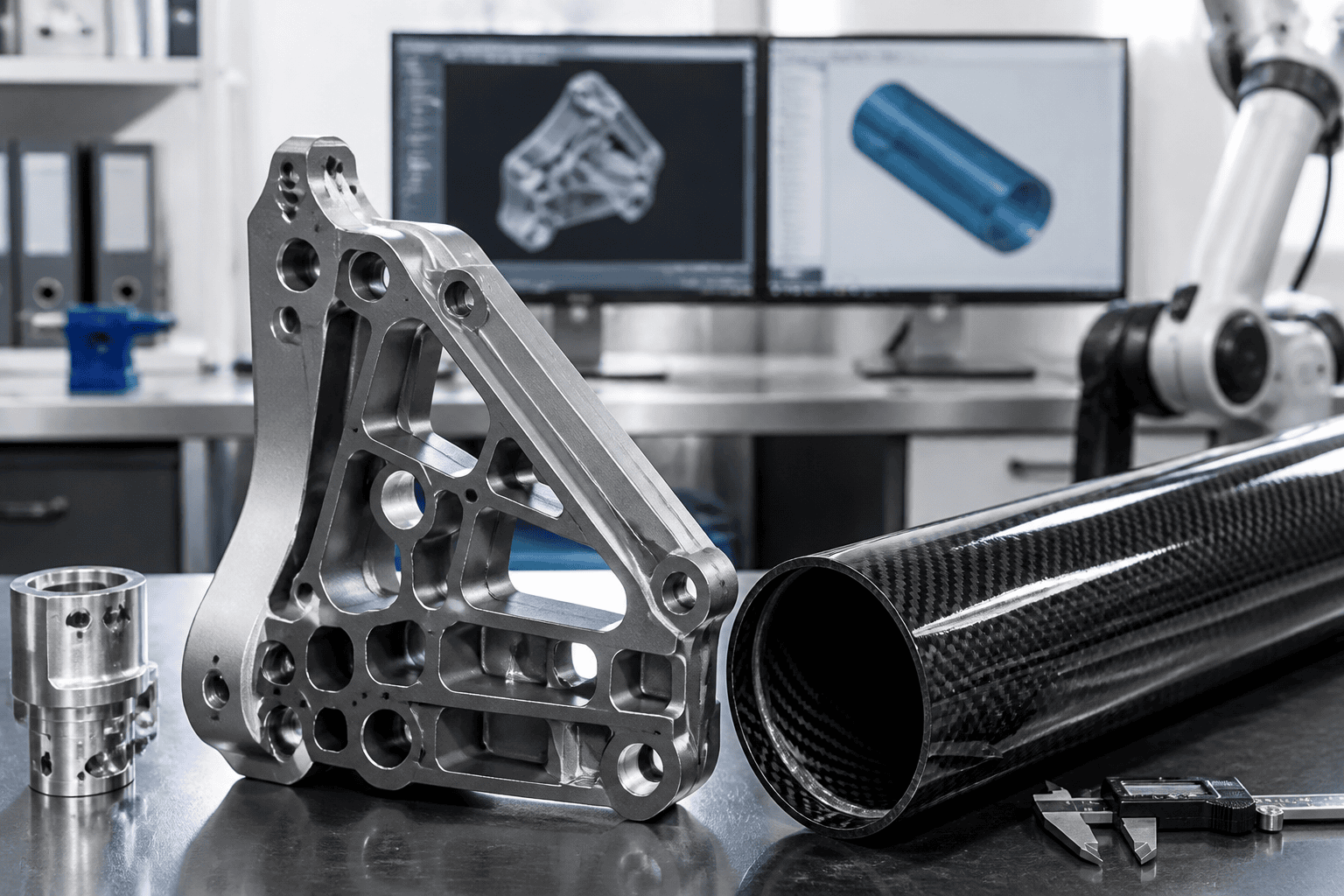
- Isotropic vs. Anisotropic Behavior: Carbon fiber strength is strictly directional along fiber orientations. Magnesium alloys are completely isotropic, delivering uniform mechanical strength, stiffness, and ductility across all 3D axes without delamination risk under multi-axial shear loads.
- Thermal Dissipation & EMI Shielding: Epoxy resin in carbon fiber composites acts as a thermal insulator ($5-15\text{ W/m·K}$), trapping heat generated by high-power motors, microprocessors, and battery modules. In contrast, magnesium ($96-120\text{ W/m·K}$) functions as a natural heat sink and provides over $60-80\text{ dB}$ of electromagnetic interference (EMI) attenuation without secondary shielding coatings.
- Tooling & Production Economics: Carbon fiber autoclaving and prepreg layups involve long cycle times and prohibitive non-recurring engineering (NRE) mold costs. Precision CNC machined or extruded magnesium parts eliminate autoclave bottlenecks, offering lower part unit costs for medium-to-high volume production.
- 100% Recyclability: Magnesium is infinitely recyclable through simple melting with <5% re-melting energy, whereas cured thermoset carbon composites pose substantial landfill and recycling hurdles.
4. Magnesium vs. Titanium (TC4): Cost-to-Weight & Precision Machinability
Titanium alloys (such as Ti-6Al-4V) are celebrated for exceptional yield strength ($>900\text{ MPa}$) and corrosion resistance. However, titanium is fundamentally misapplied in components where extreme tensile loading and temperatures above $300^\circ\text{C}$ are not strictly required:
- Extreme Density Difference: Titanium ($4.43\text{ g/cm³}$) is nearly 2.5 times heavier than magnesium ($1.78\text{ g/cm³}$). For inertial components such as robotic arm linkages and drone gimbals, titanium components dramatically increase rotational inertia ($I = m \cdot r^2$).
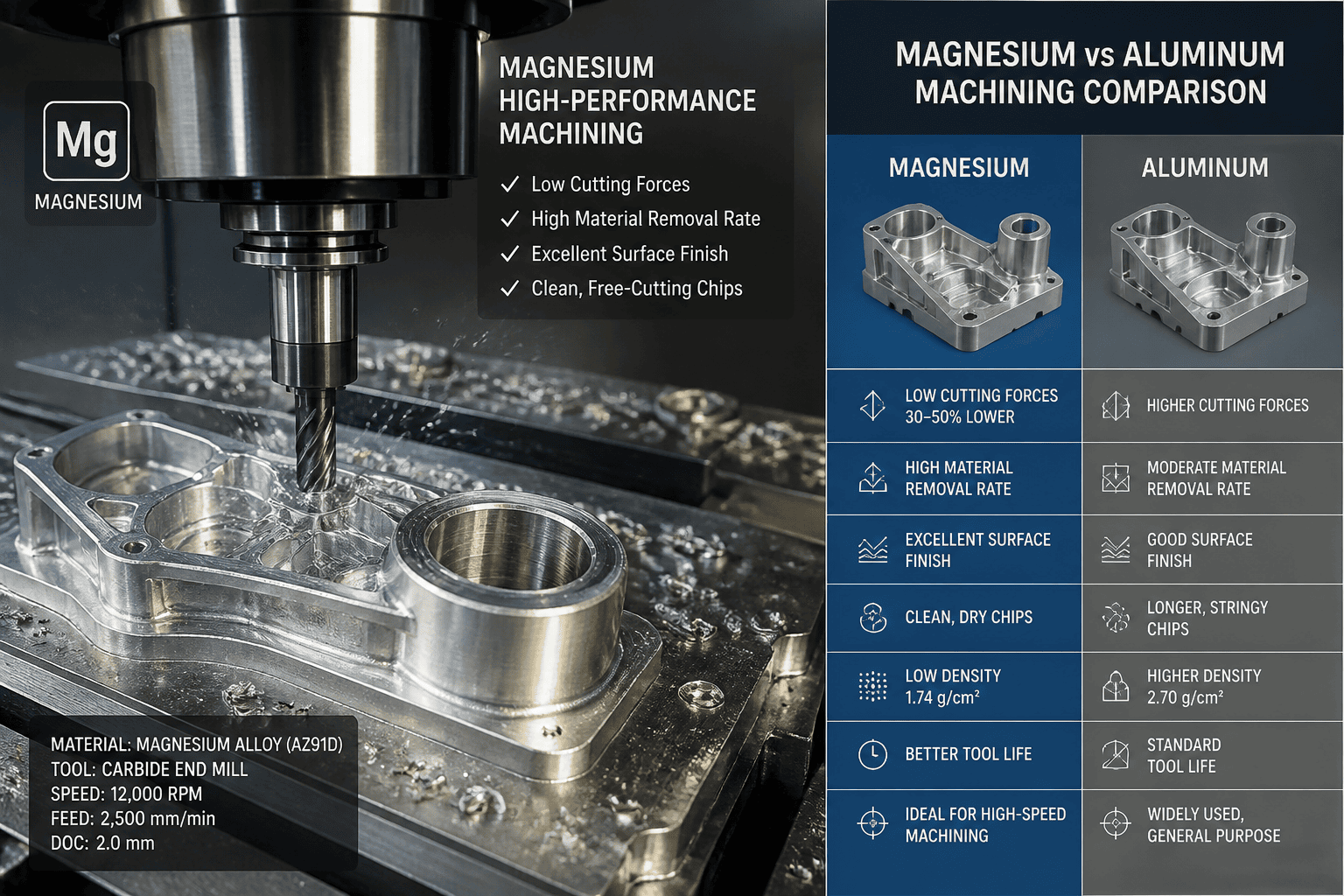
- Machinability & Tool Wear: Titanium has very low thermal conductivity and work-hardens rapidly, requiring slow cutting speeds ($v_c = 40-70\text{ m/min}$) and causing rapid carbide tool degradation. Magnesium allows ultra-high cutting speeds ($v_c = 1,000-2,500\text{ m/min}$), slashing CNC machining cycle times by up to 75% and dramatically reducing machine-hour costs.
5. Engineering Application & Material Selection Matrix
To assist design engineers in selecting the right material for specific structural requirements, consult the following application-driven matrix:
| Application Category | Primary Engineering Challenge | Recommended Material | Key Decision Driver |
|---|---|---|---|
| Drone Arms & Motor Mounts | Motor harmonic resonance & flight endurance | Magnesium (AZ31B/ZK60) | 10× vibration damping + 36% lighter than aluminum |
| Humanoid Robot Linkages | Dynamic inertia & rapid step response | Magnesium / ZK60 Forging | Lowest rotational inertia + high specific stiffness |
| EV Battery Top Covers | Weight reduction & EMI electromagnetic seal | Magnesium Sheet / Extrusions | Integrated thermal dissipation + >60 dB EMI shielding |
| Precision Optical Housings | Thermal dimensional stability & damping | Magnesium AZ31B Plate | Minimal internal stress + vibration isolation |
| High-Load Wing Spars | Unidirectional maximum tensile load | Carbon Fiber (CFRP) | Unmatched directional specific tensile modulus |
| Aerospace Turbine Hot Sections | Operating temperatures > 350°C | Titanium (Ti-6Al-4V) | High-temperature creep resistance & corrosion resistance |
6. Overcoming Magnesium Misconceptions: Corrosion & Surface Treatment
A legacy misconception regarding magnesium is corrosion vulnerability in harsh outdoor or marine environments. In modern manufacturing, advanced surface treatment engineering has entirely resolved this issue:
- Micro-Arc Oxidation (MAO / PEO): Converts the magnesium substrate into an ultra-hard, ceramic $\text{MgAl}_2\text{O}_4$ and $\text{MgO}$ crystalline coating ($10-30\,\mu\text{m}$), passing 500+ hours of ASTM B117 neutral salt spray testing and delivering exceptional dielectric breakdown voltage.
- Electroless Nickel & Chemical Passivation: Provides dense, conductive wear resistance and corrosion barrier protection for aerospace and electronic enclosures.
- Galvanic Isolation Design: Using zinc-nickel coated fasteners, nylon/PTFE insulating washers, and non-conductive primers completely prevents galvanic cell formation when assembling magnesium to steel or aluminum.
7. Summary & 24-Hour Custom Magnesium Fabrication RFQ
While carbon fiber excels in unidirectional tension and titanium dominates extreme thermal zones, Magnesium Alloys (AZ31B, ZK60, WE43) represent the definitive sweet spot for complex 3D lightweight structures—delivering unmatched vibration damping, rapid CNC machinability, natural EMI shielding, and superior manufacturing cost efficiency.
Miji Magnesium specializes in high-precision magnesium alloy manufacturing, supplying ASTM B90/B107 certified plates, extruded rods, seamless tubes, and 5-axis CNC machined custom parts with full EN 10204 3.1 MTC inspection certification.
Request a 24-Hour DFM Review & Factory Quote: Upload your 2D/3D CAD drawings (STEP, STP, IGES, DXF) to our engineering team at Precision CNC Machining Service or explore our certified stock at Magnesium Alloy Plates and Extruded Magnesium Bars.