
For industrial print production managers, foil stamping die makers, and high-end packaging engineers across print hubs in Germany, the United States, and Italy, a printing die is not just a piece of metal. It is the exact threshold where digital design transforms into high-value tangible luxury.
When executing deep-etched hot foil stamping, embossing, or high-speed letterpress operations, choosing between zinc, copper, and magnesium determines your machine uptime, line speed, and edge definition.
As a precision Magnesium Alloy Plate Manufacturer specializing in advanced alloy development at Miji Magnesium, we understand that a split-second variance in chemical etching or a micro-level inconsistency in sheet flatness can ruin a high-volume production run. This guide establishes the industrial benchmarks for integrating high-performance etched magnesium plates into modern global printing systems.
1. The Metallurgical Advantage: Why Modern Printmaking Rejects Heavy Metals
For decades, the global print industry relied heavily on zinc and copper plates for deep-etched die manufacturing. However, shifting demands for rapid turnaround times, sharper vector-to-metal translation, and strict environmental compliance have driven leading packaging manufacturers in industrial corridors like Ohio (USA) and Baden-Württemberg (Germany) toward precision-rolled photoengraving magnesium.
+-----------------------------------------------------------------------------------+
|               METALLURGICAL PERFORMANCE IN ROTARY PRINTING LINES                  |
+-----------------------------------------------------------------------------------+
|  [MAGNESIUM]  ███████████████████████████████ 100% (Ultra-Lightweight, Fast Heat) |
|  [ZINC]       ██████████████████             58%  (Heavy, Slow Thermal Response)  |
|  [COPPER]     ██████████████                 45%  (Extremely Heavy, High Cost)   |
+-----------------------------------------------------------------------------------+
Magnesium features a unique crystalline structure that allows for fast, uniform acid-etching profiles without the lateral undercutting common in lower-grade zinc sheets. Because magnesium is significantly lighter than copper, it dramatically reduces rotational inertia when mounted on high-speed rotary printing cylinders. This reduction protects drive motors from premature wear and minimizes vibration-induced registration errors on high-speed lines, prompting global buyers to establish strategic partnerships with a reliable custom magnesium alloy supplier to ensure stable production.
2. Thermal Dynamics in High-Speed Hot Foil Stamping and Embossing
In high-volume luxury packaging production—such as premium cosmetics folding cartons or spirits labeling—thermal conductivity dictates maximum line speed. Premium magnesium alloy products transfer heat faster and more evenly than steel or copper alternatives.
2.1 Uniform Heat Dispersion
When a hot foil stamping machine cycles at thousands of impressions per hour, any thermal dead zones across the die face will cause foil flaking or incomplete transfer. High-purity magnesium sheets guarantee homogenous thermal energy distribution. This allows operators to maintain lower, safer operating temperatures while achieving clean foil releases on complex substrates, from textured uncoated papers to synthetic polymers.
2.2 Structural Stability Under Cyclic Compression
Inferior photoengraving plates often experience thermal expansion and structural deformation under the continuous high-tonnage pressure of embossing lines. Precision-processed photoengraving magnesium maintains its dimensional integrity over long production runs. This stability eliminates structural warping, ensuring that fine lines and micro-text details remain crisp from the first impression to the last.
3. Structural Integration: Connecting Heavy Machinery Charts to Die Thickness
Selecting the correct gauge for your photoengraving plate is critical for ensuring smooth mechanical integration on the press bed. Much like choosing the correct industrial piping standards as detailed in our comprehensive Miji pipe and tube size chart guide, selecting printing plate thickness requires matching material characteristics with the exact mechanical clearances of your machinery.
For instance, flatbed cylinders used in traditional letterpress systems require different clearance tolerances than those found in modern CNC-milled rotary foil stamping units. Sourcing plates from an advanced magnesium alloy factory that features exact, uniform thickness across the entire surface area prevents uneven impression depth, saving press operators from spending hours applying manually cut make-ready patches underneath the die base.
4. Solving the Chemical Etching Equation: Depth vs. Shoulder Angle
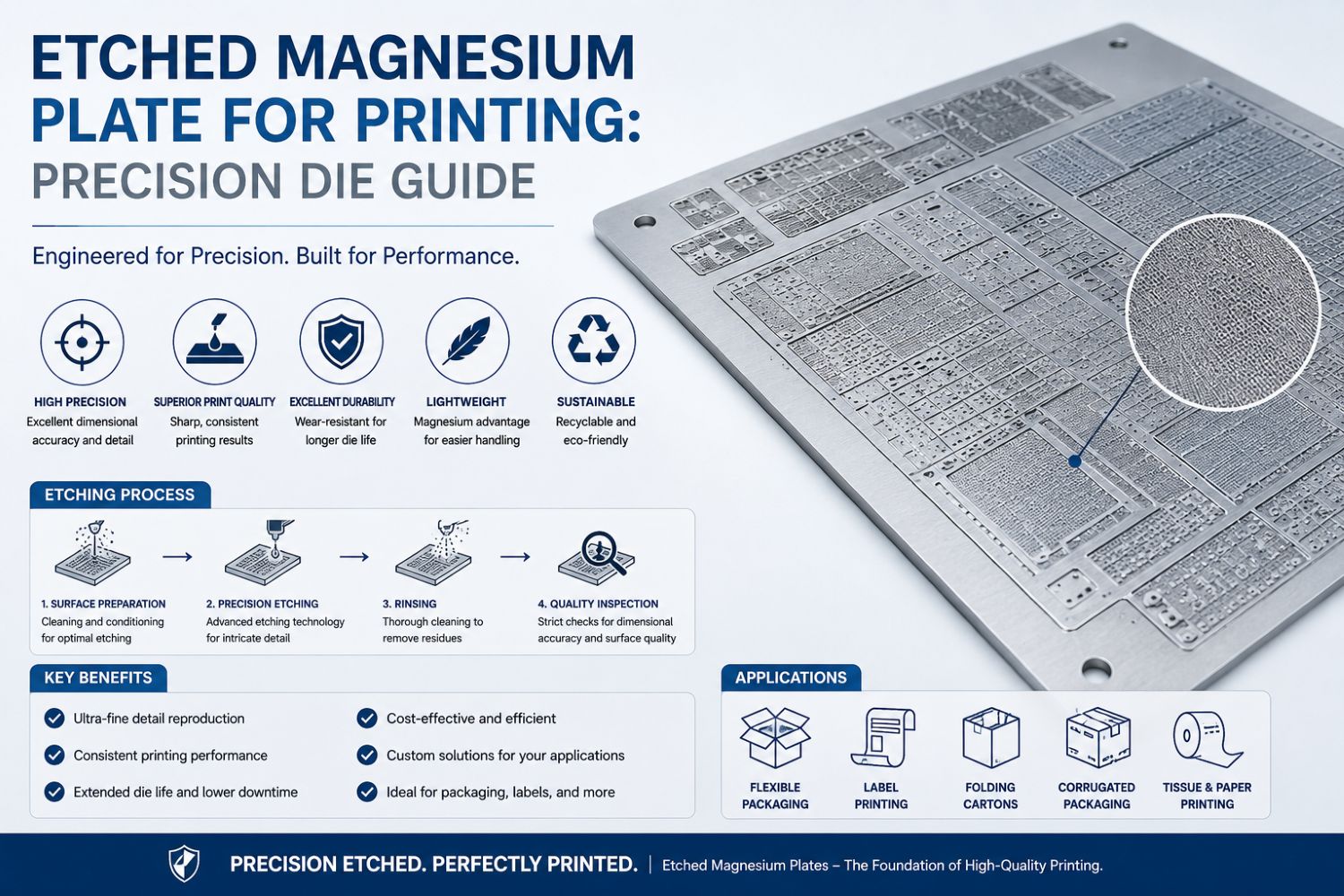
The hallmark of a high-performance etched magnesium plate lies in its shoulder profile. In both automated vertical etching machines and traditional splash etching tanks, the goal is to achieve deep, clean relief without weakening the structural base of fine design elements.
      CORRECT PROFILE (Steep Shoulder)           INCORRECT PROFILE (Undercutting)

               ▇▇▇▇   <- Image Face                    ▇▇▇▇   <- Image Face
              /    \                                  (    )
             /      \  <- Robust Support             /      \ <- Weak Base
      ═══════        ═══════                  ═══════        ═══════
When processing fine-serif typography or security micro-patterns, the nitric acid bath must dissolve unexposed areas vertically rather than cutting horizontally beneath the photoresist layer. High-quality custom magnesium plates are formulated with optimized grain structures that react predictably to chemical additives like filming agents. This chemical balance creates clean, steep shoulders that support delicate design highlights, preventing fine type from collapsing under heavy impression pressure.
5. Global Logistics Alignment: Sourcing High-Performance Alloys for Western Print Hubs
Sourcing raw industrial materials from East Asian manufacturing centers requires careful supply chain management, clear material certification, and strict adherence to international shipping standards.
- Custom Protection and Zero-Defect Crating: Because magnesium is reactive to atmospheric moisture, international shipments require protective, humidity-controlled vacuum packaging to prevent oxidation during transit.
- Traceable Heat Lot Certifications: Every industrial batch must be accompanied by accurate chemical composition analysis reports, ensuring cross-border compliance with material regulations across North America and Europe.
- Predictable Lead-Time Engineering: Print production facilities operate on rigid fulfillment schedules. Industrial suppliers must sync production outputs directly with global air-freight and ocean-freight networks to ensure raw die stocks arrive well ahead of critical production deadlines.
6. Real-World Field Analysis: Fixing Premature Die Wear in Heavy Packaging Production
An industrial print finisher based in Texas (USA) experienced frequent line stoppages due to premature die wear while running a high-speed folding carton embossing job on dense, recycled board stock. The zinc dies they were using flattened out after less than 30,000 impressions, causing a noticeable loss of crisp edge detail.
6.1 Diagnostic Assessment
An analysis of the worn dies revealed that abrasive fibers within the recycled board stock were wearing down the soft face of the zinc metal. Additionally, the constant impact pressure was causing minor structural compression across the broader background areas of the design.
6.2 Tactical Resolution
The production team replaced the zinc dies with precision-hardened magnesium plates sourced directly from Miji Magnesium. Thanks to magnesium’s higher surface hardness and exceptional structural resilience, the replacement plates completed the entire production run of over 150,000 impressions without requiring a single die swap. This upgrade eliminated unexpected downtime and maintained sharp, uniform embossing quality from start to finish.
7. Strategic FAQ: Critical Questions Asked by Industrial Print Engineers
7.1 What is the maximum impression limit for an etched magnesium plate before detail degradation occurs?
On standard paperboard or premium label stocks, a properly processed, high-grade etched magnesium plate comfortably delivers between 100,000 and 200,000 crisp impressions. If the plate is chrome-plated or treated with specialized hard-anodized surface coatings, it can easily handle extended runs exceeding 300,000 impressions on non-abrasive substrates.
7.2 Why choose magnesium over copper for complex, multi-level embossing dies?
While copper offers high surface hardness for multi-million run jobs, magnesium etches significantly faster and more uniformly in chemical photoengraving lines. This fast processing makes magnesium far more cost-effective for medium to long runs. Furthermore, magnesium’s lightweight characteristics make it much easier and safer for pressroom operators to handle, mount, and store large-format die sets.
7.3 How should magnesium printing plates be stored to prevent oxidation between production runs?
After completing a print run, the plate must be thoroughly cleaned with solvent to remove all traces of ink, oil, or fountain solution. Once clean, spray the die face with a light layer of moisture-displacing protective oil, wrap it in anti-tarnish paper, and store it in a climate-controlled environment with low relative humidity.
8. Procurement Blueprint: Secure Direct Technical Consultation
Optimizing your press lines for high-performance etched magnesium plates requires looking past simple catalog numbers and choosing a partner who understands the underlying material science. Whether you are running high-speed rotary letterpress systems in Kentucky or manufacturing heavy foil-stamping dies in Bavaria, your metal substrate determines your finished print quality.
Contact our application engineering team directly at sales@mijimg.com or send a technical inquiry via our official Miji Magnesium portal. Provide your exact machinery models, desired etching depths, and production line speeds, and we will formulate a material solution designed to optimize your print operations.