
Copper sheet and copper plate come from the same metal, but they are not interchangeable purchasing terms. Thickness changes how the material bends, cuts, machines, ships, and performs in the finished product.
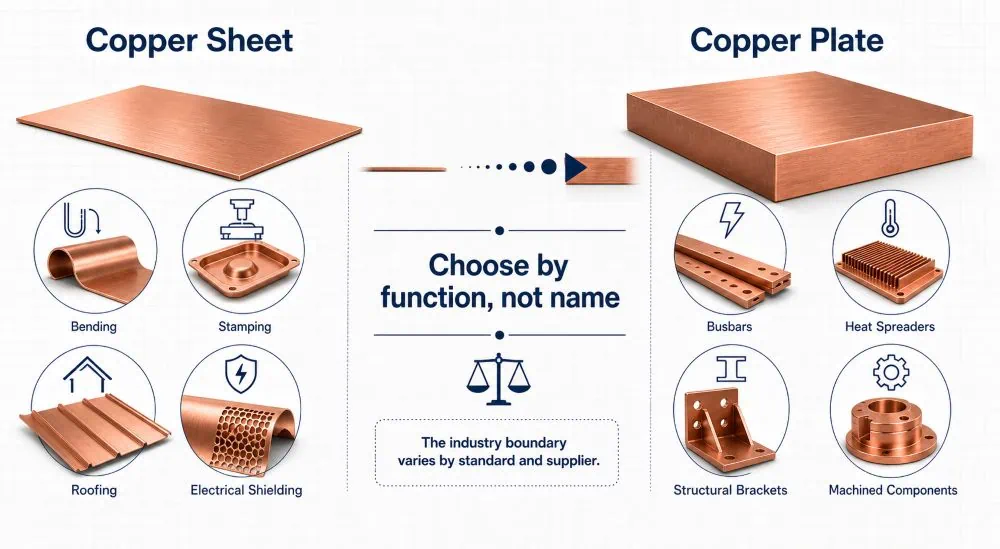
The simple rule is that sheet is the thinner, more formable option, while plate is thicker and more rigid. The useful rule is to choose by function. A heat spreader, busbar, stamped cover, roofing panel, and machined electrical part do not need the same copper form.
What Is the Difference Between Copper Sheet and Plate?
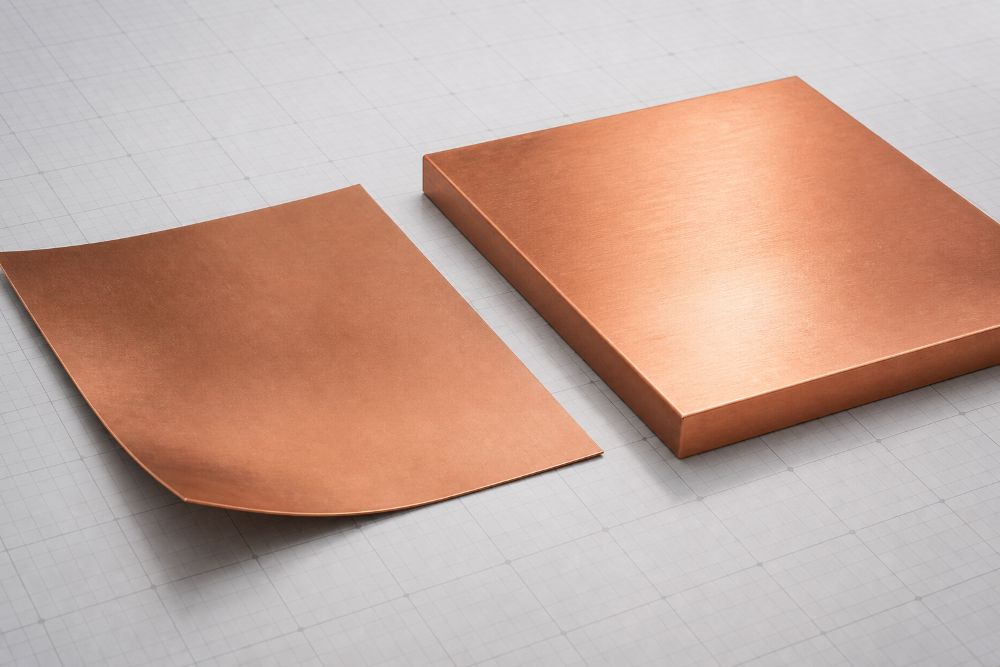
Both are flat-rolled copper products. The main difference is thickness. Copper sheet is generally supplied in thinner gauges or thicknesses and is easier to bend, stamp, shear, or form. Copper plate is thicker, stiffer, and more often cut, drilled, machined, or used where section thickness matters.
There is no single global thickness line that every mill, standard, and supplier uses. Some North American purchasing conversations treat 0.25 in. as a practical dividing point, but this is not universal. Standards, copper grade, stock range, and local industry practice can use different names.
For that reason, do not buy on the word “sheet” or “plate” alone. Put the actual thickness, tolerance, temper, width, length, finish, and grade on the RFQ.
Copper Sheet vs Copper Plate at a Glance
| Buying factor | Copper sheet | Copper plate |
|---|---|---|
| Typical form | Thin, flexible flat stock | Thick, rigid flat stock |
| Best downstream work | Bending, stamping, forming, shearing | Machining, structural fabrication, heavy-current parts |
| Handling | Often easier to coil, stack, and form | Heavier, more stable, may need lifting support |
| Main risk | Dents, distortion, spring-back | Higher material weight and more machining time |
| What to specify | Thickness, temper, flatness, surface | Thickness, flatness, edge condition, machining allowance |
This table is a buying guide, not a substitute for a standard. A 3 mm copper product may be called sheet by one supplier and plate by another. The drawing and application should decide the purchase description.
Thickness: Why the Name Matters Less Than the Number
Thickness affects nearly every downstream decision. Thin copper can bend around a radius, form into a cover, or be stamped into a shallow shape. Thick copper resists bending, supports deeper machining, and carries more section for current or heat transfer.
It also changes weight quickly. Copper is dense. A small increase in thickness can have a meaningful impact on material cost, handling, shipping, and the design of brackets or supports.
For an electrical part, the required cross-section may drive the choice. For an enclosure, forming behavior may drive it. For a heat spreader, flatness, contact area, thickness, and finish may all matter. Start with what the part has to do, then choose the form.
When Copper Sheet Is the Better Choice
Copper sheet is usually the better route when the part needs to bend, stamp, roll, draw, or cover a large area without unnecessary weight. It is widely used for formed electrical shields, roofing and cladding details, lightweight covers, heat-transfer skins, stamped electrical parts, and fabrication blanks.
The temper matters as much as thickness. A soft or annealed sheet may form well but can scratch or dent more easily. A harder temper may hold shape better but needs a larger bend radius and more forming force.
Thin stock can also distort during cutting or machining. If a flatness requirement is important, tell the supplier how the part will be supported and measured. A tight flatness callout on a thin sheet part can require a different process than a simple sheared blank.
For product examples and common uses of copper sheets, see Miji’s Copper Sheet/Plate product page.
When Copper Plate Is the Better Choice
Copper plate is the stronger starting point when the part needs stiffness, section thickness, machining allowance, or a stable mounting surface. Common examples include busbars, heavy electrical contacts, heat spreaders, tooling components, machined brackets, current-carrying plates, and thick thermal interfaces.
Plate is often a practical choice for CNC milling because it gives the cutter enough material to create pockets, steps, holes, and mounting features. That does not mean every plate part needs machining. Many parts are simply sawn, waterjet cut, drilled, or finished at the edges.
The buyer should also consider flatness and surface condition. A plate used as a heat-spreader contact surface may need a different finish from a plate used as a hidden structural part.
Fabrication and Machining Differences
The same copper grade can behave very differently once thickness changes.
| Operation | Copper sheet considerations | Copper plate considerations |
|---|---|---|
| Bending and forming | Strong option when temper and bend radius match | Higher force; may be impractical for a tight form |
| Stamping | Efficient for repeat thin parts | Less common; tool load rises sharply with thickness |
| Shearing or blanking | Fast, but edges may need deburring | More cutting load; saw or waterjet may be preferred |
| CNC machining | Needs good support to avoid vibration or distortion | Gives more stable machining stock and deeper feature options |
| Welding or brazing | Heat can warp thin material quickly | Greater heat sink effect; joint design still matters |
Copper transfers heat very well. That is valuable in the finished part, but it can complicate cutting, joining, and heat control. The right process depends on copper grade, thickness, temper, feature geometry, and the required finish.
Copper Grade and Temper Still Matter
“Copper” is not a complete specification. C11000 is a common high-conductivity choice for electrical and general fabrication work. C10100 and C10200 are used where higher purity may matter. Other copper alloys may be selected for better machinability, strength, or high-temperature behavior.
Temper tells you how hard or soft the material is. It affects bending, stamping, spring-back, and sometimes the flatness you can expect after fabrication. A supplier cannot make a safe recommendation from thickness alone.
At minimum, include the grade or UNS designation, temper, thickness, dimensions, and end use. If conductivity, certification, surface finish, or plating compatibility matter, say so early.
Cost Differences: What Buyers Actually Pay For
Copper market value is a major part of the cost, and it changes over time. The difference between sheet and plate is not a fixed price-per-pound rule. A thicker plate simply contains more copper per piece, so part weight climbs quickly.
The total cost also depends on the material form, thickness tolerance, grade, temper, width and length, surface condition, cut-to-size work, processing yield, packaging, and freight. A thin custom-width sheet can cost more per pound than a standard plate size if it needs special rolling or slitting. A heavy plate can cost more to ship and handle even when the material rate is similar.
| Cost driver | Why it changes the quote |
|---|---|
| Weight per part | Thicker material uses more copper and increases freight |
| Grade and certification | Purity, traceability, and test documents can add cost |
| Temper and flatness | Special processing and control may be required |
| Cut size and yield | Nonstandard sizes can create more scrap from a parent sheet or plate |
| Secondary work | Cutting, drilling, machining, deburring, and protective packing add labor |
The most cost-effective choice is not always the thinnest piece that survives. It is the form that meets function with the least avoidable material, processing, and quality risk.
How to Choose the Right Copper Form
- What does the part do: conduct current, spread heat, form a cover, carry load, or support a machined feature?
- What exact thickness does the design need?
- Does the part need bending, stamping, machining, brazing, welding, or plating?
- Which copper grade and temper fit the job?
- Is flatness, conductivity, surface finish, or certification critical?
- What are the finished dimensions and quantity?
If the part will be formed, include the bend details. If it will be machined, include the drawing and any critical faces or holes. If it carries current, provide the operating condition instead of naming a thickness without context.
Common Buying Mistakes
The first mistake is assuming all flat copper products are the same. Grade, temper, thickness, and surface condition can change the result.
The second is requesting “copper plate” without a thickness tolerance. A nominal thickness may be fine for a decorative part and unacceptable for a current-carrying or precision-machined part.
The third is overlooking handling and packaging. Copper surfaces scratch easily. Thin sheets can dent or bend in transit; heavy plates can damage edges or require pallet support. State whether the surface is cosmetic, electrical-contact critical, or protected by a later process.
Frequently Asked Questions
Is copper sheet the same as copper plate?
They are both flat copper products, but sheet is generally thinner and more formable while plate is thicker and more rigid. The exact naming boundary varies, so always specify the actual thickness.
What thickness is considered copper plate?
There is no universal cutoff. Some buyers use 0.25 in. as a practical guide, but supplier and standard terminology varies. Purchase by documented thickness, not by name alone.
Is copper sheet cheaper than copper plate?
Not automatically. Plate usually costs more per piece because it contains more copper. But total cost also depends on grade, dimensions, tolerance, yield, processing, packaging, and freight.
Can copper plate be bent?
Yes, but thicker material needs more force and a larger bend radius. At some thicknesses, machining or fabrication from multiple pieces is more practical than bending one plate.
Which is better for a busbar?
It depends on required current, cross-section, connection method, and installation space. Thicker plate or bar stock is common for high-current parts, but the final selection should follow the electrical design.
Which is better for heat spreaders?
Plate is often used where stiffness, thermal mass, flat contact area, and machining are needed. Thin sheet may work for covers or formed heat-transfer skins. Surface flatness and the interface design matter as much as thickness.
Final Takeaway
The difference between copper sheet and copper plate is not just a name. It changes formability, stiffness, processing route, shipping weight, and cost. Specify the real thickness and the job the part must perform. That gives your supplier enough information to quote the right copper form instead of the closest stock they happen to have.